C++ and Beyond 2010: Registration Now Open

I’m happy to report that registration is now open for C++ and Beyond 2010 with me, Scott Meyers, and Andrei Alexandrescu. The event will start on the evening of Sunday October 24 with a reception, to be followed by three solid breakfast-to-bedtime days full of structured and unstructured technical content and learning opportunities in what is designed to be a C++-and-more immersion retreat.

Over the past few days, Scott has written up three nice informational pieces on the C&B blog:

  • C++ and Beyond event structure: How it’s not a conference, runs from morning till late night daily for in-depth technical immersion, and more.
  • The venue for C&B: A description of the event location and surroundings, focusing on what makes it a perfect fit for our kind of up-close-and-personal event.
  • Registration is now open! Quoting most of today’s announcement:

Groups of 3 or more get 10% off, and individual or group registration during the Early Bird period (now until July 24) knocks another 10% off the price.  Attendance is limited to 60, so if you’re interested in being part of C&B, I suggest you register as soon as you can.

Click here to register.

We hope to see you atop Snoqualmie Falls in October!

I’m looking forward to this information-packed and not-boring-conference event, and spending time with many of you one-on-one.

“Readability”

If you like reading just about anything on the web, including my articles, in a pretty nicely rendered plain format with no ads or other distractions, you might want to try out arc90’s Readability.

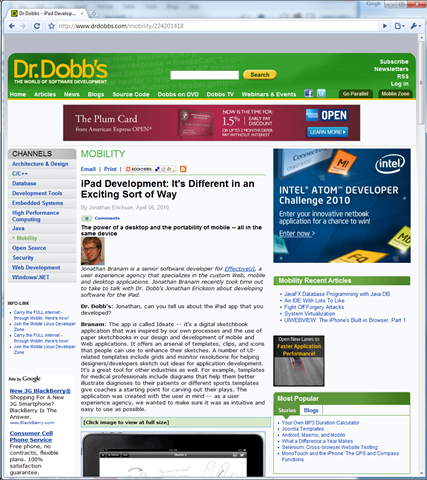
All you do is drag a bookmarklet to your bookmark bar, and then on any article-like web page you can click on the bookmarklet to turn this:

image

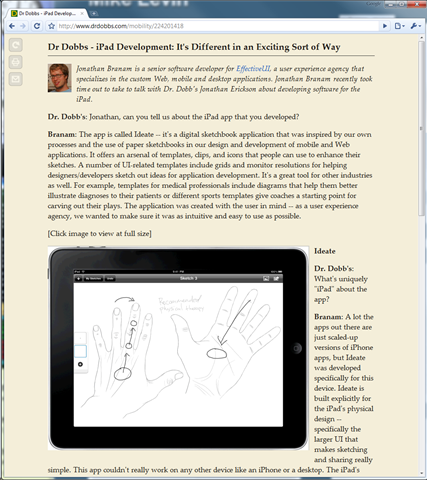
into this (with a few choices each for font, size, and margin):

image

This lets you gain a lot in readability when all you want to do is read the article itself with basic text and graphics rendered fairly nicely. You do lose a little formatting, such as colored text which I sometimes use in my articles’ code examples, but the overall effect is pretty nice.

I’ll keep trying Readability out, especially on smaller-than-desktop screens, to see if it’s a keeper. So far the overall effect is pretty nice. Thanks to James P. Hogan for the tip, even if the link his page gives is broken.


Note: If you’re using Mobile Safari (i.e., iPhone or iPad) you’ll need to do a little bit more work because that software doesn’t currently support dragging the bookmarklet to its bookmark bar. Fortunately, there’s a workaround:

  • Find the Javascript code. I just made the bookmarklet on a desktop browser and copied the code from there to an email to myself (some things are faster with a keyboard and mouse). Alternatively you can inspect the HTML using HTML Viewer right on the same device as Mobile Safari and cut-and-paste from that.
  • In Mobile Safari, make a new bookmarklet.
  • Edit it, and paste the Javascript code as the URL.

As has been true since the early Mac days in the 1980s, Apple products and SDKs make every piece of functionality either super easy if it’s supported, or super painful if it’s not. :-)

Pre-emptive snarky comment: Yes, I know some people will retort that Microsoft and Linux products are better, because at least they consistently make everything super painful all of the time… but I think that’s only half true.

Links I enjoyed this week

C++ and C++0x

C++0x Core Language Features in VC10 [Visual C++ 2010] (MSDN)
This is the VC++ team’s overview, side by side with the previous release. Includes handy links to the C++ committee paper numbers.

See also Scott Meyers’ C++0x feature availability tracker for gcc and VC++, which is fairly up to date although it primarily represents the compiler versions and features that Scott has exercised personally, not necessarily the latest compiler or all features that are actually supported.

Other interesting stuff

Ars Technica Reviews the iPad (Ars Technica)
Here’s a good example why I often like Ars reviews better than those at other “gizmo” sites (you know who you are). Whereas lots of other sites climbed over each other to be the first to breathlessly post reviews based on using the iPad simulator rather than having real hardware in hand and actually using the device they’re reviewing, Ars waited until their reviewers could report based on actually using the device personally. What a refreshing idea!

Of course, to make it a no-brainer purchase for me, it still needs a stylus and OneNote.

Links I enjoyed, and iPad musings

Appetizers: Three cool links

The Design of Design by Fred Brooks (Amazon)
Yes, a new book by the Fred Brooks. Started reading it in Stanza on my iPhone today…

A Turing Machine (aturingmachine.com)
I’m in love. This is my favorite computer ever. I so want one.

The Evolution of Visual C++ in Visual Studio 2010 (VS Magazine)
A summary of what’s new in VC++ 2010, from the C++0x language and library features, to concurrency runtime and libraries, to faster and more accurate Intellisense (running the EDG engine), and more. All I can say is that VS 2010 is available imminently…

Entree: My favorite link this week

What the iPad Really Is (Michael Swaine, Dr. Dobb’s)
Swaine gets it. The iPad is a “read-mostly” and “anywhere” device.

That’s why Steve Jobs is correct that this segment between notebooks and phones exists, and that serving that segment expands the market rather than competing directly with either neighboring segment. The tablet, spelled with “i” or otherwise, mostly doesn’t compete with desktops and notebooks (except for users who only do read-mostly stuff) or smartphones (except for users who need a bigger screen); it complements both. I’ve been using Windows convertible tablets off and on for years for this part of my computing life.

For my tablet needs, the iPad as launched had only two disappointments. The killer piece of missing software was a OneNote equivalent, and the killer piece of missing hardware was a stylus – really, because I want to finally have a real paper-notebook replacement. My convertible tablet/notebook has these covered, but maybe if a dedicated tablet can match this part too it can take over the “tablet segment” for me and I can go back to a notebook that’s a dedicated notebook. We’ll see.

Incidentally, now with Netflix (if it’s not a 4/1 joke) and Hulu and Flickr and ABC joining the burgeoning flood, it looks more and more like “iPad, iPad everywhere”

Flash In the Pan

You’ve no doubt noticed the recent acceleration of the transition from Flash in favor of HTML5, thanks in large part to Apple’s refusal to support Flash on iPhone and iPad. First YouTube, and now TED, Vimeo, CBS, and Time and The New York Times are adding support for HTML5 in addition to, or instead of, Flash.

I’ve lately come to dislike Flash for personal reasons. Specifically, the Shockwave Player plugin is buggy and keeps hanging Chrome in particular and costing me a few minutes every few days while I wait for the “want to kill this plugin?” dialog to come up. It’s not the end of the world, just an annoyance. But it is annoying.

Aside: This seemed to start, or at least get a lot more frequent, around the time I installed Windows 7, which means we can have many interesting discussions about who broke whom. However, in searching around I see on Web forums there’s been a lot of chatter about Shockwave Player crashes on multiple browsers and OSes.

But given that the world is starting to move on anyway, and because I like to tinker, I wondered what “the Web without Flash” would look like on my PC. I already know what it looks like on my iPhone, but the PC gets heaver use and I generally use it to visit richer sites.

So yesterday I decided to take the plunge and uninstall Flash entirely. Flash used to be a de rigueur add-on. Now I’ll see what the Web is like without it.

So far, so good. My Machine Architecture talk on Google Video doesn’t play, but other than that the main difference is just that I see less distracting content and that I get a cute little bar at the top of many pages asking me to install a plugin to fully display the page; dismissing the bar only lasts for the duration of the page, but I find that the bar quickly fades into the background of consciousness.

We’ll see how long I can last sans Flash.

C++0x FCD launches, will be freely available online in about a week

This morning, the C++0x Final Committee Draft (FCD) text was completed by our tireless project editor Pete Becker, approved by the review committee of Steve Adamczyk and Howard Hinnant, and sent to SC22 for FCD ballot. The SC22 secretariat has informed us that the FCD ballot will begin today and close on July 26.

Thank you to everyone involved with the C++ committee for the huge amount of work they’ve invested over the past six months and more to resolve design corner cases, drive down issues list bug counts, and make it possible for us to approve several key papers and unanimously vote out an FCD two weeks ago in Pittsburgh. After two more weeks of hard work to apply the approved papers to the working draft, today the baby was ready to dress up in a cute ISO cover sheet and show to the world. As Joe Biden might say, this is a big deal.

The FCD document will be freely-as-in-beerly available on the committee’s 2010 papers page in about a week, when the post-meeting mailing goes up. Watch that space for details.

[Updated 3/26 to spell out “Final Committee Draft”]

Links I enjoyed reading this week

Software-related

PDF the Most Common Malware Vector (Schneier)
It’s almost non-news, because it’s been obvious for years that this was coming. Malware writers target the common programs and formats. Several years ago, I talked to senior developers from a major software company on multiple occasions about memory safety and secure coding, and at the time they weren’t interested because exploits didn’t affect them (yet). As an example, I pointed out: “Look, do you think software like Acrobat Reader needs to care about secure coding? – But of course it does. Isn’t it obvious that it’ll be targeted sooner rather than later?” Moral: If you write popular software, the need for secure coding affects you and your product; if it doesn’t today, it will tomorrow. (Obligatory note: This isn’t just about C and C++. Every mainstream language lets you write exploitable security flaws.)

Visual C++ Developer Survey (MSDN)
”As we wrap up Visual Studio 2010, we are starting to plan the next release of Visual C++. … We would like to better understand what you do.”

General information/amusement

Distributed Version Control is here to stay, baby (Joel on Software)
Evidently the last Joel on Software article, too.

The Hobbit to begin shooting in July (Variety)
Where can we buy fake foot hair for the premiere?

Comment policy

[Updated 3/17 for clarity.]

On this blog, I’ve always been happy to follow a policy of not editing or filtering comments, and to let comments stand whether the commenter agrees with me or not. However, recently a few comments have strayed into name-calling (e.g., I’d never heard the term “freetard” until last week), and I’ve decided to start moderating all comments, and to remove some existing comments that seem to me to be disrespectful of others.

Fortunately, the vast majority of comments aren’t like that, and opinions that respectfully disagree with my own or with those of other commenters continue to be welcome. Thanks for understanding.