Two Sessions: C++ Concurrency and Parallelism – 2012 State of the Art (and Standard)

It’s time for, not one, but two brand-new, up-to-date talks on the state of the art of concurrency and parallelism in C++. I’m going to put them together especially and only for C++ and Beyond 2012, and I’ll be giving them nowhere else this year:

  • C++ Concurrency – 2012 State of the Art (and Standard)
  • C++ Parallelism – 2012 State of the Art (and Standard)

And there’s a lot to tell. 2012 has already been a busy year for the pushing the boundaries of both “shipping-and-practical” and “proto-standard” concurrency and parallelism in C++:

  • In February, the spring ISO C++ standards meeting saw record attendance at 73 experts (normal is 50-55), and spent the full week primarily on new language and library proposals, with notable emphasis on the area of concurrency and parallelism. There was so much interest that I formed four Study Groups and appointed chairs: the largest on concurrency and parallelism (SG1, Hans Boehm), and three others on modules (SG2, Doug Gregor), filesystem (SG3, Beman Dawes), and networking (SG4, Kyle Kloepper).
  • Three weeks ago, we hosted another three-day face-to-face meeting for SG1 and SG4 – and at nearly 40 people the SG1 attendance rivaled that of a normal full ISO C++ meeting, with a who’s-who of the world’s concurrency and parallelism experts in attendance and further proposal presentations from companies like IBM, Intel, and Microsoft. There was so much interest that I had to form a new Study Group 5 for Transactional Memory (SG5), and appointed Michael Wong of IBM as chair.
  • Over the summer, we’ll all be working on updated proposals for the October ISO C++ meeting in Portland.

Things are heating up, and we’re narrowing down which areas to focus on.

I’ve spoken and written on these topics before. Here’s what’s different about these talks:

  • Brand new: This material goes beyond what I’ve written and taught about before in my Effective Concurrency articles and courses.
  • Cutting-edge current: It covers the best-practices state of the art techniques and shipping tools, and what parts of that are standardized in C++11 already (the answer to that one may surprise you!) and what’s en route to near-term standardization and why, with coverage of the latest discussions.
  • Mainstream hardware – many kinds of parallelism: What’s the relationship among multi-core CPUs, hardware threads, SIMD vector units (Intel SSE and AVX, ARM Neon), and GPGPU (general-purpose computation on GPUs, which I covered at C++ and Beyond 2011)? Which are most interesting, what technologies are available now, and what’s being considered for near-term standardization?
  • Blocking vs. non-blocking: What’s the difference between blocking and non-blocking styles, why on earth would you care, which kinds does C++11 support, and how are we looking at rounding it out in C++1y?
  • Task and data parallelism: What’s the difference between task parallelism and data parallelism, which kind of of hardware does each allow you to exploit, and why?
  • Work stealing: What’s the difference between thread pools and work stealing, what are the major flavors of work stealing, which of these (if any) does C++11 already support and is already shipping on some advanced commercial C++ compilers today (this answer will likely surprise you), and what needs to be done in the next round for a complete state-of-the-art parallelism story in C++1y?

The answers all matter to you – even the ones not yet in the C++ standard – because they are real, available in shipping products, and affect how you design your software today.

This will be a broad and deep dive. At C++ and Beyond 2011, the attendees (audience!) included some of the world’s leading experts on parallelism and compilers. At these sessions of C&B 2012, I expect anyone who wasn’t personally at the SG1 meeting this month, even world-class experts, will learn something new in these talks. I certainly did, and that’s why I’m motivated to turn the information into talks and share. This isn’t just cool stuff – it’s important and useful in production code today.

I hope to see many of you at C&B 2012. I’m excited about these topics, and about Scott’s and Andrei’s new material – you just can’t get this stuff anywhere else.

Asheville is going to be blast. I can’t wait.

Herb


P.S.: I haven’t seen this much attention and investment in C++ since last century – C++ conferences at record numbers, C++ compiler investments by the biggest companies in the industry (e.g., Clang), and much more that we’ve seen already…

… and a little bird tells me there’s a lot more major C++ news coming this year. Stay tuned, and fasten your seat belts. 2012 ain’t done yet, not by a long shot, and I’ll be able to say more about C++ as a whole (besides the specific topics mentioned above) for the first time at C&B in August. I hope to see you there.

FYI, C&B is already over 60% full, and early bird registration ends this Friday, June 1 – so register today.

C++ Libraries: Casablanca

imageAt GoingNative in February, I emphasized the need for more modern and portable C++ libraries, including for things like RESTful web/cloud services, HTTP, JSON, and more. The goal is to find or develop modern C++ libraries that leverage C++11 features, and then submit the best for standardization.

Microsoft wants to do its part, and here’s a step in that direction.

Today I’m pleased to see Soma’s post about “C++, Cloud Services, and You” announcing the DevLabs release of Casablanca, a set of C++ libraries for Visual C++ users that start to bring the same modern conveniences already enjoyed by .NET and Node.js and Erlang users also to C++ developers on our local and cloud platforms, including modern C++ libraries for REST, HTTP, and JSON. From Soma’s announcement, adding my own emphasis and minor code edits:

Historically, we’ve lacked such simple tools for developers using C++.  While there are multiple relevant native networking APIs (e.g. WinINet, WinHTTP, IXMLHttpRequest2, HTTP Server API), these are not optimized from a productivity perspective for consuming and implementing RESTful cloud services using modern C++.  They don’t compose particularly well with code based on the standard C++ libraries, and they don’t take advantage of modern C++ language features and practices in their programming models.

This is where “Casablanca” comes in.  “Casablanca” is a set of libraries for C++ developers, taking advantage of some recent standard language features already available through Visual Studio.

“Casablanca” aims to make it significantly easier for C++ coders to consume and implement RESTful services.  It builds on lessons from .NET, from Node.js, from Erlang, and from other influencers to create a modern model that is meant to be easy to program while still being scalable, composable, and flexible.

As an example, here’s a snippet that uses the client HTTP library to search Bing for my name and output the results to the console:

    http_client bing( L"http://www.bing.com/search" );

    bing.request( methods::GET, L"?q=S.Somasegar" )
        .then( []( http_response response ) {
            cout << "HTML SOURCE:" << endl << response.to_string() << endl; })
        .wait();

and here’s a simple web listener hosted in a console application:

    listener::create( argv[1], []( http_request req ) {
            req.reply( status_codes::OK, "Namaste!" ); })
        .listen( []{ fgetc( stdin ); } )
        .wait();

For those of you looking to build Azure services in C++, “Casablanca” comes with a Visual Studio wizard to set up everything up correctly.  You can target both Web and Worker roles, and you can access Azure storage using the built-in C++ library bindings. […] Taking C++ to the cloud with “Casablanca” is another exciting step in that journey.

Today’s Casablanca release is as a DevLabs project, to get usability feedback and to eventually support these features in the full Visual C++ product. If you’re interested in using C++ to consume and implement cloud services, and sharing what kind of support you want and whether you think Casablanca is on the right track, please let us know in the forums.

Looking beyond Visual C++, one piece of Casablanca is already being proposed for standardization, namely the “future.then” nonblocking continuations that are required to be able to write highly responsive composable libraries – you really want all async libraries to talk about their work using the same type, and std::future already gives half of what we need (blocking synchronization) and just needs the non-blocking part too. Also being proposed as an optional layer on top of “future.then” is an “await” style of language support to make the async operations as easy to express and use in C++ as in any of the best languages in the world.

Note that there are other C++ libraries too for several of these facilities. Repeating what I said at GoingNative, we (Microsoft) don’t care whose libraries get standardized – whether ones we contribute or someone else’s. We care most that there be standard C++ libraries for these modern uses, starting with the most basic “future.then” support, and to encourage all companies and groups who have libraries in these important spaces to contribute them and take the best and make them available to C++ developers on all platforms. This is a small step in that process.

Talk Video: Welcome to the Jungle

Last month in Kansas City I gave a talk on “Welcome to the Jungle,” based on my recent essay of the same name (sequel to “The Free Lunch Is Over”) concerning the turn to mainstream heterogeneous distributed computing and the end of Moore’s Law.

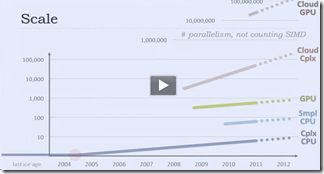
Perceptive Software has now made the talk available online [EOA: the talk itself starts six minutes in]:

Welcome to the Jungle

In the twilight of Moore’s Law, the transitions to multicore processors, GPU computing, and HaaS cloud computing are not separate trends, but aspects of a single trend – mainstream computers from desktops to ‘smartphones’ are being permanently transformed into heterogeneous supercomputer clusters. Henceforth, a single compute-intensive application will need to harness different kinds of cores, in immense numbers, to get its job done. – The free lunch is over. Now welcome to the hardware jungle.

I hope you enjoy it.

Warning: It’s two hours (with Q&A) because of the broad and deep material. There’s a nice pause point between major sections at the one-hour mark that makes it convenient to split it into two one-hour lunchtime brownbag viewings.

We want await! A C# talk that’s applicable to C++

A nice talk by Mads Torgersen just went live on Channel 9 about C#’s non-blocking Task<T>.ContinueWith() library feature and await language feature, which are a big hit in C# (and Visual Basic) for writing highly concurrent code that looks pretty much just like sequential code. Mads is one of the designers of await.

If you’re a C++ programmer, you may be interested in this because I’ve worked to have these very features be offered as proposals for ISO C++, just with a few naming tweaks like renaming Task<T>.ContinueWith() to std::future<T>::then(). They were initially presented at the recent Kona meeting in February, and we’ll dig deeper next month at the special ISO C++ study group meeting on concurrency and parallelism.

Here’s the talk link and abstract:

Language Support for Asynchronous Programming

Mads Torgersen

Asynchronous programming is what the doctor usually orders for unresponsive client apps and for services with thread-scaling issues. This usually means a bleak departure from the imperative programming constructs we know and love into a spaghetti hell of callbacks and signups. C# and VB are putting an end to that, reinstating all your tried-and-true control structures on top of a future-based model of asynchrony.

While we were chatting after the talk, I managed to gently twist Mads’ arm and he has graciously agreed to come to the May 7-9 ISO C++ parallelism study group special meeting to present this to the committee members in detail and answer questions about await’s design and C# users’ experience with it in production code, which will help the committee decide whether or not this is something they want to pursue for ISO C++.

I hope you enjoy the talk. While at Lang.NEXT, I also participated in a panel and gave a C++ talk but those sessions aren’t live yet; I’ll post links once they are.

Trivia: If you noticed the Romanian accent in the first question from the audience, it’s because it came from Andrei Alexandrescu, who was sitting beside Walter Bright, both of whom were two of the other speakers at the conference. It was fun to be in a room full of language designers and implementers sharing notes about each other’s languages and experience.

“Welcome to the Jungle” in Kansas City – March 20, 2012

WelcomeThanks to Perceptive Software who are bringing me to Kansas City in two weeks to give a free talk on “Welcome to the Jungle.”

The talk will be based on my recent essay of the same name (sequel to ”The Free Lunch Is Over”) concerning the turn to mainstream heterogeneous distributed computing and the end of Moore’s Law, with ample time for Q&A and discussion.

Here are the coordinates:

Computing Trends with Herb Sutter: Welcome to the Jungle

When: Tuesday, March 20 at 1:00 – 3:00 P.M.

Where: Boulevard Brewery, 2501 Southwest Blvd, Kansas City, MO, USA 64108

Abstract: In the twilight of Moore’s Law, the transitions to multicore processors, GPU computing, and HaaS cloud computing are not separate trends, but aspects of a single trend – mainstream computers from desktops to ‘smartphones’ are being permanently transformed into heterogeneous supercomputer clusters. Henceforth, a single compute-intensive application will need to harness different kinds of cores, in immense numbers, to get its job done. – The free lunch is over. Now welcome to the hardware jungle.

This is a free lecture; all are invited, but you should register to make sure you’ll have a seat. Note that this talk is live only and is not being recorded or webcast.

I look forward to meeting many of you there in person.

Welcome to the Jungle

With so much happening in the computing world, now seemed like the right time to write “Welcome to the Jungle” – a sequel to my earlier “The Free Lunch Is Over” essay. Here’s the introduction:


Welcome to the Jungle

In the twilight of Moore’s Law, the transitions to multicore processors, GPU computing, and HaaS cloud computing are not separate trends, but aspects of a single trend – mainstream computers from desktops to ‘smartphones’ are being permanently transformed into heterogeneous supercomputer clusters. Henceforth, a single compute-intensive application will need to harness different kinds of cores, in immense numbers, to get its job done.

The free lunch is over. Now welcome to the hardware jungle.


From 1975 to 2005, our industry accomplished a phenomenal mission: In 30 years, we put a personal computer on every desk, in every home, and in every pocket.

In 2005, however, mainstream computing hit a wall. In “The Free Lunch Is Over” (December 2004), I described the reasons for the then-upcoming industry transition from single-core to multi-core CPUs in mainstream machines, why it would require changes throughout the software stack from operating systems to languages to tools, and why it would permanently affect the way we as software developers have to write our code if we want our applications to continue exploiting Moore’s transistor dividend.

In 2005, our industry undertook a new mission: to put a personal parallel supercomputer on every desk, in every home, and in every pocket. 2011 was special: it’s the year that we completed the transition to parallel computing in all mainstream form factors, with the arrival of multicore tablets (e.g., iPad 2, Playbook, Kindle Fire, Nook Tablet) and smartphones (e.g., Galaxy S II, Droid X2, iPhone 4S). 2012 will see us continue to build out multicore with mainstream quad- and eight-core tablets (as Windows 8 brings a modern tablet experience to x86 as well as ARM), image_thumb99and the last single-core gaming console holdout will go multicore (as Nintendo’s Wii U replaces Wii).

This time it took us just six years to deliver mainstream parallel computing in all popular form factors. And we know the transition to multicore is permanent, because multicore delivers compute performance that single-core cannot and there will always be mainstream applications that run better on a multi-core machine. There’s no going back.

For the first time in the history of computing, mainstream hardware is no longer a single-processor von Neumann machine, and never will be again.

That was the first act.  . . .


I hope you enjoy it.

Daniel Moth’s C++ AMP session is now online

In my keynote on Wednesday, I highlighted just the top two important features in the C++ AMP programming model. That afternoon, my coding colleague and demo demigod Daniel Moth gave a 45-minute session covering the entire C++ AMP programming model that walked through all the features with more examples. Daniel’s talk is now also online at Channel 9. I hope you enjoy it.

Note: The PDF slides link is small but important — the screen isn’t easy to see in the video itself.

C++ AMP keynote is online

Yesterday I had the privilege of talking about some of the work we’ve been doing to support massive parallelism on GPUs in the next version of Visual C++. The video of my talk announcing C++ AMP is now available on Channel 9. (Update: Here’s an alternate link; it seems to be posted twice.)

The first 20 minutes has nothing to do with C++ in particular or any platform in particular, but tries to make the case that the right way to view the “trends” of multicore computing, GPU computing, and cloud computing (HaaS) is that they are not three trends at all, but merely facets of the same single trend — heterogeneous parallel computing.

If they are, then one programming model should be able to address them all. We think we’ve found one.

The main reasons we decided to build a new model is that we believe there needs to be a single model that has all of the following attributes:

  • C++, not C: It should leverage C++’s power for strong abstraction without sacrificing performance, not just be a dialect of C.
  • Mainstream: It should be programmable by millions of developers, not just by a priesthood. Litmus test: Is the Hello World parallel GPU program a page and half, or a couple of lines?
  • Minimal: It adds just one general-purpose language extension that addresses not only the immediate problem (dealing with cores that can’t support full C++) but many others. With the right general-purpose extension, the rest can be done as just a library.
  • Portable: It allows shipping a single EXE that can use any combination of GPU vendors’ hardware. The initial implementation uses DirectCompute and supports all devices that are DX11 capable; DirectCompute is just an implementation detail of the first release, and the model can (and I expect will) be implemented to directly talk to any interesting hardware.
  • General and future-proof: The initial release will focus on GPU computing, but it’s intended to enable people to write code for the GPU in a way that in the future we can recompile with few or no changes to spread across any and all accessible compute cores, including ones in the cloud.
  • Open: I mentioned that Microsoft intends to make the C++ AMP specification open, and encourages its implementation on other C++ compilers for any hardware or OS target. AMD announced that they will implement C++ AMP in their FSA reference compiler. NVidia also announced support.

We’re really excited about this, and I hope you find the information in the talk to be useful. A prerelease implementation in Visual C++ that runs on Windows will be available later this year. More to come…

AFDS Keynote Live Stream

Just a reminder for those interested in using C++ to harness GPUs for fast code: My keynote at AMD Fusion Developer’s Conference will be webcast live. I’ll post another link when the recorded talk is available for on-demand viewing.

The talk starts at 8:30am U.S. Pacific time tomorrow (Wed June 15).

Today Jem Davies of ARM also gave a keynote. He’s a great speaker with a great message; look for it when it becomes available on demand. Recommended viewing whether or not you target ARM processors.


Interview on Channel 9

Channel 9 just posted a new interview with me about ISO C++0x, C++’s place in the modern world, and all things C++. The topics we talked about ranged pretty widely, as you can see from the questions below.

Here’s the blurb as posted on Channel 9 with links to specific questions in the interview. Enjoy.

Herb

I was lucky enough to catch up with Herb Sutter not too long after the FDIS announcement (Final Draft International Standard is complete).

As usual when talking to Herb, the conversation is all about C++ (well, we do talk about C# for a little while, but in the context of C++. Why? Tune in…).

See below for the specific questions that were asked. You can simply click on a link to move directly to that point in the conversation. I do, however, strongly recommend that you watch the entire thing. I also recommend that you don’t get used to this level of categorization in my videos (it takes a fair amount of time to do this sort of thing, so enjoy the times when I actually do this, but don’t expect me to do this all of the time).

It’s always great to talk to Herb and get a glimpse of what goes on in the C++ Standards Committee (which Herb chairs). In this specific conversation, it’s uplifting to see how excited Herb is for the future of one of the world’s most capable and widely used general purpose programming languages. C++ is a modern programming language for power and performance, but it’s also a highly abstracted general purpose language for building user mode applications, mobile apps, etc. The amazing part is how C++ can provide rich general programming abstractions and also ensure that your code can run at machine speeds. We talk about this, of course.

Tune in. Learn. Go native!

1:37 -> What were the goals of the C++0x standard, at a high level?

2:40 -> Language and Library abstractions and performance (how high can you go and still be fast as possible?)…

5:23 -> C++ as an application development language (in addition to the traditional C++ is a systems programming language meme)…

07:17 -> C++0x or can we now call it C++11?

09:21 -> Standards committees and real world user representation…

10:39 -> Who comes up with the new features that get standardized (or not…)?

13:01 -> What were the goals of the C++0x standard (non-canned answer)?

14:21 -> What does Bjarne mean by C++0x being a better C++ for novice programmers?

15:51 -> Why can’t C++ look more like C#?

18:50 -> At the end of the day, everything(in terms of programmer-controlled computing) boils down to memory, right?

23:12 -> What are some of the most significant new features in C++0x?

25:05 -> What can VC++ developers expect to see in terms of C++0x implementation in Visual C++ next?

27:09 -> C++ and type safety…

29:05 -> C++0x and backwards compatibility: any big breaking changes?

34:16 -> C++0x in the Standard Library…

37:01 -> Any thinking in the Committee about doing more frequent experimental releases C++?

39:04 -> Are their features that didn’t make it into the standard that you really wanted to be standardized?

41:45 -> Are you comfortable with C++’s current state? Is it modern enough?

43:22 -> Conclusion (or Charles doesn’t end the conversation when his farewell begins – where does it go from there? )