
I’m pleased to announce that Bjarne and I are going to have another two-day event co-located with SD West in San Jose, California, this March. Most of the talks are new ones we’ve never given publicly before, along with updated classics that people liked the best in the past. This year, three of my four talks have a strong emphasis on concurrency: making your application manycore-scalable, safe locking, and bleeding-fast lock-free coding.
SD graciously let me publish an extra-discount code for readers of this blog. Here it is… if you register before Feb 8, use the following code to get the early bird price (up to $300 off) plus an extra $50 off any package:
Discount code: 8WSUT (expires Feb 8)
Here’s a link to the conference site, and their summary:
Stroustrup & Sutter #4
Back with brand new and freshly updated content!
The preeminent super session on the C++ language is back at SD West—and full of new and updated material! Join Bjarne Stroustrup, C++ creator and original implementer, and Herb Sutter, C++ and concurrency guru, for two jam-packed days of new and completely updated courses. The seminar is filled with instructive, revealing and highly pragmatic material, and is structured with both talks and panels—not to mention liberal break times, so that the instructors and attendees can mix, eat and chat together.
In addition to lots of information you can use today, Herb and Bjarne will also reveal important, forward-looking information about what’s coming in the next version of the C++ Standard, C++0x, and related efforts. As key designers of several of the new core features, their personal experiences are invaluable.
Finally, for convenience, below is a cut-and-paste of the session topics and abstracts.
I look forward to seeing many of you in San Jose! Best wishes,
Herb
DAY 1: Monday, March 3
C++0x Overview
Bjarne Stroustrup
We now know the expected contents of the next C++ Standard, which is targeted to be feature-complete in mid-2008 with final text in 2009. This presentation articulates the main principles of the design of C++0x, outlines the ISO C++ standards process, summarizes the new features and libraries, and gives key examples using new features. Major features, such as concepts, the memory model, and major libraries (such as threads and regular expression matching) are covered by other tutorials, so they will be only briefly mentioned here. The focus of this presentation is the various "minor" features, such as the unified initializer syntax (including variable length initializer lists), decltype and the new form of auto, template aliases, nullptr, generalized constant expressions, "strong" enumerations, the new for statement, static assertions, and rvalue references. But a language is far more than a mere list of features: My aim is to show how these features fit together and fit with C++98 features to better support programming techniques. As ever, the ultimate aim of this language design is to allow clearer expression of real-world ideas, leading to better-performing and easier-to-maintain code. Even the "minor features" can significantly affect your programming style.
What Not to Code: Avoiding Bad Design Choices and Worse Implementations
Herb Sutter
Our reality show premise is simple: Friends and coworkers nominate code that they consider poorly "fashioned" and ask the show to make over the victim. Our Code Police swoop in with a deal: We’ll provide up to 15 minutes of public assistance in the form of amusing analyses and insightful improvements, discussing tradeoffs and alternatives that can make the code clearer, faster, simpler, and/or safer… but only on the condition that they allow our instructor (that’s Herb) to ruthlessly critique their existing code, and in some cases throw it out altogether, in front of a live studio audience (that’s you). As members of that interactive audience, you will refresh your sense of elegance and beauty, not to mention old-fashioned performance and robustness and maintainability, so often lacking in the broken code littering today’s bleak postmodern corporate landscape.
How to Design Good Interfaces
Bjarne Stroustrup
So: We have classes, derived classes, virtual bases, templates, const, overloading, exceptions, and a host of other useful language features. How do we use them to produce well performing maintainable code? All too often we get seduced into using powerful language features to write clever (i.e., complicated) code rather than to simplify our interfaces and to make the organization of our code easier to understand. This presentation is a tour of the most useful C++ features from the point of view of how they can be used to express the structure of code and to define interfaces that serve basic needs such as flexibility, early error detection, acceptable compile time, performance, decent error reporting, and maintainability.
How to Migrate C++ Code to the Manycore "Free Lunch"
Herb Sutter
For decades, we enjoyed the "free lunch" of seeing existing applications naturally run faster on new hardware with a faster single CPU core. Computation power is still growing, but in a fundamentally different direction — more and more cores. We can regain the free lunch, but only by building applications in new ways that correctly apply concurrency and parallelism to express lots of latent concurrency that can scale well to a given number of cores but avoids penalizing the application when running on older hardware with one or few cores. This talk addresses the question of how to design new code, and how to migrate existing code, to be multicore/manycore enabled. We will cover best practices for finding and exploiting parallelism in algorithms and data structures, avoiding data structures that harm concurrency, using thread pools and background tasks effectively, and ways to cheat (if not entirely avoid) the specter of Amdahl’s Law. Most code examples will be illustrated using draft standard C++0x syntax, but can be directly translated to popular platforms and concurrency libraries, including Linux, Windows, .NET, and pthreads.
Grill the Experts: Ask Us Anything!
Bjarne Stroustrup and Herb Sutter
This is your opportunity to get "thought leader" answers to your favorite C++ questions! We strongly encourage you to submit your questions in advance, preferably by email or in writing at the beginning of the seminar. Audience questions will also be taken from the floor. Both instructors will answer as many questions as time permits.
DAY 2: Tuesday, March 4
"Best of Stroustrup & Sutter": Concepts and Generic Programming in C++0x
(Update of talk voted “Most Informative” at S&S 2007)
Bjarne Stroustrup
An updated version of the talk voted "Most Informative" at S&S 2007: C++ templates are immensely flexible and the basis of most modern C++ high-performance programming techniques and of many el
egant library designs. They are the key language feature behind the standard library’s algorithms and containers: the STL. However, they can also be tricky to use, cause spectacularly bad error messages when misused, and sometimes require unreasonable amounts of code to express apparently simple ideas. C++0x will address these issues directly, and the key to resolving the problems with templates without loss of flexibility or loss of performance is "concepts." Concepts provide a type system for C++ types and for combinations of C++ types and values. Thus, we are able to provide what feels a lot like conventional type checking for template arguments (including simple and elegant overloading based on template arguments). This presentation explains the notion of concepts and shows how to use concepts to write clearer and more robust generic code using templates. People who can’t wait for C++0x before trying out concepts (and other new C++0x features related to generic programming) can try the proof-of-concept implementation, ConceptGCC.
Safe Locking: Best Practices to Eliminate Race Conditions
Herb Sutter
From many core to web services, writing highly concurrent software is increasingly becoming a mainstream requirement. But how can we best manage shared state, specifically objects in shared memory? We need to chart a safe course between the Scylla of data corruption due to race conditions on one side, and the Charybdis of excessive contention and even deadlock or livelock on the other side. This talk covers these important problems, as well as the simplicity vs. scalability tradeoff and the composability conundrum. It focuses on solutions, from basics like scoped locks through correct use of lock hierarchies, disciplines to associate data with locks, essential guidelines for writing lock-safe code, and other important best practices. Most code examples will be illustrated using draft standard C++0x syntax, but can be directly translated to popular platforms and concurrency libraries, including Linux, Windows, .NET, and pthreads.
Q&A: C++ Design and Evolution
Bjarne Stroustrup
This is a unique opportunity for a "fireside interview" with the creator of C++, moderated by Herb Sutter. After a brief introduction and opening thoughts, Bjarne Stroustrup will take all questions and share thoughtful observations on topics ranging from essential trends affecting software development across languages today, to observations on the strengths and applicability of existing and new languages, to the role of C++ in the 21st century, and more. Attendees are strongly encouraged to submit questions in advance.
Lock-Free Programming in C++—or How to Juggle Razor Blades
Herb Sutter
Concurrent programs increasingly face pressure to avoid locks altogether. This talk focuses on techniques we can sometimes apply to avoid the need for locking and its difficulties. We will cover many effective best practices, from ways to avoid or better manage shared state through to effective use of atomic operations for lock-free coding, including patterns like lock-free mailboxes, low-contention lazy initialization, internally versioned objects, and more. Most code examples will be illustrated using draft standard C++0x syntax and the C++0x memory model, but can be directly translated to popular platforms and concurrency libraries, including Linux, Windows, .NET, and pthreads.
Discussion on Questions Raised During the Seminar
Herb Sutter and Bjarne Stroustrup
This panel is set aside for follow-up comments and discussion on issues that are raised during the seminar. During the other talks and panels, or during between-session chats, questions often come up that the instructors want to research. Some of the resulting information will be of general interest, and this final panel provides the needed convenient opportunity to promulgate it to everyone.

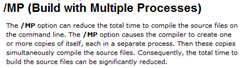 Visual C++ 2008’s /MP flag tells the compiler to compile files in the same project in parallel. I typically get linear speedups on the compile phase. The link phase is still sequential, but on most projects compilation dominates.
 Since Visual Studio 2005 we’ve supported parallel project builds in Batch Build mode, where you can build multiple subprojects in parallel (e.g., compile your release and debug builds in parallel), though that feature didn’t let you compile multiple files in the same project in parallel. (As I’ve blogged about before, Visual C++ 2005 actually already shipped with the /MP feature, but it was undocumented.)
 Excel 2007 does parallel recalculation. Assuming the spreadsheet is large and doesn’t just contain sequential dependencies between cells, it usually scales linearly up to at least 8 cores (the most I heard that was tested before shipping). I’m told that customers who are working on big financial spreadsheets love it.
 … And need I mention games? (This is just a snarky comment… Jeff already correctly noted that “rendering, encoding, or scientific applications” are often scalable today.)
 Sutter’s Mill