We’re hiring (again & more)

The Visual C++ team is looking for a number of people to do great work on C++11, parallelizing/vectorizing, cloud, libraries, and more. All I can say is that there’s a lot of cool stuff in the pipeline that directly addresses real needs, including things people regularly comment about on this blog that I can’t answer specifically yet but will soon.

If you might like to be part of it, here’s how – 13 positions right now and more to come as we update this list:

Be What’s Next (We’re hiring!)

The C++ organization is growing and hiring across all feature areas (C++ 11, compiler front-end, compiler back-end, C++ AMP, PPL, libraries & runtime, IDE, Casablanca). We are looking for passionate program managers, developers and testers to bang out the next versions of the toolset!

What’s in it for you:

  1. Be part of the C++ standards evolution – you’ll have the opportunity to work side-by-side with folks like Herb Sutter

  2. Solve exciting challenges as we navigate the hardware evolution (newer chipsets, multi-core, GPU, heterogeneous cores etc.)

  3. Be part of the technology that builds all of Microsoft’s platforms like Windows, Xbox, Windows Phone and Windows Embedded.

Please apply directly using the links below. We’ll keep this list updated for the next couple of months.

Current job list is available on that page.

Two Sessions: C++ Concurrency and Parallelism – 2012 State of the Art (and Standard)

It’s time for, not one, but two brand-new, up-to-date talks on the state of the art of concurrency and parallelism in C++. I’m going to put them together especially and only for C++ and Beyond 2012, and I’ll be giving them nowhere else this year:

  • C++ Concurrency – 2012 State of the Art (and Standard)
  • C++ Parallelism – 2012 State of the Art (and Standard)

And there’s a lot to tell. 2012 has already been a busy year for the pushing the boundaries of both “shipping-and-practical” and “proto-standard” concurrency and parallelism in C++:

  • In February, the spring ISO C++ standards meeting saw record attendance at 73 experts (normal is 50-55), and spent the full week primarily on new language and library proposals, with notable emphasis on the area of concurrency and parallelism. There was so much interest that I formed four Study Groups and appointed chairs: the largest on concurrency and parallelism (SG1, Hans Boehm), and three others on modules (SG2, Doug Gregor), filesystem (SG3, Beman Dawes), and networking (SG4, Kyle Kloepper).
  • Three weeks ago, we hosted another three-day face-to-face meeting for SG1 and SG4 – and at nearly 40 people the SG1 attendance rivaled that of a normal full ISO C++ meeting, with a who’s-who of the world’s concurrency and parallelism experts in attendance and further proposal presentations from companies like IBM, Intel, and Microsoft. There was so much interest that I had to form a new Study Group 5 for Transactional Memory (SG5), and appointed Michael Wong of IBM as chair.
  • Over the summer, we’ll all be working on updated proposals for the October ISO C++ meeting in Portland.

Things are heating up, and we’re narrowing down which areas to focus on.

I’ve spoken and written on these topics before. Here’s what’s different about these talks:

  • Brand new: This material goes beyond what I’ve written and taught about before in my Effective Concurrency articles and courses.
  • Cutting-edge current: It covers the best-practices state of the art techniques and shipping tools, and what parts of that are standardized in C++11 already (the answer to that one may surprise you!) and what’s en route to near-term standardization and why, with coverage of the latest discussions.
  • Mainstream hardware – many kinds of parallelism: What’s the relationship among multi-core CPUs, hardware threads, SIMD vector units (Intel SSE and AVX, ARM Neon), and GPGPU (general-purpose computation on GPUs, which I covered at C++ and Beyond 2011)? Which are most interesting, what technologies are available now, and what’s being considered for near-term standardization?
  • Blocking vs. non-blocking: What’s the difference between blocking and non-blocking styles, why on earth would you care, which kinds does C++11 support, and how are we looking at rounding it out in C++1y?
  • Task and data parallelism: What’s the difference between task parallelism and data parallelism, which kind of of hardware does each allow you to exploit, and why?
  • Work stealing: What’s the difference between thread pools and work stealing, what are the major flavors of work stealing, which of these (if any) does C++11 already support and is already shipping on some advanced commercial C++ compilers today (this answer will likely surprise you), and what needs to be done in the next round for a complete state-of-the-art parallelism story in C++1y?

The answers all matter to you – even the ones not yet in the C++ standard – because they are real, available in shipping products, and affect how you design your software today.

This will be a broad and deep dive. At C++ and Beyond 2011, the attendees (audience!) included some of the world’s leading experts on parallelism and compilers. At these sessions of C&B 2012, I expect anyone who wasn’t personally at the SG1 meeting this month, even world-class experts, will learn something new in these talks. I certainly did, and that’s why I’m motivated to turn the information into talks and share. This isn’t just cool stuff – it’s important and useful in production code today.

I hope to see many of you at C&B 2012. I’m excited about these topics, and about Scott’s and Andrei’s new material – you just can’t get this stuff anywhere else.

Asheville is going to be blast. I can’t wait.

Herb


P.S.: I haven’t seen this much attention and investment in C++ since last century – C++ conferences at record numbers, C++ compiler investments by the biggest companies in the industry (e.g., Clang), and much more that we’ve seen already…

… and a little bird tells me there’s a lot more major C++ news coming this year. Stay tuned, and fasten your seat belts. 2012 ain’t done yet, not by a long shot, and I’ll be able to say more about C++ as a whole (besides the specific topics mentioned above) for the first time at C&B in August. I hope to see you there.

FYI, C&B is already over 60% full, and early bird registration ends this Friday, June 1 – so register today.

Reminder: Win8 tablet apps and VC++

Day-before reminder: If you are interested in tablet apps using VC++, check out the livestream starting at 9am U.S. Pacific time tomorrow, or come back later to watch the talks on demand.

Herb Sutter's avatarSutter’s Mill

Want to know how to write cool tablet apps using Visual C++?

On May 18, Microsoft is hosting a one-day free technical event for developers who want to write Metro apps for Windows 8 using Visual C++. I’m giving the opening talk, and the rest of the day is full of useful technical information on everything from XAML and DirectX to networking and VC++ compiler flags.

Please note: This event is Windows-specific, and talks will use both portable ISO C++ as well as Visual C++-specific libraries and compiler extensions; for brevity these are being referred to as "C++" to highlight to a Microsoft-specific audience that that this day is about Visual C++, not about Visual C# or Visual Basic or JavaScript.

From the page:

Join the Microsoft Visual C++ and Windows teams in Redmond on May 18, 2012 for a free, all-day event focused on building Windows 8 Metro…

View original post 275 more words

VC++ and Win8 Metro apps: May 18, livestream and on-demand

Want to know how to write cool tablet apps using Visual C++?

On May 18, Microsoft is hosting a one-day free technical event for developers who want to write Metro apps for Windows 8 using Visual C++. I’m giving the opening talk, and the rest of the day is full of useful technical information on everything from XAML and DirectX to networking and VC++ compiler flags.

Please note: This event is Windows-specific, and talks will use both portable ISO C++ as well as Visual C++-specific libraries and compiler extensions; for brevity these are being referred to as "C++" to highlight to a Microsoft-specific audience that that this day is about Visual C++, not about Visual C# or Visual Basic or JavaScript.

From the page:

Join the Microsoft Visual C++ and Windows teams in Redmond on May 18, 2012 for a free, all-day event focused on building Windows 8 Metro style apps with C++. 

These Windows-specific talks will use both portable ISO C++ and Visual C++-specific compiler extensions; for brevity below we’ll refer to both as "C++" (i.e., this day is about Visual C++, not Visual C# or JavaScript).

We will have pragmatic advice for every developer writing Metro style apps and games with XAML and/or DirectX and C++.

Register now!

Agenda:

  • Visual C++ for Windows 8, Keynote by Herb Sutter
  • Building Windows 8 apps with XAML and C++
  • Building Windows 8 games with DirectX and C++
  • Introduction to the Windows Runtime Library  (WRL)
  • Writing Connected apps: Writing networking code with C++
  • Combining XAML & DirectX in a Metro style apps
  • Writing WinRT components to be consumed from any language
  • VC11 compiler flags for getting the most out of C++

All sessions will be recorded and available for on demand viewing on C9.

I wish I’d blogged about it right away when it was announced a week or so ago, because registration filled immediately before I could blog it (I think on the first day), and then when the room was expanded it filled again right away again before I could blog about it. Then I procrastinated for a few days. You can still register here for the waitlist to see it in person, but I have good news…

All sessions will be broadcast livestream and then available for viewing on demand. If you’re halfway around the world, or just halfway across the country, it’s hard to fly somewhere for a one-day event anyway; thanks to livestream and on-demand, the Internet is our friend. I look forward to seeing and e-seeing many of you there.

Reader Q&A: What about VC++ and C99?

imageI occasionally get asked about whether, or how well, Visual C++ supports C99.

The short answer is that Visual C++’s focus is to support ISO C code that is supported by ISO C90 or ISO C++ (98 or 11). For the longer answer, I’m combining my UserVoice answers below, plus an additional comment about restrict in particular.


Our focus in Visual C++ is on making a world-class C++ compiler, and we’re heads-down on C++11 conformance. For C programmers, the good news is twofold:

1. Our primary goal is to support "most of C99/C11 that is a subset of ISO C++98/C++11."

  • VC++ 2010 already fully supports the C subset of C++98, including things like <stdint.h> and declarations in the middle of a block.[*] The C subset of C++98 is approximately C95 (with very few incompatibilities with C95; i.e., there are very few cases where legal C95 code has a different meaning or is invalid in C++98) plus a few C99 features like declaring variables in the middle of blocks).
  • VC++11 now in beta already adds partial support for the C11 subset of C++11 (e.g., it supports the new C11 atomic_int types for concurrency and parallelism).
  • Soon after VC++11 ships we have announced we will do out-of-band releases for additional C++11 conformance which will naturally also include more C11 features that are in the C subset of C++11. We intend to implement all of the C++11 standard, which includes much of C99 — roughly, it includes the C99 preprocessor and library extensions but not the language extensions like restrict.

So we already support large subsets of C99 and some-and-soon-more of C11. Our immediate and long-term goal is to fully support the C subsets of ISO C++.

2. We also for historical reasons ship a C90 compiler which accepts (only) C90 and not C++.

For the (hopefully rare) cases where legal C90 code has a different meaning in C++98 and this matters to C developers, for backward compatibility with older C90 code we also continue to ship a C compiler that implements Standard C90 exactly (using /TC or naming files as something.c).

Granted, however, there is also bad news for C programmers:

3. We do not plan to support ISO C features that are not part of either C90 or ISO C++.

I understand C programmers may be disappointed or angry with this answer and I’m sorry to have to say no here. It’s true, and very quotable, that "focus means saying no," but that doesn’t make it easy to say — it is hard to say no to you, and I’m sorry to say it. But we have to choose a focus, and our focus is to implement (the standard) and innovate (with extensions like everyone but which we also contribute for potential standardization) in C++.

Recommendations

We recommend that C developers use the C++ compiler to compile C code (using /TP if the file is named something.c). This is the best choice for using Visual C++ to compile C code.

Alternatively, we recommend that C developers use the C90 compiler (using /TC or naming files as something.c) if you need to write C90 conforming code that exercises some of the rarer cases that in C++98 are illegal or have changed meaning. This is a fallback primarily intended to support historical C code.

If you really need either of the following:

  • features in C95/C99/C11 that are not part of ISO C++; or
  • features in C that are in the C++ subset but without also enabling the writing of C++ code;

then we recommend that you consider using a different compiler such as Intel or gcc (short-term) and/or pressure your standards committee representatives to have ISO C++ include more of the C standard (longer-term).


[*] Visual C++ also partly supports some C99 language features under a slightly different syntax and possibly with slightly different semantics. Notably, we support __restrict – we did (and could again) consider allowing the standard C99 spelling restrict here for this feature, but please understand that this is not as simple as it looks. Not only the VC++ team, but also the ISO C++ standards committee, considered adding restrict to VC++ and ISO C++, respectively. Although it was specifically suggested for ISO C++11, it was rejected, in part because it’s not always obvious how it extends to C++ code because C++ is a larger language with more options and we would want to make sure the feature works correctly across the entire language.

C++ Libraries: Casablanca

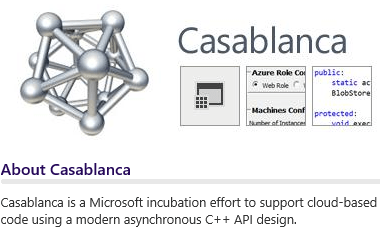
imageAt GoingNative in February, I emphasized the need for more modern and portable C++ libraries, including for things like RESTful web/cloud services, HTTP, JSON, and more. The goal is to find or develop modern C++ libraries that leverage C++11 features, and then submit the best for standardization.

Microsoft wants to do its part, and here’s a step in that direction.

Today I’m pleased to see Soma’s post about “C++, Cloud Services, and You” announcing the DevLabs release of Casablanca, a set of C++ libraries for Visual C++ users that start to bring the same modern conveniences already enjoyed by .NET and Node.js and Erlang users also to C++ developers on our local and cloud platforms, including modern C++ libraries for REST, HTTP, and JSON. From Soma’s announcement, adding my own emphasis and minor code edits:

Historically, we’ve lacked such simple tools for developers using C++.  While there are multiple relevant native networking APIs (e.g. WinINet, WinHTTP, IXMLHttpRequest2, HTTP Server API), these are not optimized from a productivity perspective for consuming and implementing RESTful cloud services using modern C++.  They don’t compose particularly well with code based on the standard C++ libraries, and they don’t take advantage of modern C++ language features and practices in their programming models.

This is where “Casablanca” comes in.  “Casablanca” is a set of libraries for C++ developers, taking advantage of some recent standard language features already available through Visual Studio.

“Casablanca” aims to make it significantly easier for C++ coders to consume and implement RESTful services.  It builds on lessons from .NET, from Node.js, from Erlang, and from other influencers to create a modern model that is meant to be easy to program while still being scalable, composable, and flexible.

As an example, here’s a snippet that uses the client HTTP library to search Bing for my name and output the results to the console:

    http_client bing( L"http://www.bing.com/search" );

    bing.request( methods::GET, L"?q=S.Somasegar" )
        .then( []( http_response response ) {
            cout << "HTML SOURCE:" << endl << response.to_string() << endl; })
        .wait();

and here’s a simple web listener hosted in a console application:

    listener::create( argv[1], []( http_request req ) {
            req.reply( status_codes::OK, "Namaste!" ); })
        .listen( []{ fgetc( stdin ); } )
        .wait();

For those of you looking to build Azure services in C++, “Casablanca” comes with a Visual Studio wizard to set up everything up correctly.  You can target both Web and Worker roles, and you can access Azure storage using the built-in C++ library bindings. […] Taking C++ to the cloud with “Casablanca” is another exciting step in that journey.

Today’s Casablanca release is as a DevLabs project, to get usability feedback and to eventually support these features in the full Visual C++ product. If you’re interested in using C++ to consume and implement cloud services, and sharing what kind of support you want and whether you think Casablanca is on the right track, please let us know in the forums.

Looking beyond Visual C++, one piece of Casablanca is already being proposed for standardization, namely the “future.then” nonblocking continuations that are required to be able to write highly responsive composable libraries – you really want all async libraries to talk about their work using the same type, and std::future already gives half of what we need (blocking synchronization) and just needs the non-blocking part too. Also being proposed as an optional layer on top of “future.then” is an “await” style of language support to make the async operations as easy to express and use in C++ as in any of the best languages in the world.

Note that there are other C++ libraries too for several of these facilities. Repeating what I said at GoingNative, we (Microsoft) don’t care whose libraries get standardized – whether ones we contribute or someone else’s. We care most that there be standard C++ libraries for these modern uses, starting with the most basic “future.then” support, and to encourage all companies and groups who have libraries in these important spaces to contribute them and take the best and make them available to C++ developers on all platforms. This is a small step in that process.

World’s youngest C++ programmer?

I’m seeing many younger programmers picking up C++. The average age at C++ events over the past year has been declining rapidly as the audience sizes grow with more and younger people in addition to the C++ veterans.

But this one just beats all [Facebook link added]:

A six-year-old child from Bangladesh is hoping to be officially recognised as the world’s youngest computer programmer.

Wasik Farhan-Roopkotha showed an aptitude for computing at an early age and started typing in Microsoft Word at just three years old, BBC News reports.

The precocious youngster was programming game emulators from the age of four and his achievements have already received extensive media coverage in his home country.

He has also gained knowledge of C++, the programming language developed by Danish computer scientist Bjarne Stroustrup, without any formal training.

This kid seems pretty exceptional. Welcome, Wasik! I don’t expect the programs to be very complicated, and I’ll leave aside questions of balancing computer time with real-world time and exercise, but this is still quite an achievement.

How young were you when you wrote your first program? I discovered computers for the first time at age 11 when I switched to a new school that had a PET 2001, and wrote my first BASIC programs when was 11 or 12, first on paper and then a little on the PET when I could get access to it. I still fondly remember when I finally got my own Atari 800 when I was 13… thanks again for the loan for that, mum and dad! the first loan I ever took, and paid off in a year with paper-route money. Having that computer was definitely worth a year of predawn paper delivery in the rain, sleet, and snow.

C++ and Beyond Panel: Modern C++ = Clean, Safe, and Faster Than Ever

I just posted the following panel announcement to the C++ and Beyond site. The three-day event (plus evening-before reception) with me, Scott Meyers, and Andrei Alexandrescu will be held on August 5-8, and early-bird registration is open until May 31.


image_thumb[1]C++11 is kind of like “C++ Dreamliner.” It’s built with world-class modern materials. It took a couple more years to finish than originally expected. But now it’s starting to roll out worldwide and flying more safely and efficiently than ever. (European readers may equally consider it “C++ 380.”)

As I write and teach about C++11, I emphasize that:

Modern C++ is clean, safe, and fast – modern C++ code is as readable and as type- and memory-safe as code written in any other modern language [*], and it has always been the king of ‘fast’ and is now faster than ever with new features like move semantics.

Bjarne Stroustrup made me add, at the end of the “clean and safe” part:

“[*] When used in a modern style.” – Bjarne Stroustrup

Bjarne and I claim this to be true. Others have disputed various parts of this statement – whether C++11 really has a usable safe subset, whether C++ is really necessarily faster than code in other languages, and other questions. What’s the truth?

These answers matter. Type safety and memory safety are important not only for writing reliable code that will fail or be abused less often, but also for improving developer productivity so that developers can spend less time on overhead “taxes” like checking for unsafe casts or buffer overruns. And the claim that C++ really is the king of “fast” has been consistently challenged for most of its history.

In this panel, Scott, Andrei, and I will weigh in with discussion – and data – on these important and current questions.

“Mobile” vs. “PC”?

In answering a reader question about Flash today, I linked to Adobe’s November press release and I commented:

Granted, Adobe says it’s abandoning Flash ‘only for new mobile device browsers while still supporting it for PC browsers.’ This is still a painful statement because [in part] … the distinction between mobile devices and PCs is quickly disappearing as of this year as PCs are becoming fully mobilized.

But what’s a “mobile device” vs. a “PC” as of 2012? Here’s a current data point, at least for me.

For almost two weeks now, my current primary machine has been a Slate 7 running Windows 8 Consumer Preview, and I’m extremely pleased with it. It’s a full Windows notebook (sans keyboard), and a full modern tablet. How do I slot it between “mobile device” and “PC,” exactly? Oh, and the desktop browser still supports Flash, but the tablet style browser doesn’t…

Since I’ve been using it (and am using it to write this post), let me write a mini-review.

I loved my iPad, and still do, and so I was surprised how quickly I came to love this snappy device even more. Here are a few thoughts, in rough order from least to most important:

  • It has a few nice touches that I miss on iOS, like task switching by simple swipe-from-left (much easier than double-clicking the home button and swiping, and my iPhone home button is started to get unreliable with all the double-clicking [ETA: and I never got used to four-finger swiping probably in part because it isn’t useful on the iPhone]), having a second app open as a sidebar (which greatly relieves the aforementioned back-and-forth task-switching I find myself doing on iOS to refer to two apps), and some little things like including left- and right-cursor keys on the on-screen keyboard (compared to iOS’s touch-and-hold to position the cursor by finger using the magnification loupe). In general, the on-screen keyboard is not only unspeakably better than Win7’s attempt, but even slightly nicer than iPad’s as I find myself not having to switch keyboards as much to get at common punctuation symbols.
  • I was happily surprised to find that some of my key web-related apps like Live Writer came already installed.
  • The App Store, which isn’t even live yet, already had many of my major apps including Kindle, USA Today, and Cut the Rope. Most seem very reliable; a few marked “App Preview” are definitely beta quality at the moment though. The Kindle app is solid and has everything I expected, except for one complaint: It should really go to a two-column layout in landscape mode like it does on iPad, especially given the wider screen. Still, the non-“preview” apps do work, and the experience and content is surprisingly nice for a not-officially-open App Store.
  • Real pen+ink support. This is a Big Deal, as I said two years ago. Yes, I’ve tried several iPad pens and apps for sort-of-writing notes, and no, iOS has nothing comparable here; the best I can say for the very best of them is that they’re like using crayons. Be sure to try real “ink” before claiming otherwise – if you haven’t, you don’t know what you’re missing. iPad does have other good non-pen annotation apps, and I’ve enjoyed using iAnnotate PDF extensively to read and annotate almost half of Andrei’s D book. But for reading articles and papers I just really, really miss pen+ink.
  • All my software just works, from compilers and editors to desktop apps for full Office and other work.
  • Therefore, finally, I get my desktop environment and my modern tablet environment without carrying two devices. My entire environment, from apps to files, is always there without syncing between notebook and tablet devices, and I can finally eliminate a device. I expected I would do that this year, but I’m pleasantly surprised to be able to do it for real already this early in the year with a beta OS and beta app store.

I didn’t expect to switch over to it this quickly, but within a few days of getting it I just easily switched to reading my current book-in-progress on this device while traveling (thanks to the Kindle app), reading and pen-annotating a couple of research papers on lock-free coding techniques (it’s by far my favorite OneNote device ever thanks to having both great touch and great pen+ink and light weight so I can just write), and using it both as a notebook and as a tablet without having to switch devices (just docking when I’m at my desk and using the usual large monitors and my favorite keyboard+mouse, or holding it and using touch+pen only). It already feels like a dream and very familiar both ways. I’m pretty sure I’ll never go back to a traditional clamshell notebook, ever.

Interestingly, as a side benefit, even the desktop apps are often very, and more, usable when in pure tablet+touch mode than before despite the apparently-small targets. Those small targets do sometimes matter, and I occasionally reach for my pen when using those on my lap. But I’ve found in practice they often don’t matter at all when you swipe to scroll a large region – I was surprised to find myself happily using Outlook in touch-only mode. In particular, it’s my favorite OneNote device ever.

By the end of this week when I install a couple of more apps, including the rest of my test C++ compilers, it will have fully replaced my previous notebook and my previous tablet, with roughly equal price and power as the former alone (4GB RAM, 128GB SSD + Micro SD slot, Intel Core i5-2467M) and roughly equal weight and touch friendliness as the latter alone (1.98lb vs. 1.44lb). Dear Windows team, my back thanks you.

So, then, returning to the point – in our very near future, how much sense does it really make to distinguish between browsers for “mobile devices” and “PCs,” anyway? Convergence is already upon us and is only accelerating.