Trip report: Winter ISO C++ standards meeting (Jacksonville)

[Edited to add C++20 schedule at end]

On Saturday March 17, the ISO C++ committee completed its winter meeting in Jacksonville, Florida, USA, hosted with thanks by the Standard C++ Foundation and Perennial. We had some 140 people at the meeting, representing 8 national bodies. As usual, we met for six days Monday through Saturday, including all evenings.

A special highlight was on Thursday evening (the only non-officially-working evening) when Bjarne Stroustrup personally hosted the entire committee for a celebratory dinner to share the 2018 Charles Stark Draper Prize, the U.S.’s top engineering honor, which this year was awarded for a programming language for only the second time in its history. Although the prize was awarded to Bjarne personally, he made it clear that he considered this an award for the whole C++ community, without whom C++ would never have been successful, and so he hosted the dinner for the committee as a representative proxy for the entire worldwide C++ community. — So to all C++ programmers and contributors who are reading this: Thank you, from Bjarne and from us, for your support, and consider yourselves part of this year’s Draper Prize.

The following are some highlights of what we achieved this week. You can find a brief summary of ISO procedures here. The main things to note are:

  • “IS” means “international standard.” In our case, it’s the core C++ standard itself. Think of this as “trunk.”
  • “TS” means “technical specification,” a document separate from the main standard where we can gain experience with new features before putting them into the IS. We have several of these, summarized on the status page. Think of these as “beta branches.”

Leading up to this meeting

As I reported in my previous trip report for the fall meeting (Albuquerque 2017), last time we almost completed addressing the comments received from national bodies in the Modules comment ballot that ran last summer. The rest were addressed in a series of teleconferences between meetings, and the Modules TS was finalized and shipped to ISO at the end of January.

One of the highlights in the pre-meeting mailing was “Direction for ISO C++” (Beman Dawes, Howard Hinnant, Bjarne Stroustrup, Daveed Vandevoorde, Michael Wong). Although non-binding, it’s the first set of recommendations from our recently created advisory Direction Group, a small subgroup of respected long-time participants that currently consists of those paper authors and is chaired this year by Bjarne Stroustrup.

Features adopted for C++20

We adopted several new features into the draft standard.

[[no_unique_address]] (Richard Smith). You know the empty base optimization (EBO)? If you do, can you remember the (probably many) times you’ve artificially made another class a base of your class, instead of just a data member, just so you could get EBO? And, every time that happened, you wished C++ had the empty member optimization (let’s call it “EMO”)? In C++20, it does, and you opt in via [[no_unique_address]]. Here’s an example from the paper:

template<typename Key, typename Value,
         typename Hash, typename Pred, typename Allocator>
class hash_map {
  [[no_unique_address]] Hash hasher;         // EMOji
  [[no_unique_address]] Pred pred;           // EMOji
  [[no_unique_address]] Allocator alloc;     // EMOji
  Bucket *buckets;
  // ...
public:
  // ...
};

[[likely]] and [[unlikely]] (Clay Trychta). (The link is to R2 of the paper, which contains more description. The R4 version is the one that was adopted.) Many compilers already allow you to “hint” whether a branch is likely or unlikely to be true, which can help optimizations. This standardizes that. Here’s an example from the paper:

if (foo()) [[unlikely]] return false;
if (bar()) [[unlikely]] return false;
baz();

Major disclaimer: This feature comes with the same warning label as the existing compiler extensions, which is “measure, measure, measure!” Compilers already know which branches are likely, usually better than you do (especially with profile-guided optimization, aka PGO). A major reason to use this feature is not actually to optimize (though it can help if you don’t have PGO), but to control which path gets optimized for other reasons. For example, for some code it is essential to make the uncommon path faster so that it is faster when you do hit it — and in such cases you would actually use this attribute in the inverted sense, so please also write a comment nearby to document that intent otherwise some hapless reader (more than likely your future self) will be temporarily confused.

Extending <chrono> to calendars and time zones (Howard Hinnant, Tomasz Kamiński). This is a much-loved (and huger-than-you-think) library addition that will help a lot of users, and really exercises modern C++ features like user-defined literals.

span: Bounds-safe views for sequences of objects (Neil MacIntosh, Stephan T. Lavavej). This one comes directly from the C++ Core Guidelines’ Guideline Support Library (GSL), and is intended to be a replacement especially for unsafe C-style (pointer,length) parameter pairs. We expect to be used pervasively as a vocabulary type for function parameters in particular.

Cleanup adopted for C++20

We also made some improvements to existing features.

“Down with typename!” (Nina Ranns, Daveed Vandevoorde). Are you tired of writing typename redundantly in places where the compiler should know only a type was possible? So were the proposal authors. Now typename is required in fewer places.

Lambda capture initializers can now expand variadic parameter packs (Barry Revzin). An example, taken from the paper:

template<class F, class... Args>
auto delay_invoke(F f, Args... args) {
    return [f=std::move(f), ...args=std::move(args)]() -> decltype(auto) {
        return std::invoke(f, args...);
    };
}

The now-allowed expansion is the one in the third line.

Consistent begin/end for range-for (Ville Voutilainen). The range-based for loop is already customizable, and can handle ranges that have both member rng.begin()/rng.end() functions or ones that have non-member begin(rng)/end(rng) functions. But what if it relies on the non-member functions, but happens to also have one member named either begin or end (such as, say, end in ios_base)? That’s now legal, we ignore the one-off member and use the non-member pair. Here’s an example from the paper that is not legal in C++17 but now works in C++20:

struct X : std::stringstream { /*...*/ };

std::istream_iterator<char> begin(X& x)
  { return std::istream_iterator<char>(x); }

std::istream_iterator<char> end(X& x)
  { return std::istream_iterator<char>(); }

int main() {
    X x;
    for (auto&& i : x) {   // works in C++20
      // ...
    }
}

Interesting tidbit: This is one of those “new functionality” features created by removing wording in the standard, namely removing a restriction. The entire wording change was to change “either (or both) finds” to “both find” in one place.

Structured bindings can access accessible members (Timur Doumler). In C++17, you could use structured bindings to bind to class members as long as they were public. But what if you’re inside a member or friend of the class? Shouldn’t you be able to use structured bindings on members, which are visible (i.e., accessible) to you even if they aren’t public to everyone, just like we can do any other normal thing with those members? In C++17 that didn’t work, but it was an oversight and now we can do that:

class X {
    int i;
    int j;
public:
    friend void f();
};

void f() {
    X x;
    auto [myi, myj] = x;   // now ok
}

We also adopted some other fixes, including:

… and a few more including a couple of small extensions to coroutines and networking. Note that those two TSes were already published, and are not yet merged into the C++ draft standard, but we are still maintaining those experimental TS “branches” with fixes and updates, so that those will be done and ready once we are ready to merge those TS branches into the C++ “trunk” project itself.

Other major full committee approvals

We approved Parallelism TS 2 to be extended with the (huge) extensions in Data-parallel vector types and operations (Matthias Kretz) and declared it feature-complete: It is now being sent out for its main ISO comment ballot.

We also decided to officially open a Reflection TS work item, which means that the committee as a whole is taking ownership of the proposal and intends to progress it as a TS. The initial content is from the paper “Static reflection” (Matúš Chochlík, Axel Naumann, David Sankel) but everyone should understand that the surface syntax will change. The primary point of the TS is in the underlying “engine” and functionality, and the intention is to replace the placeholder template-metaprogramming-like reflexpr syntax with an object-like model that looks like “more constexpr code” — regular C++ code that is able to be run at compile time.

Language/library evolution subgroup approvals

Here is a list of proposals that achieved Evolution or Library Evolution working group (EWG or LEWG) design approval. This means that the subgroup responsible for approving the design has done so (sometimes provisionally, with a few “revision is expected” notes below), and the next step is that they now enter wording review in the Core or Library working group (CWG or LWG), and are slated to be proposed for formal adoption in C++20 at a future meeting. Thanks to Olivier Giroux, Ville Voutilainen, Titus Winters for their notes that contributed to this summary.

For contracts, EWG discussed a clarification to what the result of observable side-effects in contract pre/post-conditions is, and the guidance is that it’s undefined behavior.

For reflection and related facilities, EWG approved some papers that are significant milestones for compile-time programming:

EWG also approved:

We also decided to pursue putting in writing two statements about how we evolve C++:

  • EWG decided to pursue turning “C++ Stability, Velocity, and Deployment Plans” (Titus Winters) into a Standing Document, with the expectation is that the document will be revised and reviewed again. Titus Winters will be the main author, and Gabriel Dos Reis, Bjarne Stroustrup, and Mike Spertus will assist.
  • EWG also supports turning “Standard library compatibility promises” (Titus Winters) into a Standing Document, and to add the promises also to the standard’s own Library Introduction clause. Titus Winters will be the main author, with help from Ashley Hedberg, Nevin Liber, Bjarne Stroustrup, James Dennett, Walter E. Brown, Gor Nishanov, Alisdair Meredith, Mike Spertus, Robert Steagall and Daveed Vandevoorde.

We decided to launch a systematic effort to drive out the remaining uses of macros by providing replacements for those uses. We requested an analysis paper listing all the remaining use cases for macros are, a description of the status of the non-macro solutions for those problems, and possible solutions. This paper will be led by Ville Voutilainen, assisted by Bjarne Stroustrup, Gabriel Dos Reis, James Dennett, and Vittorio Romeo.

Somewhat stunningly (to me), we decided to pursue some cleanup to the C fundamental types that would be a breaking change to certain kinds of C and C++17 code. It came up via the discussion of “Towards consistency between <=> and other comparison operators” (Richard Smith), which observed that when we added <=> to C++20, in <=> only we deliberately decided not to repeat the well-known issues that we did not want to perpetuate with C’s two-way comparisons for fundamental types (e.g., signed-unsigned comparison surprises like -1 < 0u giving the “wrong” answer)… which naturally meant that we now have inconsistencies between the preexisting two-way comparison operators and the shiny new three-way <=> operator. When faced with this, the subgroup discovered that we had a consensus in the room that enough really was enough, and we decided to seriously investigate doing some housecleaning and fix those things even though that would include breaking changes to (mostly ill-behaved) C and C++17 code. For example, we are now on a path to pursue deprecating or outright removing the ability to compare two unrelated enumerations (which is just plain suspicious code), and to require -1 < 0u to give the mathematically correct answer even when in the worst case that means generating two comparison machine instructions instead of just one (any code that does such ill-advised things would change from being a correctness problem into “just” a one-extra-instruction performance problem). — We have made no decisions about actually doing this or the ship vehicle for such changes, which likely would have to be rolled out in stages via deprecation followed by removel, and we expect more data to be gathered before Rapperswil regarding how much code could be affected. But as far as I can recall, this is the most breaking-change cleanup to C’s fundamental types that we have ever been willing to seriously consider.

LEWG approved Standard library concepts (Casey Carter). This is the first part of the Ranges TS to be on track for merging into C++20 at an upcoming meeting, and contains the core concepts from the Ranges TS. It is also the first appearance of the concepts language feature in the standard library.

Other progress

Also for concepts, at this meeting EWG approved pursuing a direction based on my paper “Concepts in-place syntax” (Herb Sutter) to have a shorthand syntax for declaring constrained templates.

At this meeting, we considered further improvements to the modules design, including a renewed proposal focusing on a bridge to help existing header-based code move toward a modules-enabled world. By the end of the meeting, the main participants had hammered out a plan to, over the next few meetings:

  • move a core set of modules functionality into C++20 that is “clean” and uncompromised by legacy concerns; and
  • concurrently update the remaining modules TS with features specific to transitioning header-based code to modules, which might include support for macros.

There’s a lot of work remaining, but we’ll know in the next few meetings how the objectives are progressing.

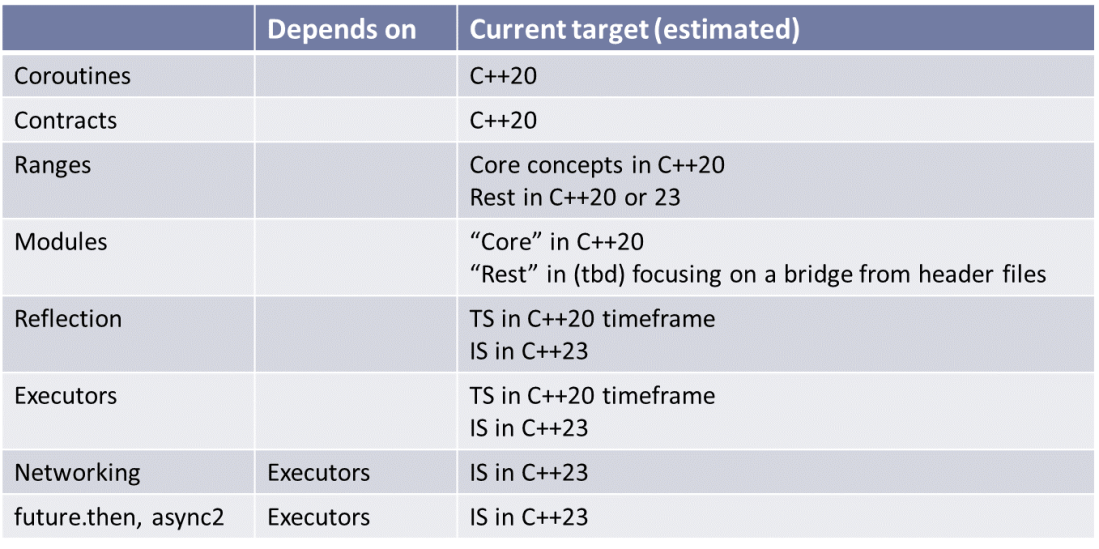
After several years of incubation, executors are now making strong progress and are on track to become a TS in the C++20 timeframe. (Let me explicitly say “thread pools” for the benefit of those who are Ctrl-F’ing to find out how C++ intends to support modern thread pools such as in Windows 10 and Grand Central Dispatch. You’re now in the right place: Modern thread pool support is coming as part of executors.)

Note that there is a dependency on executors before we can merge the networking TS and the future.then feature in the concurrency TS into the C++ draft standard, which means that all of those features are likely to be merged early in the C++23 cycle rather than in C++20.

We are going to try to ship coroutines in C++20.

We are opening a new work item for Library Fundamentals TS3, the third batch of library additions, even as we will soon be starting to fold in material from the recently-published Library Fundamentals TS2 into C++20.

SG15 (Tooling) (Titus Winters) had its first meeting, and there is a shared belief that we need to take concrete steps toward enabling better support for tools for two things in particular: modules, and C++ library package managers. That coincided very nicely with the 2018-02 isocpp.org survey, where on the open-ended question 10, the #1 write-in answer was to request “dependencies / package manager” (15% of all write-ins mentioned that). Clearly there is interest in this area, and it will be interesting to see how this develops into proposals over the coming meetings.

We also created a new study group SG16 (Unicode) with Tom Honermann as the SG chair.

What’s next

Whew! Here is a cheat-sheet summary of our current expectations for some of the major pieces of work that are not already in draft C++20. Note that this is an estimate only.
cpp11147020 - 201803

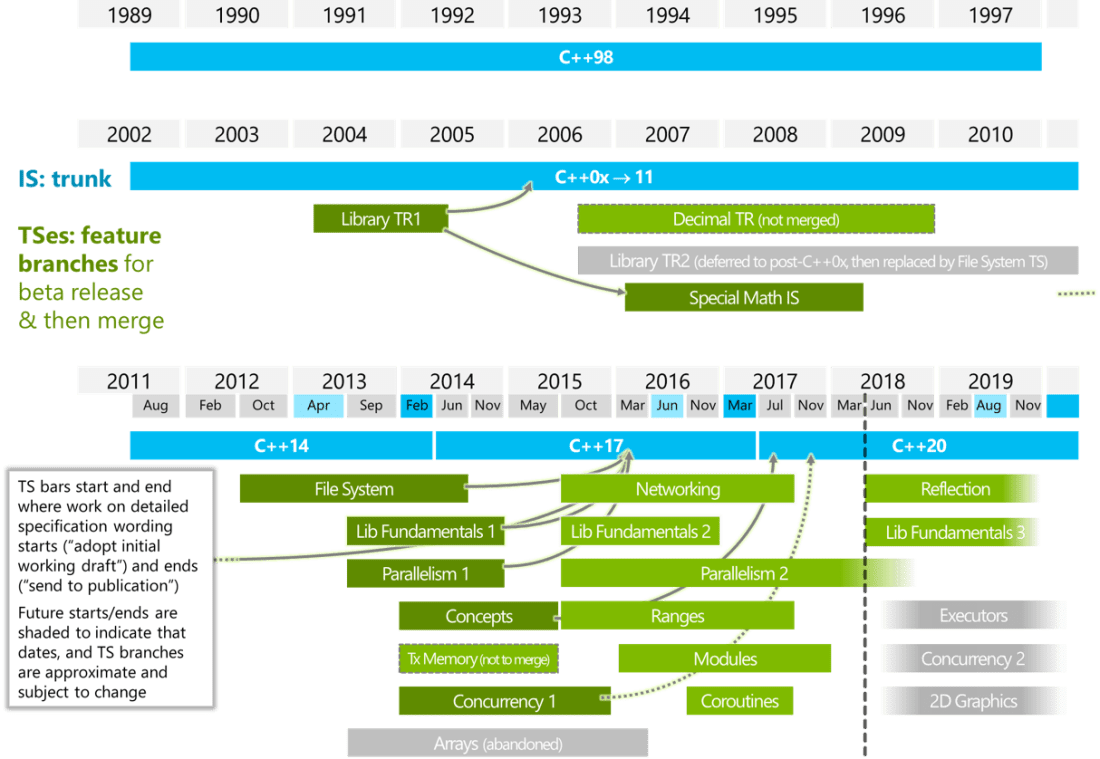
And here is an updated snapshot of where we are on the timeline for C++20 and the TSes that are completed, in flight, or expected to begin:
wg21-timeline-2018-03.png

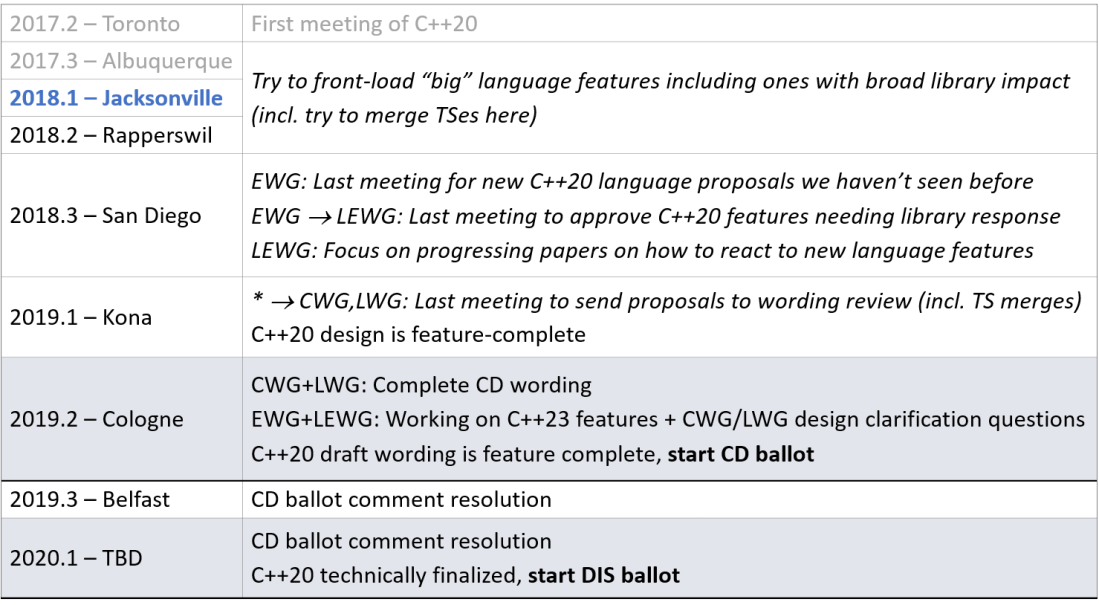
Finally, here is the schedule for the C++20 cycle approved by unanimous consent at this meeting:
wg21-schedule-2018-03

Thank you again to the approximately 140 experts who attended this meeting, and the many more who participate in standardization through their national bodies! Have a good spring… we look forward now to our next meetings in June (Rapperswil, Switzerland) and November (San Diego, CA, USA).
Trip report: Fall ISO C++ standards meeting (Albuquerque)

A few minutes ago, the ISO C++ committee completed its fall meeting in Albuquerque, New Mexico, USA, hosted with our thanks by Sandia National Laboratories. We had some 140 people at the meeting, representing 10 national bodies. As usual, we met for six days Monday through Saturday, including several evenings.

The following are some highlights of what we achieved this week. You can find a brief summary of ISO procedures here. The main things to note are:

  • “IS” means “international standard.” In our case, it’s the core C++ standard itself. Think of this as “trunk.”
  • “TS” means “technical specification,” a document separate from the main standard where we can gain experience with new features before putting them into the IS. We have several of these, summarized on the status page. Think of these as “beta branches.”

Modules TS ballot comments: Almost done

A primary goal of the meeting was to address the comments received from national bodies in the Modules TS’s comment ballot that ran this summer. We managed to address them all in one meeting, as well as deal with most of the specification wording issues discovered in the process of responding to the national comments; we discovered one or two areas where the TS wording did not quite match the approved design intent, and so the plan is to finish addressing those and to approve the Modules TS for publication in between meetings via a teleconference, rather than wait for our next face to face meeting in March.

It will be great to get the TS published, and continue getting experience with implementations now in progress, at various stages, in all of Visual C++, Clang, and gcc as we let the ink dry and hammer out some remaining design issues, before starting to consider adopting modules into the C++ draft standard itself. I do not know whether modules will make the feature cutoff for C++20, but a lot of people are working hard to maximize the chances… we’ll know in another 12-18 months when we reach the C++20 feature cutoff.

Second meeting for C++20

This was also the second meeting where we could vote changes into Draft C++20. And we did!

Here are some of the features that were added to C++20 at this meeting. Note: These links currently find the most recent pre-meeting papers and so may not reflect the exact wording adopted at the meeting, but the links will light up to the post-meeting versions of the papers that were actually adopted as soon as those are available in the post-meeting mailing about three weeks from now.

Range-based for statements with initializer (Thomas Köppe). In C++17, we already allowed initialization of if-scoped and switch-scoped variables, just like the ordinary for loop has already had for years. Today, we added the same for the range-based for loop, which gives the same benefit: It enables and encourages locally scoped variables without the programmer having to introduce a scope manually. To take an example from the paper, in C++17 we might write the following to get a variable thing that exists just as long as is needed for the for loop, which avoids a bad pitfall (do you see why the “WRONG” comment is wrong? it might work depending on what f() returns, or it might be undefined behavior):

{
  T thing = f();
  for (auto& x : thing.items()) {
    // Note: “for (auto& x : f().items())” is WRONG
    mutate(&x);
    log(x);
  }
}

and now in draft C++20 we can write the recommended local scoping directly with less ceremony of { } and indenting, and follow the C++ Core Guidelines scoping recommendations now also for range-for, as just:

for (T thing = f(); auto& x : thing.items()) {
  mutate(&x);
  log(x);
}

Bit-casting object representations (JF Bastien). This proposal gives a way to copy the bits of an object in a consistent and simple manner. It adds the new header <bit>, and provides bit_cast for trivially-copyable “bag-o-bits” objects, to easily copy the bits of any such object to another of the same size (the types need not be the same). Note: Yes, we already have memcpy, but bit_cast is safer and also can run at compile time.

Lots of other cleanup. We did various smaller features and cleanup, sometimes to fix bugs, sometimes to improve consistency and generality, and sometimes to make the language a little simpler to use.

  • Example of bug fixes: Draft C++20 sets forth more precisely where constexpr functions are defined (core issue 1581).
  • Examples of consistency and generality: Draft C++20 now supports concepts requires-clauses in more places including lambdas (P0857, Thomas Köppe). Also, stateless (non-capturing) lambdas are now default constructible and assignable, which makes them more convenient to create and use (P0624, Louis Dionne).

Operator <=>, aka “spaceship” (myself). Beyond those, my personal favorite is that the committee adopted my own proposal for the <=> “spaceship” three-way comparison operator (language wording; library wording). Many thanks to all the proposal’s reviewers, including all the authors of previous proposals in this area and especially Jens Maurer and Walter Brown for standardese wording help. This will greatly simplify how to write comparisons.

For example, in C++17 if we want to have a case-insensitive string type CIString that supports comparisons between two CIStrings and between a CIString and a C-style char* string, we would have to write something like the following 18 nonmember friend functions:

class CIString {
  string s;
public:
  // ...

  friend bool operator==(const CIString& a, const CIString& b) { return ci_compare(a.s.c_str(), b.s.c_str()) != 0; }
  friend bool operator< (const CIString& a, const CIString& b) { return ci_compare(a.s.c_str(), b.s.c_str()) <  0; }
  friend bool operator!=(const CIString& a, const CIString& b) { return !(a == b); }
  friend bool operator> (const CIString& a, const CIString& b) { return b < a; }
  friend bool operator>=(const CIString& a, const CIString& b) { return !(a < b); }
  friend bool operator<=(const CIString& a, const CIString& b) { return !(b < a); }

  friend bool operator==(const CIString& a, const char* b) { return ci_compare(a.s.c_str(), b) != 0; }
  friend bool operator< (const CIString& a, const char* b) { return ci_compare(a.s.c_str(), b) <  0; }
  friend bool operator!=(const CIString& a, const char* b) { return !(a == b); }
  friend bool operator> (const CIString& a, const char* b) { return b < a; }
  friend bool operator>=(const CIString& a, const char* b) { return !(a < b); }
  friend bool operator<=(const CIString& a, const char* b) { return !(b < a); }

  friend bool operator==(const char* a, const CIString& b) { return ci_compare(a, b.s.c_str()) != 0; }
  friend bool operator< (const char* a, const CIString& b) { return ci_compare(a, b.s.c_str()) <  0; }
  friend bool operator!=(const char* a, const CIString& b) { return !(a == b); }
  friend bool operator> (const char* a, const CIString& b) { return b < a; }
  friend bool operator>=(const char* a, const CIString& b) { return !(a < b); }
  friend bool operator<=(const char* a, const CIString& b) { return !(b < a); }
};

With this proposal, the class’s comparisons could instead be implemented as just two ordinary member functions (vs. the 18 that had to be nonmember friends above):

class CIString {
   string s;
public:
   // ...

  std::weak_ordering operator<=>(const CIString& b) const
      { return ci_compare(s.c_str(), b.s.c_str()); }
  std::weak_ordering operator<=>(const char* b) const
      { return ci_compare(s.c_str(), b); }
};

and objects of this type can still be used just as flexibly and efficiently as if the class author had written all of the above two-way operators in the first version, because now the compiler will rewrite expressions like s1<s2 to (s1<=>s2 < 0) for you automatically. Additionally, unlike the first attempt, this version also documents in code that the kind of ordering being returned is a weak ordering, not a strong (total) ordering. I’m a fan of writing less code to say more, and to say it more accurately. Please see the paper linked above for more details.

In related news, at this meeting the Library Evolution subgroup also began considering David Stone’s proposal to apply operator<=> to the standard library, and it got a warm reception and is expected to progress over the coming meetings. If it succeeds, we hope it may possibly let us get a small reduction in the size of the standard library specification as well as a result. Additionally, at this meeting we discovered that having <=> opens an unanticipated door for language evolution: Because the default operator<=> is guaranteed to be memberwise, so that we can know those are its semantics at compile time, a brand-new proposal by Jeff Snyder can leverage it to solve the remaining problems that before prevented us from using non-built-in types as non-type template parameters; we’ll see more of his proposal at our next meeting. That’s a good sign of a feature that is generally useful in the language beyond just its intended use cases.

We also approved extensions to the standard library:

atomic<shared_ptr<T>> (myself, Alisdair Meredith): This was originally my proposal and I got it into the Concurrency TS; many thanks to Alisdair Meredith who got it the rest of the way into draft C++20 over the past two meetings. There are changes since it appeared in the Concurrency TS, including to make it use the name I originally proposed (and not “atomic_shared_ptr<T>”).

Here’s more that we got at this meeting on the standard library side. If you notice “constexpr” being mentioned a few times above already, and some more below, that’s no accident; in Library subgroup chair Marshall Clow’s words, “the future of constexpr is bright.” The following other progress also includes more work on enabling features to work at compile time, including most of the rest of the standard algorithms:

(Aside: At this meeting, the Evolution subgroup also provisionally allowed constexpr (compile-time) new, vector, and string. Stop a moment, and think about what that means. — That is not yet in C++20, but it’s on its way and could be approved for draft C++20 in another few meetings… and if this all reminds you of the CppCon “constexpr all the things!” talk title, you’re exactly right.)

And much more. Thanks to all those proposal authors and the issues list proposed wording contributors and all their helpers, without which this team effort would not succeed meeting after meeting. None of the proposers could get it done without all the contributions of many people who work tirelessly all the way from design feedback to detailed wording review, usually for no public glory, and we appreciate their indispensable help. For any of the above papers you happen to have interest to click on, please be sure to look also at the Acknowledgments section, many of which are quite extensive and deservedly so.

We also continued incubating other work. In particular, the Reflection study group had presentations, and gave direction and feedback, on static reflection for functions, as well as design feedback on Section 5 of my metaclasses paper. The Undefined/Unspecified Behavior study group met for two days with our sister committee WG23 (Vulnerabilities) co-located at the same venue to start work on a C++-specific document about programming language vulnerabilities and guidance, in conjunction with (and already providing new feedback for) the C++ Core Guidelines.

What’s next

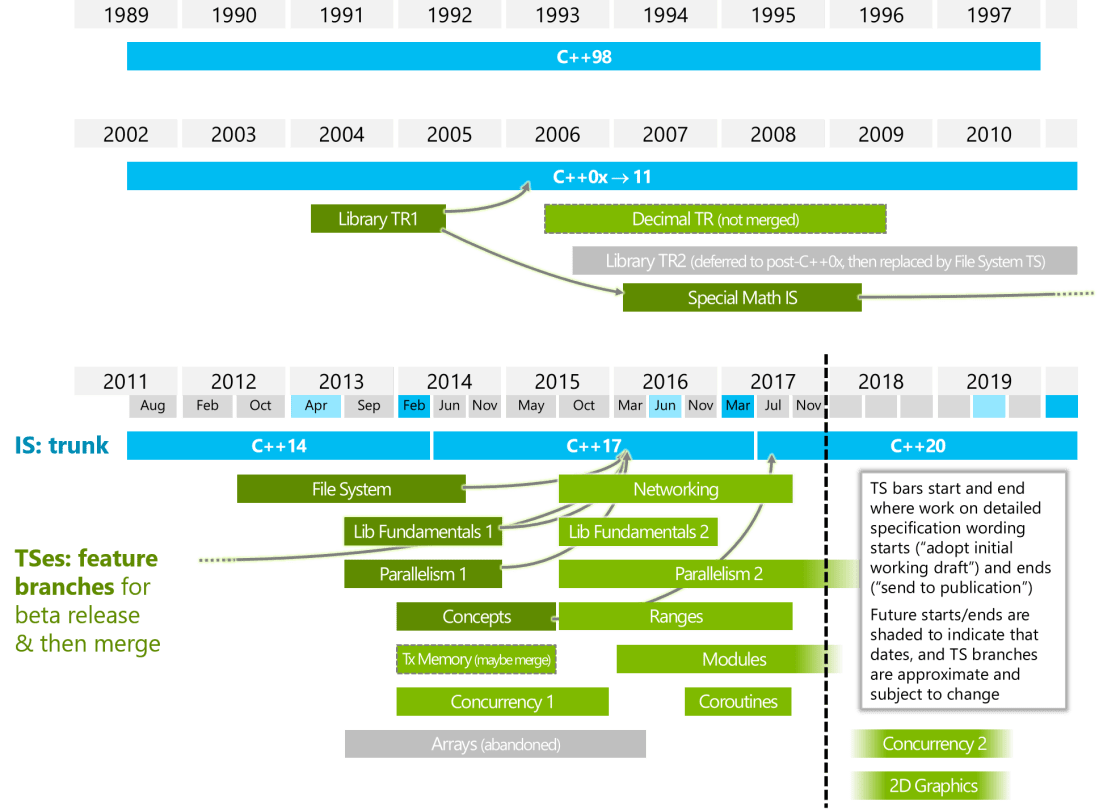
Here’s an updated snapshot of our status:

wg21-timeline-2017-11

Thank you again to the 140 experts in Albuquerque this week, and the many more who participate in standardization through their national bodies! Have a good winter… we look forward now to our next meetings in March (Jacksonville, Florida, USA) and June (Rapperswil, Switzerland).

Interview: On simplifying C++

I was also interviewed recently by Anastasia Kazakova for the CLion blog, and that interview is now live:

Toward a more powerful and simpler C++ with Herb Sutter

Topics include:

  • Concepts and modules (and coroutines) as the true hot topics right now
  • How my work on metaclasses was motivated and developed
  • Obligatory aside on operator<=> which grew out of the same work
  • Good and bad ways to learn from other languages and their experience
  • What are the next questions to be answered for metaclasses proposal
  • What has been the committee’s feedback so far
  • How can we expect to see reflection, compile-time code, injection, and metaclasses both progress in committee and get built into production compilers
  • How toolable are today’s C++11/14/17 features, and what about toolability for metaclasses

11 is the new 7: iOS designers, what is it with the motion fetish? Please stop making us motion sick

In my household, iOS 7 was sickening — literally. When it came out with its flashy parallax home screen and (IMO too often gratuitous) motion effects, my wife was one of the many people it immediately made motion-sick. After 30 years of loyally loving Apple products, my wife almost had to dump her iPhone. It was so bad that it’s the only time in my life we’ve written an email directly to the CEO of a company; we didn’t expect Tim Cook to reply, but we hope it helped raise awareness, and fortunately (likely not because of us, even slightly, but very happily), Settings > Accessibility > Reduce Motion came long just in time, and iOS was usable again.

Now iOS 11 has done it again. Just unlocking the phone is motion sickness-inducing because the lock screen now flies upward out of the way on every unlock, even if you have Settings > Accessibility > Reduce Motion enabled. (What happened to “No means no”?) And there appears to be more motion again around the lock and home screens and when just opening and switching the built-in apps, so now my wife is feeling ill again in the first 10 seconds of every phone session since she upgraded, and we’re having Android conversations again. And we don’t want Android. Really.

iOS is supposed to be the most usable phone OS, but you can’t use something if you can’t look at it.


Open letter to Apple designers:

We love your work because you love usability, and especially in recent years you love accessibility. Please, get back to those roots.

What is it with all the motion lately? You are known for minimalism, and that “design is how it works.” Design is not about “how it looks” eye candy — gratuitous motion is not a feature, yet it seems that in recent releases you have had a temptation to go for “cool” effects that do not improve usability. Please resist. I hope we can all agree that parallax on the home screen has insignificant effect on improving usability; I turned it off as soon as I could even though I’m not motion sickness-prone (seriously, this aspect of iOS reminds me unflatteringly of Clippy bouncing around). And yes, I realize that you likely made the iOS 11 lock screen swerve careen glide up on unlock in order to teach that “hey look! see? it lives up there just off the top of the screen” so that we remember that we can now pull it down anytime to get it back — yes, we know, we learned it once the first time, could we please now not have to live with that animation forever? Please stop with the careening screen elements. You know what Nancy Reagan would say about the animations: Just Say No.

Minimal-change proposed resolution: Please, just make all the new motion effects, including the fly-away lock screen, respect Settings > Accessibility > Reduce Motion. (Translation: “No means no.” We said No already. Please respect it.) Or give us a new way to turn it off. Please.

We want to keep using iOS, but we can’t use it if we can’t look at it. We don’t want to have to switch to Android to get a phone we can use. Don’t let Android win on usability, which is supposed to be your home turf — and don’t let Android win on accessibility, which is so important these days and which I know is important to you.

Thank you for your consideration and help.


If you know of a workaround that can disable these awful motion effects, please mention it in the comments. (But please don’t suggest jailbreaking, which isn’t an option for us because that would be license-violating and security-compromising.)

My CppCon 2017 session is now on YouTube

My CppCon talk yesterday is now on YouTube. You can read more about in my July blog post on “Metaclasses: Thoughts on generative C++” which contains links to the current paper and some examples that work so far on the live prototype compiler cppx.godbolt.org.

Thanks again to Bjarne Stroustrup for making C++ so general and powerful with just a single kind of “class” (essential for this work), to Andrew Sutton for implementing the prototype metaclasses compiler, to Matt Godbolt for hosting it on his site, to everyone on the committee and in the community on whose work this is trying to build and have provided comments and feedback, and to Bash Films and CppCon for making these videos available so quickly. As in previous years, the CppCon videos will also be available on Channel 9 as well, though that usually takes a few extra weeks to happen.

C++17 is formally approved

[revised 9/8 to reflect that there is no need to wait till the next WG21 meeting]

As I mentioned in my Kona (March) trip report, WG21 (the ISO C++ committee) completed work on C++17 at our March meeting. At that point it was technically finalized, and since then we have been in the final procedural endgame of formal ISO approval and publication.

Today, I’m pleased to report that the last major ballot was completed: A few hours ago, the C++17 DIS (Draft International Standard) ballot came back with 100% approval, 23 editorial comments, and no technical comments. Unanimous approval of a DIS means that we get to skip the FDIS ballot (as we hoped) and proceed directly to publication. As far as ISO is concerned, we are now done and they are just waiting for us to update the document editorially and send them the final PDF we want to be published.

So the remaining steps are:

  • The project editor (Richard Smith) and helpers will review and resolve the editorial comments, and any other pending editorial tweaks they feel like fixing (e.g., speling, formatting). This includes generating the official record of response paper summarizing what was done for each editorial DIS comment received.
  • We send the final PDF to ISO for publication, and ISO after a month or two ISO publishes it in the ISO store.

Note again that all this is just formally putting a bow on C++17. WG21’s active project now is C++20, and we already began work on that at our last meeting in Toronto, including to add a major feature (concepts!), and we’ll continue serious work on that in Albuquerque and beyond.

This is a product of many people’s labors and many often-unsung efforts. Thank you again to the hundreds of participants in the ISO C++ committee, and many interested commenters and helpers in the community, for all your work and support for C++ standardization.

Update on October seminar in London

As I mentioned earlier, part of my fall schedule is to give a repeat of this spring’s sold-out seminar: “High-Performance and Low-Latency C++” (October 9-11, London, UK).

I am still getting mails about whether there are alternative/additional European dates for this seminar. Unfortunately, the answer is still no, but since I’m getting inquiries about it let me repeat that part of the earlier post:

On October 9-11, I’ll be in London giving a one-time repeat of “High-Performance and Low-Latency C++” (course details page). This is the same as the public course I gave in Stockholm [in April]; because that course sold out, and I was coming to Europe again for Qt World Summit anyway, we decided to do a single repeat that same week, this time in London.

Notes: (1) Some of you have emailed me asking if there will be other dates/cities, and the answer is no, sorry, I do seminars very rarely and this is the last one I have time to do for the foreseeable future. So if you are interested then this is the one to attend. (2) Some of you have also emailed me to ask whether the seminar will be recorded, and the answer is again no, sorry, the organizers are not set up for that. However, you can find all of my past Effective Concurrency writing (on which parts of this course are based) freely available via this blog, just search for that phrase or use the category tag — there’s a book’s worth of free material written by me in individual-article form.

So, if you’re interested, I hope you’ll be able to attend this October, and I look forward to seeing many of you there.

Metaclasses: Thoughts on generative C++

I’ve been working on an experimental new C++ language feature tentatively called “metaclasses” that aims to make C++ programming both more powerful and simpler. You can find out about it here:

  • Current proposal paper: P0707R1. I hope the first ten pages give a readable motivation and overview. (The best two pages to start with are 9 and 10, which probably means I need to reorder the paper…)
  • Initial intro talk video: ACCU 2017 (YouTube). This is the initial public presentation three months ago. Thank you to Roger Orr, Russel Winder, Julie Archer, and the other ACCU organizers for inviting me and for holding back the video until we could have the ISO C++ summer meeting about a week ago, so it could go live along with a report (herein) on the results of this feature’s first presentation to the ISO C++ committee. And special thanks to Ina and Arvid, the two audience volunteers who graciously agreed to come on-stage to participate in a live mini UX study. There’s a lot of subtle information in their nuanced reactions to the code examples; pay special attention when their responses are different or as their responses evolve.
  • “Incomplete and experimental” prototype compiler. The Clang-based prototype by Andrew Sutton is available as an online live compiler at cppx.godbolt.org, and as source at github.com/asutton/clang. It’s incomplete but can compile a number of the examples in the paper (see the paper for example code links). Thanks to Matt Godbolt for hosting it on godbolt.org!

Please see the paper and video to answer “what are metaclasses and why should I care?” If you’re the “show me code first, English later” kind of person, try the live compiler and these quick examples: interface, base_class, value (regular type), plain_struct (these links are also in the paper).

The rest of this post aims not to duplicate any information above, but to provide some context about the broader journey, and what I and others are attempting to accomplish.

A journey: Toward more powerful and simpler C++ programming

Phase 1: By using the existing language better

About five years ago, I started working on long-term effort toward making using C++ simpler and safer.

In the first phase, a small group of us—centered on Bjarne Stroustrup, Gabriel Dos Reis, Neil MacIntosh and Andrew Pardoe—pushed to see how far we could get with “C++ as it is” plus just a few well-chosen library-only extensions, with a particular goal of improving type and memory safety. Bjarne, Neil, and I first publicly reported on this effort in the two CppCon 2015 plenary sessions “Writing Good C++14” and “Writing Good C++14… By Default.” The results of that work so far have manifested as the C++ Core Guidelines and its support library GSL that adds a limited number of library types (e.g., span, now being standardized); and I led the Lifetime design in particular (available in the Guidelines /docs folder) which Neil and I and others continue to work on formalizing with the aim of sharing a “draft” static analysis spec later this year.

One of the goals of this phase was to answer the question: “How much progress can we make toward simplifying the existing C++ language with only a few key library extensions?” The answer as I see it turned out to be: “Some solid progress, but probably not a major simplification.” And so that answer led to phase two…

Phase 2: By evolving the language

Two years ago, I started to focus specifically on exploring ways that we might evolve the C++ language itself to make C++ programming both more powerful and simpler. The only way to accomplish both of those goals at the same time is by adding abstractions that let programmers directly express their intent—to elevate comments and documentation to testable code, and elevate coding patterns and idioms into compiler-checkable declarations. The work came up with several potential candidate features where judiciously adding some power to the language could simplify code dramatically.

Of those potential candidate features, metaclasses is the first major piece I picked to propose for ISO C++. [*] We presented it for the first time at the summer ISO C++ meeting earlier this month, and it received a warm reception. There was (rare) unanimous support for pursuing this kind of capability, but also some concern about how best to expose it and specific design change feedback the committee wants us to apply to improve the proposal. [**] We’ll work to include in a revision for the November standards meeting as we start the multi-year process of vetting and refining the proposal. So this is good progress, but note that it (only) means encouragement to continue the experiment and see where it leads; it’s far too early to talk about potential ship vehicles.

So do expect change: The proposal is still evolving, and it in turn assumes and builds on the static reflection proposal (P0578 et al.) and the compile-time programming proposal (P0633), both of which are actively evolving in their own right. Incidentally, one of the contributions of Andrew Sutton’s prototype metaclasses compiler is that it is implementing those other proposals too(!), since the metaclasses feature needs them. The aim is to keep the latest compiler and the latest P0707 paper in sync with each other and with those related proposals, but there will doubtless be occasional drift in between syncs.

What’s next

I’ll talk about metaclasses more in my upcoming CppCon 2017 talk this September, and Andrew Sutton will also be giving two CppCon talks about metaclasses—one about implementing them in Clang, and one about using them for a real project.

This is just the beginning, and we’ll see whether it all pans out and leads somewhere, but I hope you enjoy this exploration and I look forward to talking with many of you about it at CppCon this September.


———

Notes

[*] I actually brought a smaller piece from this same work to the committee at the previous meeting, the winter meeting in Kona: P0515 (consistent comparisons), which proposes adding the three-way <=> comparison operator. P0515 is only about a minor feature, and not one of the most important things that can help improve C++, so normally I wouldn’t have picked that piece to contribute first; but the committee was already continuing to actively discuss comparisons, so I cherry-picked it from my design work and contributed it since I had the design in my pocket anyway. Happily the committee liked what they saw and both EWG and LEWG accepted it, and it is now progressing well and on track to hopefully be voted into draft C++20 in the next meeting or two. Thanks to Jens Maurer and Walter Brown for the heavy lifting of writing the core language and library standardese wording, respectively, for that P0515 proposal.

[**] The committee’s design feedback was primarily about how to wrap up the transformation code: Instead of putting it inside a new “meta” class-like abstraction, how about wrapping the same code inside a compile-time function-like abstraction that takes an input meta::type parameter and returns a generated meta::type return value? This doesn’t affect the proposal’s basic engine, just the shape of its steering wheel—for example, we could change the first line of each example metaclass definition from the class-like syntax

$class interface {
    constexpr {
        // … basically same code …
    }
};

to the decorator-function-like syntax

meta::type interface(const meta::type source) {
    // … basically same code …
};

where the latter has the advantage that it’s easy to see that we’re reading one type and generating another type. Interestingly, I think this dovetails with the mini UX study in the video where most of the difficulty the UX participants seemed to encounter was in understanding the $class syntax, not the metaclass bodies and not later using the metaclasses to author new types.

But we’ll explore this and other options and validate/invalidate it with more experiments… and feel free to express your thoughts in the comments if you like one of these styles better, or perhaps another variation.