C++26 is done! — Trip report: March 2026 ISO C++ standards meeting (London Croydon, UK)

News flash: C++26 is done! 🎉

On Saturday, the ISO C++ committee completed technical work on C++26 in (partly) sunny London Croydon, UK. We resolved the remaining international comments on the C++26 draft, and are now producing the final document to be sent out for its international approval ballot (Draft International Standard, or DIS) and final editorial work, to be published in the near future by ISO.

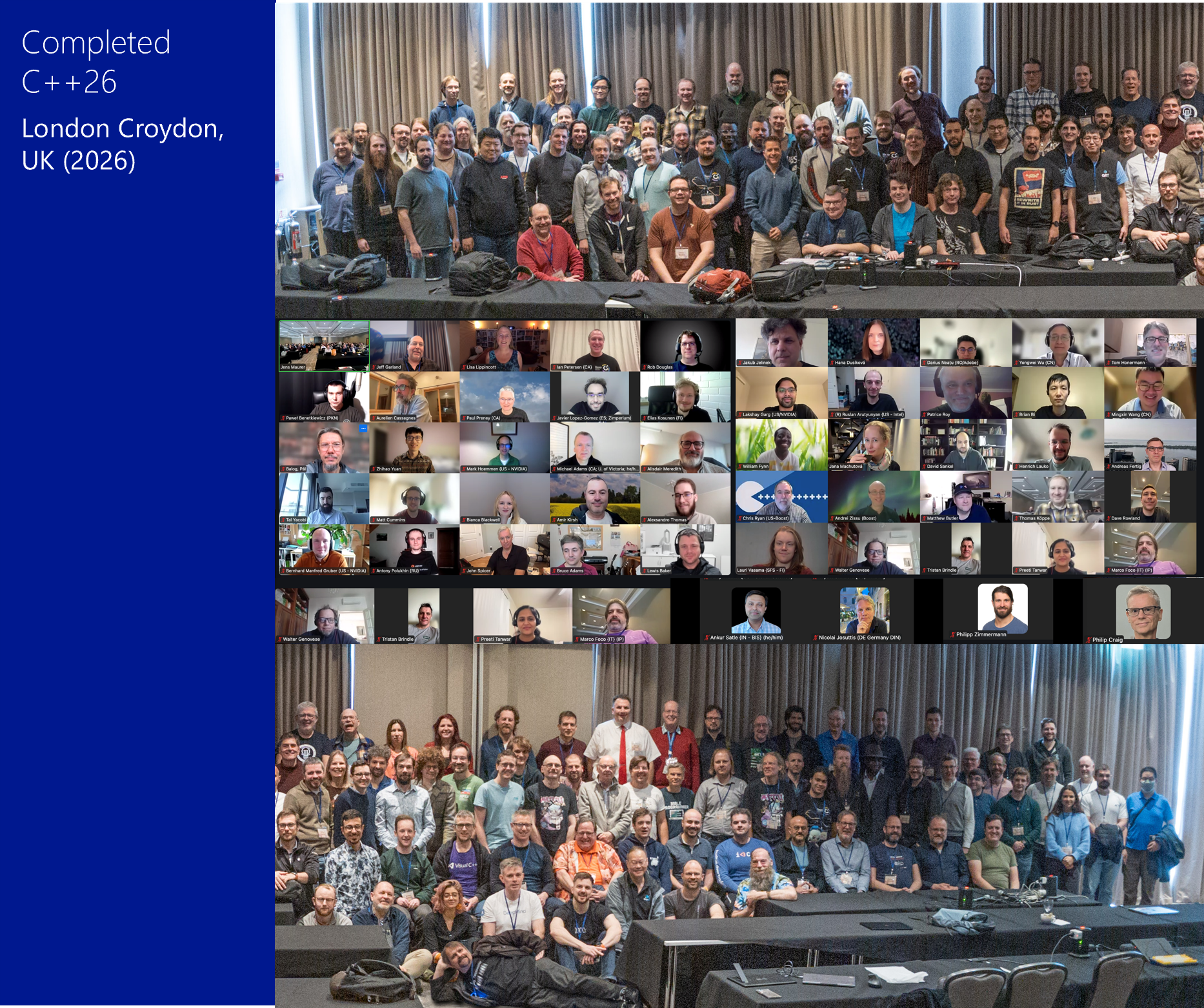
This meeting was hosted by Phil Nash of Shaved Yaks, and the Standard C++ Foundation. Our hosts arranged for high-quality facilities for our six-day meeting from Monday through Saturday. We had about 210 attendees, about 130 in-person and 80 remote via Zoom, formally representing 24 nations. At each meeting we regularly have new guest attendees who have never attended before, and this time there were 24 new guest attendees, mostly in-person, in addition to new attendees who are official national body representatives. To all of them, once again welcome!

The committee currently has 23 active subgroups, nine of which met in 6 parallel tracks throughout the week. Some groups ran all week, and others ran for a few days or a part of a day, depending on their workloads. We had three technical evening sessions on C++ compiler/library implementations, memory safety, and quantities/units. You can find a brief summary of ISO procedures here.

C++26 is complete: The most compelling release since C++11

Per our published C++26 schedule, this was our final meeting to finish technical work on C++26. No features were added or removed; we just handled fit-and-finish issues and primarily focused on finishing addressing the 411 national body comments we received in the summer’s international comment ballot (Committee Draft, or CD).

If you’re wondering “what are the Big Reasons why should I care about C++26?” then the best place to start is with the C++26 Fab Four Features…

(1) Reflection, reflection, reflection

Reflection is by far the biggest upgrade for C++ development that we’ve shipped since the invention of templates. For details, see my June 2025 trip report and my September 2025 CppCon keynote: “Reflection: C++’s decade-defining rocket engine.” From the talk abstract:

In June 2025, C++ crossed a Rubicon: it handed us the keys to its own machinery. For the first time, C++ can describe itself—and generate more. The first compile-time reflection features in draft C++26 mark the most transformative turning point in our language’s history by giving us the most powerful new engine for expressing efficient abstractions that C++ has ever had, and we’ll need the next decade to discover what this rocket can do.”

(2) Less UB for more memory safety: C++ code is more memory safe just by recompiling as C++26

C++26 has important memory safety improvements that you get just by recompiling your existing C++ code with no changes. The improvements come in two major ways.

No more undefined behavior (UB) for reading uninitialized local variables. This whole category of potential vulnerabilities disappears in C++26, just by recompiling your code as C++26. For more details, see my March 2025 trip report.

The hardened standard library provides initial cross-platform library security guarantees, including bounds safety for dozens of the most widely used bounded operations on common standard types, including vector, span, string, string_view, and more. For details, see my February 2025 trip report and run (don’t walk) to read the November 2025 ACM Queue article “Practical Security in Production: Hardening the C++ Standard Library at Massive Scale” to learn how this is already deployed across Apple platforms and Google services, hundreds of millions of lines of code, with on average 0.3% (a fraction of 1%) performance overhead. From the paper:

“The final tally after the rollout was remarkable. Across hundreds of millions of lines of C++ at Google, only five services opted out entirely because of reliability or performance concerns. Work is ongoing to eliminate the need for these few remaining exceptions, with the goal of reaching universal adoption.

Even more telling, the fine-grained API [to opt out] for unsafe access was used in just seven distinct places, all of which were surgical changes made by the security team to reclaim performance in code that was correct but difficult for the compiler to analyze. This widespread adoption stands as the strongest possible testament to the practicality of the hardening checks in real-world production environments.”

This is no just-on-paper design. At Google alone, it has already fixed over 1,000 bugs, is projected to prevent 1,000 to 2,000 bugs a year, and has reduced the segfault rate across the production fleet by 30%.

And, now, it is standardized for everyone in C++26. Thank you, Apple and Google and all the standard library implementers!

(3) Contracts for functional safety: pre, post, contract_assert

In C++26, we also have language contracts: preconditions and postconditions on function declarations and a language-supported assertion statement, all of which are infinitely better than C’s assert macro.

Note that some smart and respected ISO C++ committee experts have sustained technical concerns about contracts. For my summary of the contracts feature and all the major repeated concerns (with my opinions about them, which could be wrong!), see my CppCon 2025 contracts talk. In February 2025 when we took the plenary poll to adopt contracts in the C++26 working draft (“merge it to trunk”), the vote was:

100 in favor, 14 opposed, and 12 abstaining

Since then, the concerns have all been deeply rediscussed for the last three meetings thanks to thoughtful and high-quality technical papers; all of those papers have continued to be fully heard, often for multiple days and at many telecons between meetings. At our previous meeting in November 2025, we did fix a couple of contracts specification bugs thanks to this feedback! Yesterday, when we took the plenary poll to finalize and ship the C++26 standard, the vote was non-unanimous primarily because of the sustained concerns about contracts:

114 in favor, 12 opposed, and 3 abstaining

The unusually low number of abstentions shows that virtually all our experts now feel sure about their technical opinions, either for or against contracts. After extensive scrutiny, the committee’s opinion is clear: The ISO C++ committee still wants contracts, and so contracts have stayed in C++26.

(4) std::execution (aka “Sender/Receiver”)

std::execution is what I call “C++’s async model”: It provides a unified framework to express and control concurrency and parallelism. For details, see my July 2024 trip report. It also happens to have some important safety properties because it makes it easier to write programs that use structured (rigorously lifetime-nested) concurrency and parallelism to be data-race-free by construction. That’s a big deal.

I do want to write a warning though: This feature is great (my company has already been using it in production) but it’s currently harder to adopt than most C++ features because it lacks great documentation and is missing some “fingers-and-toes” libraries. For now, do expect great results from std::execution, but also expect to spend some initial time on learning with the help of a friend who already knows it well, and to write a few helper adapter libraries to integrate std::execution with your existing async code.

C++26 adoption will be fast

There are two reasons I expect C++26 to be adopted in industry very quickly compared with C++17, C++20, and C++23.

First, user demand for this feature set is extraordinarily high. C++11 was our last “big and impactful” release that was chock full of features that the vast majority of C++ developers would use daily (auto, range-for, lambdas, smart pointers, move semantics, threads, mutexes, …). Since then, our followup triennial standards have also had some ‘big’ features like parallel STL, concepts, coroutines, and modules, but the reality is that those weren’t as massively impactful for all C++ developers as C++11’s features were, or as C++26’s marquee features of reflection and safety hardening will be now. So even if your company has been slow to enable the C++20 switch, I think you’ll find they’ll be much faster to enable C++26. There’s just so much more high-demand value that makes it an exciting and exceptionally useful release for everyone who uses C++.

Second, conforming compiler and standard library implementations are coming quickly. Throughout the development of C++26, at any given point both GCC and Clang had already implemented two-thirds of C++26 features. Today, GCC already has reflection and contracts merged in trunk, awaiting release.

Work on C++29, especially on more memory safety and profiles

At this meeting we also adopted the schedule for C++29, which will be another three-year release cycle. To no one’s surprise, a major focus of the discussion about C++29-timeframe material was about further increasing memory safety.

This week, the main language evolution subgroup (EWG) reviewed updates on several ongoing proposals in the area of further type/memory-safety improvements for C++29, including: to pursue proposals to further reduce undefined behavior to be seen again in EWG for possible inclusion in C++29; and to pursue further development of safety profile papers in the safety and security subgroup (SG23) to then be brought to EWG targeting C++29. SG23 specifically worked on Bjarne Stroustrup’s P3984 type safety profile using the proposed general profiles framework by Gabriel Dos Reis.

Besides those sessions, type and memory safety was extensively discussed in two additional large-attendance sessions: an evening session on Wednesday night attended by the majority of the committee, and in an EWG memory safety dedicated session all Friday afternoon attended by about 90 experts. In particular, I want to thank Oliver Hunt of Apple for presenting the practical experience report P4158R0, “Subsetting and restricting C++ for memory safety,” reporting how WebKit hardened over 4 million lines of code using a subset-of-superset approach (like Stroustrup’s Profiles) and showing how that has already made a profound difference in the security of C++ code in WebKit at scale. Here are a few highlights from the introduction slide (emphasis added):

Adopted ~4MLoC of code (i.e. w/o comments, tests, external libs, etc)

Closes multiple classes of vulnerabilities, current policies would have prevented majority of historical exploits

Found (and prevented exploitability) of new and existing bugs”

C++29 is already set to build even more on the safety improvements already in C++26, and I for one welcome our new era of safer-by-default-and-still-zero-overhead-efficient-C++ overlords. C++26 is the first step into a fundamentally new era: This isn’t our grandparents’ wild-west UB-filled anything-goes C++ anymore. But even as C++ moves to being more memory-safe by default, it’s staying true to C++’s enduring core of the zero-overhead principle… you don’t pay for what you don’t use, and even when some safety is so cheap that we can turn it on by default in the language you will always have a way to opt out when you need to get the last ounce of performance in that hot path or inner loop.

We did other work, including other things related to functional safety: EWG reviewed additional plans for applying contract checks in the language and standard library. The numerics subgroup (SG6) and library incubation subgroup (SG18) progressed P3045R7, “Quantities and units library” by Mateusz Pusz, Dominik Berner, Johel Ernesto Guerrero Peña, Chip Hogg, Nicolas Holthaus, Roth Michaels and Vincent Reverdy to the main library evolution subgroup (LEWG), and we had an evening session on the topic for the whole committee on Thursday evening. I encourage reading section 7.1 “Safety concerns” in the paper, including how technology like that in this paper could have improved Black Sabbath’s 1983 tour (which was hilariously lampooned in, of course, This Is Spinal Tap).

What’s next

Our next two meetings will be in Brno, Czechia in June and in Búzios, Rio de Janeiro, Brazil in November. At those two meetings we will start work on adding features into the new C++29 working draft.

Wrapping up

Thank you again to the about 210 experts who attended on-site and on-line at this week’s meeting, and the many more who participate in standardization through their national bodies!

But we’re not slowing down… we’ll continue to have subgroup Zoom meetings, and then in less than three months from now we’ll be meeting again in Czechia and online to start adding features to C++29, with many subgroup telecons already scheduled between now and then. Thank you again to everyone reading this for your interest and support for C++ and its standardization.
Software taketh away faster than hardware giveth: Why C++ programmers keep growing fast despite competition, safety, and AI

2025 was another great year for C++. It shows in the numbers

Before we dive into the data below, let’s put the most important question up front: Why have C++ and Rust been the fastest-growing major programming languages from 2022 to 2025?

Primarily, it’s because throughout the history of computing “software taketh away faster than hardware giveth.” There is enduring demand for efficient languages because our demand for solving ever-larger computing problems consistently outstrips our ability to build greater computing capacity, with no end in sight. [6] Every few years, people wonder whether our hardware is just too fast to be useful, until the future’s next big software demand breaks across the industry in a huge wake-up moment of the kind that iOS delivered in 2007 and ChatGPT delivered in November 2022. AI is only the latest source of demand to squeeze the most performance out of available hardware.

The world’s two biggest computing constraints in 2025

Quick quiz: What are the two biggest constraints on computing growth in 2025? What’s in shortest supply?

Take a moment to answer that yourself before reading on…

— — —

If you answered exactly “power and chips,” you’re right — and in the right order.

Chips are only our #2 bottleneck. It’s well known that the hyperscalars are competing hard to get access to chips. That’s why NVIDIA is now the world’s most valuable company, and TSMC is such a behemoth that it’s our entire world’s greatest single point of failure.

But many people don’t realize: Power is the #1 constraint in 2025. Did you notice that all the recent OpenAI deals were expressed in terms of gigawatts? Let’s consider what three C-level executives said on their most recent earnings calls. [1]

Amy Hood, Microsoft CFO (MSFT earnings call, October 29, 2025):

[Microsoft Azure’s constraint is] not actually being short GPUs and CPUs per se, we were short the space or the power, is the language we use, to put them in.

Andy Jassy, Amazon CEO (AMZN earnings call, October 30, 2025):

[AWS added] more than 3.8 gigawatts of power in the past 12 months, more than any other cloud provider. To put that into perspective, we’re now double the power capacity that AWS was in 2022, and we’re on track to double again by 2027.

Jensen Huang, NVIDIA CEO (NVDA earnings call, November 19, 2025):

The most important thing is, in the end, you still only have 1 gigawatt of power. One gigawatt data centers, 1 gigawatt power. … That 1 gigawatt translates directly. Your performance per watt translates directly, absolutely directly, to your revenues.

That’s why the future is enduringly bright for languages that are efficient in “performance per watt” and “performance per transistor.” The size of computing problems we want to solve has routinely outstripped our computing supply for the past 80 years; I know of no reason why that would change in the next 80 years. [2]

The list of major portable languages that target those key durable metrics is very short: C, C++, and Rust. [3] And so it’s no surprise to see that in 2025 all three continued experiencing healthy growth, but especially C++ and Rust.

Let’s take a look.

The data in 2025: Programming keeps growing by leaps and bounds, and C++ and Rust are growing fastest

Programming is a hot market, and programmers are in long-term high-growth demand. (AI is not changing this, and will not change it; see Appendix.)

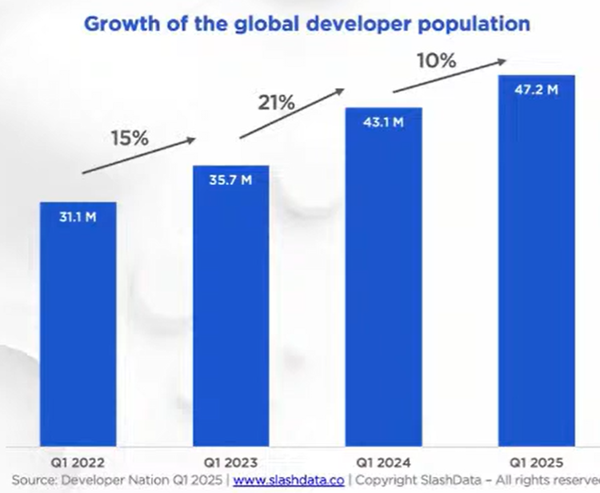
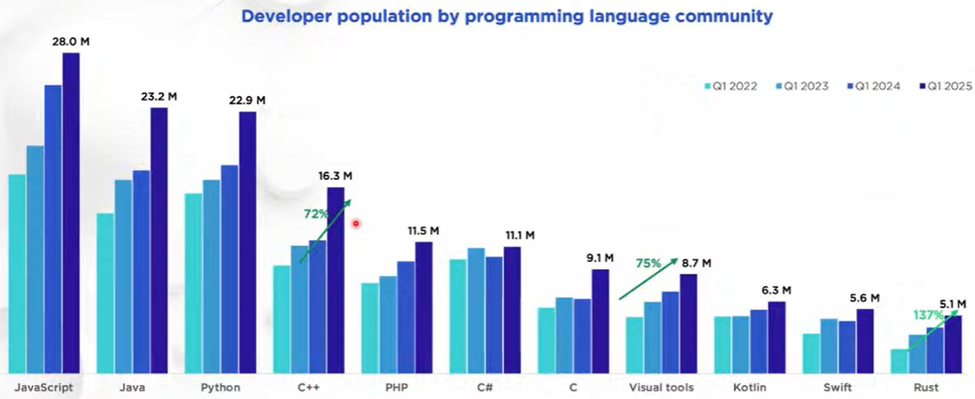
“Global developer population trends 2025” (SlashData, 2025) reports that in the past three years the global developer population grew about 50%, from just over 31 million to just over 47 million. (Other sources are consistent with that: IDC forecasts that this growth will continue, to over 57 million developers by 2028. JetBrains reports similar numbers of professional developers; their numbers are smaller because they exclude students and hobbyists.) And which two languages are growing the fastest (highest percentage growth from 2022 to 2025)? Rust, and C++.

Developer population growth 2022-2025

To put C++’s growth in context:

  • Compared to all languages: There are now more C++ developers than the #1 language had just four years ago.
  • Compared to Rust: Each of C++, Python, and Java just added about as many developers in one year as there are Rust total developers in the world.

C++ is a living language whose core job to be done is to make the most of hardware, and it is continually evolving to stay relevant to the changing hardware landscape. The new C++26 standard contains additional support for hardware parallelism on the latest CPUs and GPUs, notably adding more support for SIMD types for intra-CPU vector parallelism, and the std::execution Sender/Receiver model for general multi-CPU and GPU concurrency and parallelism.

But wait — how could this growth be happening? Isn’t C++ “too unsafe to use,” according to a spate of popular press releases and tweets by a small number of loud voices over the past few years?

Let’s tackle that next…

Safety (type/memory safety, functional safety) and security

C++’s rate of security vulnerabilities has been far overblown in the press primarily because some reports are counting only programming language vulnerabilities when those are a smaller minority every year, and because statistics conflate C and C++. Let’s consider those two things separately.

First, the industry’s security problem is mostly not about programming language insecurity.

Year after year, and again in 2025, in the MITRE “CWE Top 25 Most Dangerous Software Weaknesses” (mitre.org, 2025) only three of the top 10 “most dangerous software weaknesses” are related to language safety properties. Of those three, two (out-of-bounds write and out-of-bounds read) are directly and dramatically improved in C++26’s hardened C++ standard library which does bounds-checking for the most widely used bounded operations (see below). And that list is only about software weaknesses, when more and more exploits bypass software entirely.

Why are vulnerabilities increasingly not about language issues, or even about software at all? Because we have been hardening our software; this is why the cost of zero-day exploits has kept rising, from thousands to millions of dollars. So attackers stop pursuing that as much, and switch to target the next slowest animal in the herd. For example, “CrowdStrike 2025 Global Threat Report” (CrowdStrike, 2025) reports that “79% of [cybersecurity intrusion] detections were malware-free,” not involving programming language exploits. Instead, there was huge growth not only in non-language exploits, but even in non-software exploits, including a “442% growth in vishing [voice phishing via phone calls and voice messages] operations between the first and second half of 2024.”

Why go to the trouble of writing an exploit for a use-after-free bug to infect someone’s computer with malware which is getting more expensive every year, when it’s easier to do some cross-site scripting that doesn’t depend on a programming language insecurity, and it’s easier still to ignore the software entirely and just convince the user to tell you their password on the phone?

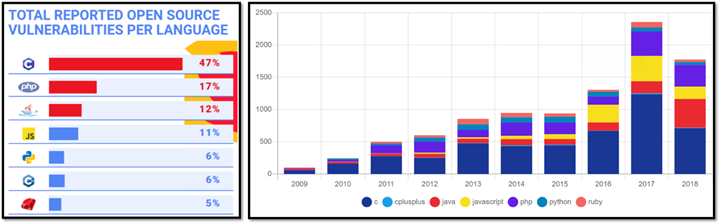
Second, for the subset that is about programming language insecurity, the problem child is C, not C++.

A serious problem is that vulnerability statistics almost always conflate C and C++; it’s very hard to find good public sources that distinguish them. The only reputable public study I know of that distinguished between C and C++ is Mend.io’s as reported in “What are the most secure programming languages?” (Mend.io, 2019). Although the data is from 2019, as you can see the results are consistent across years.

Can’t see the C++ bar? Pinch to zoom. 😉

Although C++’s memory safety has always been much closer to that of other modern popular languages than to that of C, we do have room for improvement and we’re doing even better in the newest C++ standard about to be released, C++26. It delivers two major security improvements, where you can just recompile your code as C++26 and it’s significantly more secure:

  • C++26 eliminates undefined behavior from uninitialized local variables. [4] How needed is this? Well, it directly addresses a Reddit r/cpp complaint posted just today while I was finishing this post: “The production bug that made me care about undefined behavior” (Reddit, December 30, 2025).
  • C++26 adds bounds safety to the C++ standard library in a “hardened” mode that bounds-checks the most widely used bounded operations. “Practical Security in Production” (ACM Queue, November 2025) reports that it has already been used at scale across Apple platforms (including WebKit) and nearly all Google services and Chrome (100s of millions of lines of code) with tiny space and time overhead (fraction of one percent each), and “is projected to prevent 1,000 to 2,000 new bugs annually” at Google alone.

Additionally, C++26 adds functional safety via contracts: preconditions, postconditions, and contract assertions in the language, that programmers can use to check that their programs behave as intended well beyond just memory safety.

Beyond C++26, in the next couple of years I expect to see proposals to:

  • harden more of the standard library
  • remove more undefined behavior by turning it into erroneous behavior, turning it into language-enforced contracts, or forbidding it via subsets that ban unsafe features by default unless we explicitly opt in (aka profiles)

I know of people who’ve been asking for C++ evolution to slow down a little to let compilers and users catch up, something like we did for C++03. But we like all this extra security, too. So, just spitballing here, but hypothetically:

What if we focused C++29, the next release cycle of C++, to only issue-list-level items (bug fixes and polish, not new features) and the above “hardening” list (add more library hardening, remove more language undefined behavior)?

I’m intrigued by this idea, not because security is C++’s #1 burning issue — it isn’t, C++ usage is continuing to grow by leaps and bounds — but because it could address both the “let’s pause to stabilize” and “let’s harden up even more” motivations. Focus is about saying no.

Conclusion

Programming is growing fast. C++ is growing very fast, with a healthy long-term future because it’s deeply aligned with the overarching 80-year trend that computing demand always outstrips supply. C++ is a living language that continually adapts to its environment to fulfill its core mission, tracking what developers need to make the most of hardware.

And it shows in the numbers.

Here’s to C++’s great 2025, and its rosy outlook in 2026! I hope you have an enjoyable rest of the holiday period, and see you again in 2026.

Acknowledgments

Thanks to Saeed Amrollahi Boyouki, Mark Hoemmen and Bjarne Stroustrup for motivating me to write this post and/or providing feedback.


Appendix: AI

Finally, let’s talk about the topic no article can avoid: AI.

C++ is foundational to current AI. If you’re running AI, you’re running CUDA (or TensorFlow or similar) — directly or indirectly — and if you’re running CUDA (or TensorFlow or similar), you’re probably running C++. CUDA is primarily available as a C++ extension. There’s always room for DSLs at the leading edge, but for general-purpose AI most high-performance deployment and inference is implemented in C++, even if people are writing higher-level code in other languages (e.g., Python).

But more broadly than just C++: What about AI generally? Will it take all our jobs? (Spoiler: No.)

AI is a wonderful and transformational tool that greatly reduces rote work, including problems that have already been solved, where the LLM is trained on the known solutions. But AI cannot understand, and therefore can’t solve, new problems — which is most of the current and long-term growth in our industry.

What does that imply? Two main things, in my opinion…

First, I think that people who think AI isn’t a major game-changer are fooling themselves.

To me, AI is on par with the wheel (back in the mists of time), the calculator (back in the 1970s), and the Internet (back in the 1990s). [5] Each of those has been a game-changing tool to accelerate (not replace) human work, and each led to more (not less) human production and productivity.

I strongly recommend checking out Adam Unikowsky’s “Automating Oral Argument” (Substack, July 7, 2025). Unikowsky took his own actual oral arguments before the United States Supreme Court and showed how well 2025-era Claude can do as a Supreme Court-level lawyer, and with what strengths and weaknesses. Search for “Here is the AI oral argument” and click on the audio player, which is a recording of an actual Supreme Court session and replaces only Unikowsky’s responses with his AI-generated voice saying the AI-generated text argument directly responding to each of the justices’ actual questions; the other voices are the real Supreme Court justices. (Spoiler: “Objectively, this is an outstanding oral argument.”)

Second, I think that people who think AI is going to put a large fraction of programmers out of work are fooling themselves.

We’ve just seen that, today, three years after ChatGPT took the world by storm, the number of human programmers is growing as fast as ever. Even the companies that are the biggest boosters of the “AI will replace programmers” meme are actually aggressively growing, not reducing, their human programmer workforces.

Consider what three more C-level executives are saying.

Sam Schillace, Microsoft Deputy CTO (Substack, December 19, 2025) is pretty AI-ebullient, but I do agree with this part he says well, and which resonates directly with Unikowsky’s experience above:

If your job is fundamentally “follow complex instructions and push buttons,” AI will come for it eventually.

But that’s not most programmers. Matt Garman, Amazon Web Services CEO (interview with Matthew Berman, X, August 2025) says bluntly:

People were telling me [that] with AI we can replace all of our junior people in our company. I was like that’s … one of the dumbest things I’ve ever heard. … I think AI has the potential to transform every single industry, every single company, and every single job. But it doesn’t mean they go away. It has transformed them, not replaced them.

Mike Cannon-Brookes, Atlassian CEO (Stratechery interview, December 2025) says it well:

I think [AI]’s a huge force multiplier personally for human creativity, problem solving … If software costs half as much to write, I can either do it with half as many people, but [due to] core competitive forces … I will [actually] need the same number of people, I would just need to do a better job of making higher quality technology. … People shouldn’t be afraid of AI taking their job … they should be afraid of someone who’s really good at AI [and therefore more efficient] taking their job.

So if we extend the question of “what are our top constraints on software?” to include not only hardware and power, the #3 long-term constraint is clear: We are chronically short of skilled human programmers. Humans are not being replaced en masse, not most of us; we are being made more productive, and we’re needed more than ever. As I wrote above: “Programming is a hot market, and programmers are in long-term high-growth demand.”


Endnotes

[1] It’s actually great news that Big Tech is spending heavily on power, because the gigawatt capacity we build today is a long-term asset that will keep working for 15 to 20+ years, whether the companies that initially build that capacity survive or get absorbed. That’s important because it means all the power generation being built out today to satisfy demand in the current “AI bubble” will continue to be around when the next major demand for compute after AI comes along. See Ben Thompson’s great writing, such as “The Benefits of Bubbles” (Stratechery, November 2025).

[2] The Hitchhiker’s Guide to the Galaxy contains two opposite ideas, both fun but improbable: (1) The problem of being “too compute-constrained”: Deep Thought, the size of a city, wouldn’t really be allowed to run for 7.5 million years; you’d build a million cities. (2) The problem of having “too much excess compute capacity”: By the time a Marvin with a “brain the size of a planet” was built, he wouldn’t really be bored; we’d already be trying to solve problems the size of the solar system.

[3] This is about “general-purpose” coding. Code at the leading specialized edges will always include use of custom DSLs.

[4] This means that compiling plain C code (that is in the C/C++ intersection) as C++26 also automatically makes it more correct and more secure. This isn’t new; compiling C code as C++ and having the C code be more correct has been true since the 1980s.

[5] If you’re my age, you remember when your teacher fretted that letting you use a calculator would harm your education. More of you remember similar angsting about letting students google the internet. Now we see the same fears with AI — as if we could stop it or any of those others even if we should. And we shouldn’t; each time, we re-learn the lesson that teaching students to use such tools should be part of their education because using tools makes us more productive.

[6] This is not the same as Wirth’s Law, that “software is getting slower more rapidly than hardware is becoming faster.” Wirth’s observation was that the overheads of operating systems and higher-level runtimes and other costly abstractions were becoming ever heavier over time, so that a program to solve the same problem was getting more and more inefficient and soaking up more hardware capacity than it used to; for example, printing “Hello world” really does take far more power and hardware when written in modern Java than it did in Commodore 64 BASIC. That doesn’t apply to C++ which is not getting slower over time; C++ continues to be at least as efficient as low-level C for most uses. No, the key point I’m making here is very different: that the problems the software is tackling are growing faster than hardware is becoming faster.

A new chapter, and thoughts on a pivotal year for C++

Starting today I’m excited to be working on a new team, with my C++ standards and community roles unchanged. I also wanted to write a few words about why I’m excited about continuing to invest my time heavily in C++’s standardization and evolution especially now, because I think 2024 has been a pivotal year for C++ — and so this has turned into a bit of an early “year-end C++ retrospective” post too.

It’s been a blast to be on the Microsoft Visual C++ compiler team for over 22 years! The time has flown by because the people and the challenges have always been world-class. An underappreciated benefit of being on a team that owns a foundational technology (like a major C++ compiler) is that you often don’t have to change teams to find interesting projects, because new interesting projects need compiler support and so tend to come to you. That’s been a real privilege, and why I stuck around way longer than any other job I’ve held. Now I am finally going to switch to a new job, but I’ll continue to cheer my colleagues on as a happy MSVC user on my own projects, consuming all the cool things they’re going to do next!

Today I’m thrilled to start at Citadel Securities, a firm that “combines deep trading acumen with leading-edge analytics and technology to deliver liquidity to some of the world’s most important markets, retail brokerages, and financial institutions.” I’ve known folks at CitSec for many years now (including some who participate in WG 21) and have long known it to be a great organization with some of the brightest minds in engineering and beyond. Now I’m looking forward to helping to drive CitSec’s internal C++ training initiatives, advise on technical strategy, share things I’ve learned along the way about sound design for both usability and pragmatic adoptability, and mentor a new set of talented folks there to not only take their own skilled next steps but also to themselves become mentors to others in turn. I think a continuous growth and learning culture like I’ve seen at CitSec consistently for over a dozen years is one of the most important qualities a company can have, because if you have that you can always grow all the other things you need, including as demands evolve over time. But maybe most of all I’m looking forward to learning a lot myself as I dive back into the world of finance — finance is where I started my junior career in the 80s and 90s, and I’m sure I’ll learn a ton in CitSec’s diverse set of 21st-century businesses that encounter interesting, leading-edge technical challenges every day that go well beyond the ones I encountered back in the 20th.

My other C++ community roles are unchanged — I’m continuing my current term as chair of the ISO C++ committee, I’m continuing as chair of the Standard C++ Foundation, and especially I’m continuing to work heavily on ISO C++ evolution (I have eight papers in the current mailing for this month’s Wrocław meeting!) including supporting those with cppfront prototype implementations. I meant it when I said in my CppCon talk that C++’s next decade will be dominated by reflection and safety improvements, and that C++26 really is shaping up to be the most impactful release since C++11 that started a new era of C++; it’s an exciting time for C++ and I plan to keep spending a lot of time contributing to C++26 and beyond.

Drilling down a little: Why is 2024 a pivotal year for C++? Because for the first time in 2024 the ISO committee has started adopting (or is on track to soon adopt) serious safety and reflection improvements into the draft C++ standard, and that’s a big turning point:

  • For safety: With uninitialized local variables no longer being undefined behavior (UB) in C++26 as of March 2024, C++ is taking a first serious step to really removing safety-related UB, and achieve the ‘holy grail’ of an easy adoption story: “Just recompile your existing code with a C++26 compiler, with zero manual code changes, and it’s safer with less UB.” This month, I’m following up on that proposing P3436R1, a strategy for how we could remove all safety-related UB by default from C++ — something that I’m pretty sure a lot of folks can’t imagine C++ could ever do while still remaining true to what makes C++ be C++, but that in fact C++ has already been doing for years in constexpr code! The idea I’m proposing is to remove the same cases of UB we already do in constexpr code also at execution time, in one of two ways for each case: when it’s efficient enough, eliminate that case universally the same as we just did for uninitialized locals; otherwise, leverage the great ideas in the Profiles proposals as a way to opt in/out of that case (see P3436 for details). If the committee likes the idea enough to encourage me to go do more work to flesh it out, over the winter I’ll invest the time to expand the paper into a complete catalog of safety-related UB with a per-case proposal to eliminate that UB at execution time. If we can really achieve a future C++ where you can “just recompile your existing code with safety Profiles enabled, and it’s safer with zero safety-related UB,” that would be a huge step forward. (Of course, some Profiles rules will require code changes to get the full safety benefits; see the details in section 2 of my supporting Profiles paper.)
  • For reflection: Starting with P2996R7 whose language part was design-approved for C++26 in June 2024, we can lay a foundation to then build on with follow-on papers like P3294R2 and P3437R1 to add generation and more features. As I demonstrated with examples in the above-linked CppCon talk, reflection (including generation) will be a game-changer that I believe will dominate the next decade of C++ as we build it out in the standard and learn to use it in the global C++ community. I’m working with P2996/P3294 prototypes and my own cppfront compiler to help gather usability experience, and I’m contributing my papers like P0707R5 and P3437R1 as companion/supporting papers to those core proposals to try to help them progress.

As Bjarne Stroustrup famously said, “C++11 [felt] like a new language,” starting a new “modern” C++ style featuring auto and lambdas and standard safe smart pointers and range-for and move semantics and constexpr compile-time code, that we completed and built on over the next decade with C++14/17/20/23. (And don’t forget that C++11’s move semantics already delivered the ideal adoption story of “just recompile your existing code with a C++11 compiler, with zero manual code changes, and it’s faster.”) Since 2011 until now, “modern C++” has pretty much meant “C++ since C++11” because C++11 made that much of a difference in how C++ worked and felt.

Now I think C++26 is setting the stage to do that again for a second time: Our next major era of what “modern C++” will mean will be characterized by having safety by default and first-class support for reflection-based generative compile-time libraries. Needless to say, this is a group effort that is accomplished only by an amazing set of C++ pros from dozens of countries, including the authors of the above papers but also many hundreds of other experts who help design and review features. To all of those experts: Again, thank you! I’ll keep trying to contribute what I can too, to help ship C++26 with its “version 1” of a set of these major new foundational tools and to continue to add to that foundation further in the coming years as we all learn to use the new features to make our code safer and simpler.

C++ is critically important to our society, and is right now actively flourishing. C++ is essential not only at Citadel Securities itself, but throughout capital markets and the financial industry… and even that is itself just one of the critical sectors of our civilization that heavily depend on C++ code and will for the foreseeable future. I’m thrilled that CitSec’s leadership shares my view of that, and my same goals for continuing to evolve ISO C++ to make it better, especially when it comes to increasing safety and usability to harden our society’s key infrastructure (including our markets) and to make C++ even easier to use and more expressive. I’m excited to see what the coming decade of C++ brings… 2024 really has shaped up to be a pivotal year for C++ evolution, and I can’t wait to see where the ride takes us next.