Trip report: Summer ISO C++ standards meeting (St Louis, MO, USA)

On Saturday, the ISO C++ committee completed its fourth meeting of C++26, held in St Louis, MO, USA.

Our host, Bill Seymour, arranged for high-quality facilities for our six-day meeting from Monday through Saturday. We had over 180 attendees, about two-thirds in-person and the others remote via Zoom, formally representing over 20 nations. At each meeting we regularly have new attendees who have never attended before, and this time there were nearly 20 new first-time attendees, mostly in-person. To all of them, once again welcome!

We also often have new nations joining, and this time we welcomed participants formally representing Kazakhstan and India for the first time. We now have 29 nations who are regular formal participants: Austria, Bulgaria, Canada, China, Czech Republic, Denmark, Finland, France, Germany, Iceland, India, Ireland, Israel, Italy, Japan, Kazakhstan, Republic of Korea, The Netherlands, Norway, Poland, Portugal, Romania, Russia, Slovakia, Spain, Sweden, Switzerland, United Kingdom, and United States.

Here is a Saturday group photo of the in-person attendees right after the meeting adjourned (some had already left to catch flights). Thanks to John Spicer for taking this photo. Our host Bill Seymour is seated in the front row with the yellow dot. Thank you very much again, Bill, for having us!

A photo of the C++ standards committee in St Louis, Missouri, on and in front of a staircase, with a yellow dot designating the meeting host Bill Seymour

The committee currently has 23 active subgroups, 16 of which met in parallel tracks throughout the week. Some groups ran all week, and others ran for a few days or a part of a day and/or evening, depending on their workloads. You can find a brief summary of ISO procedures here.

This time, the committee adopted the next set of features for C++26, and made significant progress on other features that are now expected to be complete in time for C+26.

Three major features made strong progress:

  • P2300 std::execution for concurrency and parallelism was formally adopted to merge into the C++26 working paper
  • P2996 Reflection was design-approved, and is now in specification wording review aiming for C++26
  • P2900 Contracts made considerable progress and has a chance of being in C++26

P2300 std::execution formally adopted for C++26

The major feature approved to merge into the C++26 draft standard was P2300 “std::execution” (aka “executors”, aka “Senders/Receivers”) by Michał Dominiak, Georgy Evtushenko, Lewis Baker, Lucian Radu Teodorescu, Lee Howes, Kirk Shoop, Michael Garland, Eric Niebler, and Bryce Adelstein Lelbach. It had already been design-approved for C++26 at prior meetings, but it’s a huge paper so the specification wording review by Library Wording subgroup (LWG) took extra time, and as questions arose the paper had to iterate with LEWG for specific design clarifications and tweaks.

P2300 aims to support both concurrency and parallelism. The definitions I use: Concurrency means doing independent work asynchronously (e.g., on different threads, or using coroutines) so that each can be responsive and progress at its own speed. Parallelism means using more hardware (cores, vector units, GPUs) to perform a single computation faster, which is the key to re-enabling the “free lunch” of being able to ship an application executable today that just naturally runs much faster on newer hardware with more compute throughput that becomes available in the future (most of which new throughput now ships in the form of more parallelism).

For concurrency, recall that in C++20 we already added coroutines, but in their initial state they were more of a “portable toolbox for writing coroutines” than a fully integrated feature (e.g., we can’t co_await a std::future with just what’s in the standard). Since then, we knew we’d want to add libraries on top to make coroutines easier to use, including std::future integration and a std::task library, which are still in progress. One of the big reasons to love std::execution is that it works well with coroutines, and is the biggest usability improvement yet to use the coroutine support we already have.

[Edited to add:] Eric Niebler provided three examples and descriptions I want to include here:

The above three example illustrate several techniques, described by Eric:

* how to cooperatively multitask on an embedded system that has only one thread and no allocator

* how to implement a multi-producer, multi-consumer tasking system

* how to use P2300 together with coroutines

* how to write a custom sender algorithm

* how to use P2300 components together with a third party library providing standard-conforming extensions

* how to spawn a variable amount of work and wait for it all to complete using the proposed async_scope from P3149

* how to use the proposed ABI-stable system context from P2079 to avoid oversubscribing the local host

Ville Voutilainen reports writing a concurrent chunked HTTPS download that integrates nicely with C++20 coroutines’ co_await and a Qt UI progress bar, using P2300’s reference implementation (plus a sender-aware task type which is expected to be standardized in the future, but third-party ones like the exec::task below work today), together with his own Qt adaptation code (about 180 lines, which will eventually ship as part of Qt). The code is short enough to show here:

exec::task<void> HttpDownloader::doFetchWithCoro()
{
    bytesDownloaded = 0;
    contentLength = 0;
    reportDownloadProgress();

    req = QNetworkRequest(QUrl(QLatin1String("https://ftp.funet.fi/pub/Linux/kernel/v5.x/linux-5.19.tar.gz")));
    QNetworkReply* reply = nam.head(req);
    co_await qObjectAsSender(reply, &QNetworkReply::finished);

    updateContentLength(reply, contentLength);
    contentLengthUpdated(contentLength);
    reply->deleteLater();

    while (bytesDownloaded != contentLength) {
        req = setupRequest(req, bytesDownloaded, chunkSize);
        QNetworkReply* get_reply = nam.get(req);
        co_await qObjectAsSender(get_reply, &QNetworkReply::finished);
        updateBytesDownloaded(get_reply, bytesDownloaded);
        reportDownloadProgress();
        get_reply->deleteLater();
    }
}

For parallelism, see the December 2022 HPC Wire article “New C++ Sender Library Enables Portable Asynchrony” by Eric Niebler, Georgy Evtushenko, and Jeff Larkin, which describes the cross-platform parallel performance of std::execution. “Cross-platform” means across different parallel programming models, using both distributed-memory and shared-memory, and across different computer architectures. (HT: Thanks Mark Hoemmen and others for reminding us about this article.) The NVIDIA coauthors of P2300 report that parallel performance is on par with CUDA code.

Mikael Simberg reports that another parallelism example from the HPC community to show off P2300 is DLA_Future (GitHub), which implements a distributed CPU/GPU eigensolver. It optionally uses std::execution’s reference implementation, and plans to use std::execution unconditionally once it ships in C++26 standard libraries. In that repo, one advanced example is this distributed Cholesky decomposition code (GitHub) (note: it still uses start_detached which was recently removed, and plans to use async_scope once available).

See also P2300 itself for more examples of both techniques.

Reflection design-approved for C++26

The Language Evolution working group (EWG) approved the design of the reflection proposal P2996R2 “Reflection for C++26” by Wyatt Childers, Peter Dimov, Dan Katz, Barry Revzin, Andrew Sutton, Faisal Vali, and Daveed Vandevoorde and it has now begun language specification wording review, currently on track for C++26. (Updated to add: The Library Evolution working group (LEWG) is still reviewing the library part of the design.)

This is huge, because reflection (including generation) will be by far the most impactful feature C++ has ever added since C++98, and it will dominate the next decade and more of C++ usage. It’s a watershed event; a sea change in C++. I say this for three reasons:

First, reflection and generation are the biggest power tool C++ has ever seen to improve library building: It will enable writing C++ libraries that were infeasible or impossible before, and its impact on writing libraries will likely be bigger than all the other library-writing improvements combined that the language has added from C++11 until now (e.g., lambdas, auto, if constexpr, requires, type traits).

Second, reflection and generation will simplify C++ language evolution: It will reduce the need to add as many future one-off or “narrow” language extensions to C++, because we will be able to write many of them as compile-time libraries in ordinary C++ consteval code using reflection and generation. That by itself will help slow down the future growth of complexity of the language. And it has already been happening; in recent years, SG7 (the subgroup responsible for compile-time programming) has redirected some narrow language proposals to explore how to write them using reflection instead.

Third, reflection and generation is the foundation for another potential way to dramatically simplify how we write C++ code, namely my metaclasses proposal which is “just” a small (but powerful) thin extension layered on top of reflection and generation… for details, see the Coda at the end of this post.

Still aiming for C++26 timeframe: Contracts

We spent four full days of subgroup time on the contracts proposal P2900 “Contracts for C++” by Joshua Berne, Timur Doumler, Andrzej Krzemieński, Gašper Ažman, Tom Honermann, Lisa Lippincott, Jens Maurer, Jason Merrill, and Ville Voutilainen: One and a half days in language design (EWG) on Monday afternoon and Tuesday, a parallel session in the safety group (SG23) on Tuesday, two days in the Contracts subgroup (SG21) on Wednesday and Thursday, then a quarter-day back in EWG on Friday after lunch for another session on virtual function contracts. In all, we worked through many design issues and made good progress toward consensus on several of them. We still have further work to do in order to build consensus on other open design questions, but the consensus is gradually improving and the list of open questions is gradually getting shorter… we’ll see! I’m cautiously optimistic that we have a 50-50 chance of getting contracts in C++26, which means that we will have to iron out the remaining differences within the next 11 months to meet C++26’s feature-freeze no-later-than hard deadline next June.

Adopted for C++26: Core language changes/features

Here are some additional highlights… note that these links are to the most recent public version of each paper, and some were tweaked at the meeting before being approved; the links track and will automatically find the updated version as soon as it’s uploaded to the public site.

The core language adopted 6 papers, including the following…

P0963R3 “Structured binding declaration as a condition by Zhihao Yuan. This allows structured binding declarations with initializers appearing in place of the conditions in if, while, for, and switch statements, so you can decompose more conveniently and take a branch only if the returned non-decomposed object evaluates to true. Thanks, Zhihao!

Adopted for C++26: Standard library changes/features

In addition to P2300 std::execution, already covered above, the standard library adopted 11 other papers, including the following…

The lowest-numbered paper approved, which means it has been “baking” for the longest time, is something some of us have been awaiting for a while: P0843R11 “inplace_vector” by Gonzalo Brito Gadeschi, Timur Doumler, Nevin Liber, and David Sankel. The paper’s overview says it all – thank you, authors!

This paper proposes inplace_vector, a dynamically-resizable array with capacity fixed at compile time and contiguous inplace storage, that is, the array elements are stored within the vector object itself. Its API closely resembles std::vector<T, A>, making it easy to teach and learn, and the inplace storage guarantee makes it useful in environments in which dynamic memory allocations are undesired.

This container is widely-used in the standard practice of C++, with prior art in, e.g., boost::static_vector<T, Capacity> or the EASTL, and therefore we believe it will be very useful to expose it as part of the C++ standard library, which will enable it to be used as a vocabulary type.

P3235R3 “std::print more types faster with less memory” by Victor Zverovich gets my vote for the “best salesmanship in a paper title” award! If you like std::print, this is more, faster, sleeker (who wouldn’t vote for that?!) by expanding the applicability of the optimizations previously delivered in P3107 which initially were applied to only built-in type and string types, and now work for more standard library types. Thanks for all the formatted I/O, Victor!

P2968R2 “Make std::ignore a first-class object” by Peter Sommerlad formally blesses the use of std::ignore on the left-hand side of an assignment. Initially std::ignore was only meant to be used with std::tie, but many folks noticed (and recommended and relied on) that on every implementation you can also use it to ignore the result of an expression by just writing std::ignore = expression;. Even the C++ Core Guidelines’ ES.48 “Avoid casts” recommends “Use std::ignore = to ignore [[nodiscard]] values.” And as of C++26, that advice will be upgraded from “already works in practice” to “officially legal.” Thank you, Peter!

Other progress

All subgroups continued progress, more of which will no doubt be covered in other trip reports. Here are a few more highlights…

SG1 (Concurrency): Discussed 24 papers, and progressed the “zap” series of papers. To the happiness of many people (including me), concurrent_queue is finally nearing completion! A concurrent queue is one of the foundational concurrency primitives sorely missing from the standard library, and it’s great to see it coming closer to landing.

SG6 (Numerics): More progress on several proposals including a quantities-and-units library.

SG7 (Compile-Time Programming): Forwarded six more papers to the main subgroups, most of them reflection-related.

SG9 (Ranges): Continued working on ranges extensions for C++26, with good progress.

SG15 (Tooling): Starting to approve sending Ecosystem papers to the main subgroups, such as metadata formats and support for build systems.

SG23 (Safety): Reviewed several different proposals for safety improvement. The group voted favorably to support P3297 “C++26 needs contracts checking” by Ryan McDougall, Jean-Francois Campeau, Christian Eltzschig, Mathias Kraus, and Pez Zarifian.

Edited to add, for completeness the other presentations were: First, Bjarne Stroustrup presented his Profiles followup paper P3274R0 “A framework for Profiles development.” Then P3297, which I called out because it was a communication to the other groups about the contracts topic that dominated the week (above). Then Thomas Köppe presented P3232R0 “User-defined erroneous behavior.” Then Sean Baxter gave an informational demo presentation (no paper yet) of his work exploring adding borrow checking to C++ in his Circle compiler.

Thank you to all the experts who worked all week in all the subgroups to achieve so much this week!

What’s next

Our next meeting will be in Wrocław, Poland in November hosted by Nokia.

Thank you again to the over 180 experts who attended on-site and on-line at this week’s meeting, and the many more who participate in standardization through their national bodies!

But we’re not slowing down… we’ll continue to have subgroup Zoom meetings, and then in just a few months from now we’ll be meeting again in person + Zoom to continue adding features to C++26. Thank you again to everyone reading this for your interest and support for C++ and its standardization.


Coda: From reflection to metaclass functions and P0707

The reason I picked reflection and generation to be the first “major” feature from Cpp2 that I brought to the committee in 2017, together with a major application use case, in the form of my “metaclasses” paper P0707, is because it was the biggest source of simplification in Cpp2, but it was also the riskiest part of Cpp2 — it was the most “different from what we do in C++” so I was not sure the committee and community would embrace the idea, and it was the most “risky to implement” because nothing like using compile-time functions to help generate class code had ever been tried for C++.

Most of my initial version of P0707 was a plea of ‘here’s why the committee should please give us reflection and generation.’ When I first presented it to the committee at the Toronto 2017 meeting immediately following the reflection presentation, I began my presentation with something like: “Hi, I’m Herb, and I’m their customer,” pointing to the reflection presenters, “because this is about what we could build on top of reflection.” That is still true; the main reason I haven’t updated P0707 since 2019 is because I haven’t needed to… the reflection work needs to exist first, and it has been continually progressing.

Historical note: Andrew Sutton’s Lock3 reflection implementation was created for, and funded by, my project that is now called Cpp2 , but which back then was called Cppx and used the Lock3 Clang-based reflection implementation; that’s why the Lock3 implementation has been available at cppx.godbolt.org (thanks again, Matt! you’re a rock star). C++20 consteval also came directly from this work, because we realized we would need functions that must run only at compile time to deal with static reflections and generation.

Now that reflection is landing in the standard, I plan to update my P0707 paper to finish proposing metaclasses for ISO C++. P0707 metaclasses (aka type metafunctions) are actually just a thin layer on top of P2996. To see why, consider this simple code:

// Example 1: Possible with P2996
consteval { generate_a_widget_class(); }
    // let’s say that executing this consteval function generates something like:
    //     class widget { void f() { std::cout << "hello"; } };

With P2996, Example 1 can write such a consteval function named generate_a_widget_class that can be invoked at compile time and generates (aka injects) that widget type as if it had been hand-written by the programmer at the same point in source code.

Next, let’s slightly generalize the example by giving it an existing type’s reflection as some input to guide what gets generated:

// Example 2: Possible with P2996 (^ is the reflection operator)
class gadget { /*...*/ };   // written by the programmer by hand
consteval{ M( ^gadget ); }  // generates widget from the reflection of gadget
    // now this generates something like:
    //     class widget { /* some body based on the reflection of what’s in gadget */ };

Still with just P2996, Example 2 can write such a consteval function named M that will generate the widget class as-if was hand-written by the programmer at this point in source code, but with the ability to refer to ^gadget… for example, perhaps widget will echo some or all the same member functions and member variables as gadget, and add additional things.

And, just like that, we’ve suddenly arrived at P0707 metaclasses because all the Lock3 implementation of Cpp2 (then Cppx) metaclasses did is to “package up Example 2,” by providing a syntax to apply the consteval function M to the type being defined:

// Example 3: class(M) means to apply M to the class being defined
// (not yet legal C++)
class(M) widget{ /*...*/ };
    // this proposed language feature would emit something like the following:
    //    namespace __prototype { class widget { /*...*/ }; }
    //    consteval{ M( ^__prototype::widget ); }  // generates widget from __prototype::widget

Historical note: My initial proposal P0707R0 proposed the syntax “M class” (e.g., interface class, value class), and the SG7 subgroup gave feedback that it preferred “class(M)” (e.g., class(interface), class(value)) to make parsing easier. I’m fine with that; the syntax is less important, what matters is getting the expressive power.

So my plan for my next revision of P0707 is to propose class(M) syntax for Standard C++ as a further extension on top of P2996 reflection, to be implemented just like Example 3 above (and as Lock3 already did since 2017, so we know it works).

Why is that so important to simplifying C++?

First, as I show in P0707, it means that we can make classes much easier and safer to write, without wrong defaults and bug-prone boilerplate code. We can stop teaching the “Rules of 0/1/3/5,” and stop teaching =delete to get rid of generated special functions we didn’t want, because when using metafunctions to write classes we’re always using a convenient word to opt into a group of defaults for the type we’re writing and can get exactly the ones we want.

Second, we can write a Java/C#-style “class(interface)” without adding a special “interface” feature to the language as a separate type category, and with just as good efficiency and usability as languages that bake interface into the language. We can add “class(value)” to invoke a C++ function that runs at compile time to get the defaults right for value types without a new language feature hardwired into the compiler. We can add class(safe_union) and class(flag_enum) and much more.

Third, as I expressed in P0707, I hope reflection+generations+metafunctions can replace Qt MOC, COM IDL, C++/CLI extensions, C++/CX IDL, all of which exist primarily because we couldn’t express things in Standard C++ that we will now be able to express with this feature. I’m responsible for some of those nonstandard technologies; I led the design of C++/CLI and C++/CX, and one of my goals for reflection+generation+metafunctions is that I hope I will never need to design such language extensions again, by being able to express them well in normal (future) Standard C++. And I’m not alone; my understanding is that many of the vendors who own technologies like the above are already eagerly planning to responsibly transition such currently-add-on technologies to a standard reflection-and-generation based implementation, once reflection and generation are widely available in C++ compilers.

If you’re interested in more example of how metafunctions can work, I strongly recommend re-watching parts of two talks:

  • The middle section of my CppCon 2023 talk, starting around 18:50 up to 44:00, which shows many examples that work today using my cppfront compiler to translate them to regular C++, including detailed walkthroughs of the “enum” and “union” metaclass functions (in Cpp2 syntax, but they will work just as well as a minor extension of today’s C++ syntax as described above).
  • My original CppCon 2017 talk starting a few minutes in (an earlier version of this talk premiered initially at ACCU 2017), which demonstrates the approach and shows the first few examples working on the early Lock3 reflection implementation. The syntax has changed slightly, but the entire talk is still super current in 2024 as the reflection and generation it relies upon is now on its way to (finally!) landing in the standard.

I’m looking forward to finally resume updating P0707 to propose adding the rest of the expressive power it describes, as an extension to today’s C++ standard syntax, built on top of Standard C++26 (we hope!) reflection and generation. I hope to bring an updated proposal to our next meeting in November. My first step will be to try writing P0707 metafunctions in P2996 syntax to validate everything is there and works as I expect. So far, the only additional reflection support I know of that I’ll have to propose adding onto today’s P2996 is is_default_accessiblity() (alongside is_public() et al.) to query whether a member has the “default” accessibility of the class, i.e., is written before any public: or protected: or private: access specifier; that’s needed by metafunctions like “interface” that want to apply defaults, such as to make functions public and pure virtual by default without the user having to write public: or virtual or =0.

Safety is very important and we’ll be working hard on that too. But I would be remiss not to emphasize that the arrival of reflection (including generation) is a sea change that will drive of our next decade and more of C++… it’s really that big a deal, a rising tide that will lift all other boats including safety and simplicity as well. Starting soon, for many years we won’t be able to go to a C++ conference whose program doesn’t heavily feature reflection… and I’m not saying that just because I know several reflection talks have been accepted for CppCon 2024 two months from now; this really will be talked about and heavily used everywhere across our industry because there’s so much goodness to learn and use in this powerful feature.

Podcast: Interview with Software Engineering Daily

Also in April, I was interviewed by Jordi Mon Companys for Software Engineering Daily, and that interview was just published on the SE Daily podcast.

Here is a copy of the page’s additional details, including a transcript link at bottom.


The U.S. government recently released a report calling on the technical community to proactively reduce the attack surface area of software infrastructure. The report emphasized memory safety vulnerabilities, which affect how memory can be accessed, written, allocated, or deallocated.

The report cites this class of vulnerability as a common theme in the some of the most infamous cyber events, such as the Morris worm of 1988, the Heartbleed vulnerability in 2014, and the Blastpass exploit of 2023.

Herb Sutter works at Microsoft and chairs the ISO C++ standards committee. He joins the show to talk about C++ safety.

Jordi Mon Companys is a product manager and marketer that specializes in software delivery, developer experience, cloud native and open source. He has developed his career at companies like GitLab, Weaveworks, Harness and other platform and devtool providers. His interests range from software supply chain security to open source innovation. You can reach out to him on Twitter at @jordimonpmm.

Please click here to see the transcript of this episode.

April talk video posted: “Safety, Security, Safety[sic] and C/C++[sic]”

Many thanks to ACCU for inviting me back again this April. It was my first time back to ACCU (and only my second trip to Europe) since the pandemic began, and it was a delight to see many ACCUers in person again for the first time in a few years.

I gave this talk, which is now up on YouTube here:

It’s an evolved version of my March essay “C++ safety, in context.” I don’t like just repeating material, so the essay and the talk each covers things that the other doesn’t. In the talk, my aim was to expand on the key points of the essay with additional discussion and data points, including new examples that came up in the weeks between the essay and the talk, and relating it to ongoing ISO C++ evolution for safety already in progress.

The last section of the talk is a Cppfront update, including some interesting new results regarding compile- and run-time performance using metafunctions. One correction to the talk: I looked back at my code and I had indeed been making the mistake of creating a new std::regex object for each use, so that accounted for some of the former poor performance. But I retested and found that mistake only accounted for part of the performance difference, so the result is still valid: Removing std::regex from Cppfront was still a big win even when std::regex was being used correctly.

I hope you find the talk interesting and useful. Thanks very much to everyone who has contributed to C++ safety improvement explorations, and everyone who has helped with Cppfront over the past year and a half since I first announced the project! I appreciate all your input and support for ISO C++’s ongoing evolution.

Pre-ACCU interview video is live

On Friday, I sat down with Kevin Carpenter to do a short (12-min) interview about my ACCU talk coming up on April 17, and other topics.

Apologies in advance for my voice quality: I’ve been sick with some bug since just after the Tokyo ISO meeting, and right after this interview I lost my voice for several days… we recorded this just in time!

Kevin’s questions were about these topics in order (and my short answers):

  • Chatting about my ACCU talk topics (safety, and cppfront update)
  • Is it actually pretty easy to hop on a stage and talk about C++ for an hour (nope; or at least for me, not well)
  • In ISO standardization, how to juggle adding features vs. documenting what’s done (thanks to the Reddit trip report coauthors!)
  • ISO C++ meetings regularly have lots of guests, including regularly high school classes (yup, that’s a thing now)
  • Safety and C++ and cppfront topics
  • Kevin’s outro: “Get your ticket for ACCU now!”

Effective Concurrency course & upcoming talks

With the winter ISO meeting behind us, it’s onward into spring conference season!

ACCU Conference 2024. On April 17, I’ll be giving a talk on C++’s current and future evolution, where I plan to talk about safety based on my recent essay “C++ safety, in context,” and progress updates on cppfront. I’m also looking forward to these three keynoters:

  • Laura Savino, who you may recall gave an outstanding keynote at CppCon 2023 just a few months ago. Thanks again for that great talk, Laura!
  • Björn Fahller, who not only develops useful libraries but is great at naming them (Trompeloeil, I’m looking at you! [sic]).
  • Inbal Levi, who chairs one of the two largest subgroups in the ISO C++ committee (Library Evolution Working Group, responsible for the design of the C++ standard library) and is involved with organizing and running many other C++ conferences.

Effective Concurrency online course. On April 22-25, I’ll be giving a live online public course for four half-days, on the topic of high-performance low-latency coding in C++ (see link for the course syllabus). The times of 14.00 to 18.00 CEST daily are intended to be friendly to the home time zones of attendees anywhere in EMEA and also to early risers in the Americas. If you live in a part of the world where these times can’t work for you, and you’d like another offering of the course that is friendlier to your home time zone, please email Alfasoft to let them know! If those times work for you and you’re interested in high performance and low latency coding, and how to achieve them on modern hardware architectures with C++17, 20, and 23, you can register now.

Beyond April, later this year I’ll be giving talks in person at these events:

Details for the November conferences will be available on their websites soon.

I look forward to chatting with many of you in person or online this year!

Trip report: Winter ISO C++ standards meeting (Tokyo, Japan)

Moments ago, the ISO C++ committee completed its third meeting of C++26, held in Tokyo, Japan. Our hosts, Woven by Toyota, arranged for high-quality facilities for our six-day meeting from Monday through Saturday. We had over 220 attendees, about two-thirds in-person and the others remote via Zoom, formally representing 21 nations. That makes it roughly tied numerically for our largest meeting ever, roughly the same attendance as Prague 2020 that shipped C++20 just a few weeks before the pandemic lockdowns. — However, note that it’s not an apples-to-apples comparison, because the pre-pandemic meetings were all in-person, and since the pandemic they have been hybrid. But it is indicative of the ongoing strong participation in C++ standardization.

At each meeting we regularly have new attendees who have never attended before, and this time we welcomed over 30 new first-time attendees, mostly in-person, who were counted above. (These numbers are for technical participants, and they don’t include that we also had observers, including a class of local high school students visiting for part of a day, similarly to how a different local high school class did at our previous meeting in Kona in November. We are regularly getting high-school delegations as observers these days, and to them once again welcome!)

The committee currently has 23 active subgroups, 16 of which met in parallel tracks throughout the week. Some groups ran all week, and others ran for a few days or a part of a day and/or evening, depending on their workloads. You can find a brief summary of ISO procedures here.

This week’s meeting: Meeting #3 of C++26

At the previous two meetings in June and November, the committee adopted the first 63 proposed changes for C++26, including many that had been ready for a couple of meetings while we were finishing C++23 and were just waiting for the C++26 train to open to be adopted. For those highlights, see the June trip report and November trip report.

This time, the committee adopted the next set of features for C++26, and made significant progress on other features that are now expected to be complete in time for C+26.

Here are some of the highlights… note that these links are to the most recent public version of each paper, and some were tweaked at the meeting before being approved; the links track and will automatically find the updated version as soon as it’s uploaded to the public site.

Adopted for C++26: Core language changes/features

The core language adopted 10 papers, including the following…

P2573R2 “=delete(“should have a reason”)” by Yihe Li does the same for =delete as we did for static_assert: It allows writing a string as the reason, which makes it easier for library developers to give high-quality compile-time error messages to users as part of the compiler’s own error message output. Thanks, Yihe!

Here is an example from the paper that will now be legal and generate an error message similar to the one shown here:

class NonCopyable
{
public:
    // ...
    NonCopyable() = default;

    // copy members
    NonCopyable(const NonCopyable&)
        = delete("Since this class manages unique resources, \
copy is not supported; use move instead.");
    NonCopyable& operator=(const NonCopyable&)
        = delete("Since this class manages unique resources, \
copy is not supported; use move instead.");
    // provide move members instead
};

<source>:16:17: error: call to deleted
constructor of 'NonCopyable': Since this class manages unique resources, copy is not supported; use move instead.
    NonCopyable nc2 = nc;
                ^     ~~

P2795R5 “Erroneous behavior for uninitialized reads” by Thomas Köppe is a major change to C++ that will help us to further improve safety by providing a tool to reduce undefined behavior, especially that it removes undefined behavior for some cases of uninitialized objects.

I can’t do better than quote from the paper:

Summary: We propose to address the safety problems of reading a default-initialized automatic variable (an “uninitialized read”) by adding a novel kind of behaviour for C++. This new behaviour, called erroneous behaviour, allows us to formally speak about “buggy” (or “incorrect”) code, that is, code that does not mean what it should mean (in a sense we will discuss). This behaviour is both “wrong” in the sense of indicating a programming bug, and also well-defined in the sense of not posing a safety risk.

With increased community interest in safety, and a growing track record of exploited vulnerabilities stemming from errors such as this one, there have been calls to fix C++. The recent P2723R1 proposes to make this fix by changing the undefined behaviour into well-defined behaviour, and specifically to well-define the initialization to be zero. We will argue below that such an expansion of well-defined behaviour would be a great detriment to the understandability of C++ code. In fact, if we want to both preserve the expressiveness of C++ and also fix the safety problems, we need a novel kind of behaviour.

Reading an uninitialized value is never intended and a definitive sign that the code is not written correctly and needs to be fixed. At the same time, we do give this code well-defined behaviour, and if the situation has not been diagnosed, we want the program to be stable and predictable. This is what we call erroneous behaviour.

In other words, it is still an “wrong” to read an uninitialized value, but if you do read it and the implementation does not otherwise stop you, you get some specific value. In general, implementations must exhibit the defined behaviour, at least up until a diagnostic is issued (if ever). There is no risk of running into the consequences associated with undefined behaviour (e.g. executing instructions not reflected in the source code, time-travel optimisations) when executing erroneous behaviour.

Adding the notion of “erroneous behavior” is a major change to C++’s specification, that can help not only with uninitialized reads but also can be applied to reduce other undefined behavior in the future. Thanks, Thomas!

Adopted for C++26: Standard library changes/features

The standard library adopted 18 papers, including the following…

In the “Moar Ranges!” department, P1068R11 “Vector API for random number generation” by Ilya Burylov, Pavel Dyakov, Ruslan Arutyunyan, Andrey Nikolaev, and Alina Elizarova addresses the situation that, when you want one random number, you likely want more of them, and random number generators usually already generate them efficiently in batches. Thanks to their paper, this will now work:

std::array<std::uint_fast32_t, arrayLength> intArray;
std::mt19937 g(777);

std::ranges::generate_random(intArray, g);

// The above line will be equivalent to this:
for(auto& e : intArray)
    e = g();

In the “if you still didn’t get enough ‘Moar Ranges!’” department, P2542 “views::concat” by Hui Xie and S. Levent Yilmaz provides an easy way to efficiently concatenate an arbitrary number of ranges, via a view factory. Thanks, Hui and Levent! Here is an example from the paper:

std::vector<int> v1{1,2,3}, v2{4,5}, v3{};
std::array  a{6,7,8};
auto s = std::views::single(9);

std::print("{}\n", std::views::concat(v1, v2, v3, a, s)); 
// output:  [1, 2, 3, 4, 5, 6, 7, 8, 9]

Speaking of concatenation, have you ever wished you could write “my_string_view + my_string” and been surprised it doesn’t work? I sure have. No longer: P2591R4 “Concatenation of strings and string views” by Giuseppe D’Angelo adds operator+ overloads for those types. Thanks, Giuseppe, for finally getting us this feature!

P2845 “Formatting of std::filesystem::path” by Victor Zverovich (aka the King of Format) provides a high-quality std::format formatter for filesystem paths that addresses concerns about quoting and localization.

A group of papers by Alisdair Meredith removed some (mostly already-deprecated) features from the standard library. Thanks for the cleanup, Alisdair!

P3142R0 “Printing Blank Lines with println” by Alan Talbot is small but a nice quality-of-life improvement: We can now write just println() as an equivalent of println(“”). But that’s not all: See the yummy postscript in the paper. (See, Alan, we do read the whole paper. Thanks!)

Those are some of the “bigger” or “likely of wide interest” papers as just a few highlights… this week there were 28 papers adopted in all, including other great work on extensions and fixes for the C++26 language and standard library.

Aiming for C++26 timeframe: Contracts

The contracts proposal P2900 “Contracts for C++” by Joshua Berne, Timur Doumler, Andrzej Krzemieński, Gašper Ažman, Tom Honermann, Lisa Lippincott, Jens Maurer, Jason Merrill, and Ville Voutilainen progressed out of the contracts study group, SG21, and was seen for the first time in the Language (EWG) and Library (LEWG) Evolution Working Groups proper. Sessions started in LEWG right on the first day, Monday afternoon, and EWG spent the entire day Wednesday on contracts, with many of the members of the safety study group, SG23, attending the session. There was lively discussion about whether contracts should be allowed to have, or be affected by, undefined behavior; whether contracts should be used in the standard library; whether contracts should be shipped first as a Technical Specification (TS, feature branch) in the same timeframe as C++26 to gain more experience with existing libraries; and other aspects… all of these questions will be discussed again in the coming months, this was just the initial LEWG and EWG full-group design review that generated feedback to be looked at. The subgroups considered the EWG and LEWG groups’ feedback later in the week in two more sessions on Thursday and Friday, including in a joint session of SG21 and SG23.

Both SG21 and SG23 will have telecons about further improving the contracts proposal between now and our next hybrid meeting in June.

On track for targeting C++26: Reflection

The reflection proposal P2996R2 “Reflection for C++26” by Wyatt Childers, Peter Dimov, Barry Revzin, Andrew Sutton, Faisal Vali, and Daveed Vandevoorde progressed out of the reflection / compile-time programming study group, SG7, and was seen by the main evolution groups EWG and LEWG for the first time on Tuesday, which started with a joint EWG+LEWG session on Tuesday, and EWG spent the bulk of Tuesday on its initial large-group review aiming for C++26. Then SG7 continued on reflection and other topics, including a presentation by Andrei Alexandrescu about making sure reflection adds a few more small things to fully support flexible generative programming.

Other progress

All subgroups continued progress. A lot happened that other trips will no doubt cover, but I’ll call out two things.

One proposal a lot of people are watching is P2300 “std::execution” (aka “executors”) by Michał Dominiak, Georgy Evtushenko, Lewis Baker, Lucian Radu Teodorescu, Lee Howes, Kirk Shoop, Michael Garland, Eric Niebler, and Bryce Adelstein Lelbach, which was already design-approved for C++26. It’s a huge paper (45,000 words, of which 20,000 words is the standardese specification! that’s literally a book… my first Exceptional C++ book was 62,000 words), so it has been taking time for the Library Wording subgroup (LWG) to do its detailed review of the specification wording, and at this meeting LWG spent a quarter of the meeting completing a first pass through the entire paper! They will continue to work in teleconferences on a second pass and are now mildly optimistic of completing P2300 wording review at our next meeting in June.

And one more fun highlight: We all probably suspected that pattern matching is a “ground-shaking” proposed addition to future C++, but in Tokyo during the pattern matching session there was a literal earthquake that briefly interrupted the session!

Thank you to all the experts who worked all week in all the subgroups to achieve so much this week!

What’s next

Our next meeting will be in St. Louis, MO, USA in June hosted by Bill Seymour.

Wrapping up

Thank you again to the over 210 experts who attended on-site and on-line at this week’s meeting, and the many more who participate in standardization through their national bodies!

But we’re not slowing down… we’ll continue to have subgroup Zoom meetings, and then in just three months from now we’ll be meeting again in person + Zoom to continue adding features to C++26. Thank you again to everyone reading this for your interest and support for C++ and its standardization.

C++ safety, in context

Scope. To talk about C++’s current safety problems and solutions well, I need to include the context of the broad landscape of security and safety threats facing all software. I chair the ISO C++ standards committee and I work for Microsoft, but these are my personal opinions and I hope they will invite more dialog across programming language and security communities.

Acknowledgments. Many thanks to people from the C, C++, C#, Python, Rust, MITRE, and other language and security communities whose feedback on drafts of this material has been invaluable, including: Jean-François Bastien, Joe Bialek, Andrew Lilley Brinker, Jonathan Caves, Gabriel Dos Reis, Daniel Frampton, Tanveer Gani, Daniel Griffing, Russell Hadley, Mark Hall, Tom Honermann, Michael Howard, Marian Luparu, Ulzii Luvsanbat, Rico Mariani, Chris McKinsey, Bogdan Mihalcea, Roger Orr, Robert Seacord, Bjarne Stroustrup, Mads Torgersen, Guido van Rossum, Roy Williams, Michael Wong.

Terminology (see ISO/IEC 23643:2020).Software security” (or “cybersecurity” or similar) means making software able to protect its assets from a malicious attacker. “Software safety” (or “life safety” or similar) means making software free from unacceptable risk of causing unintended harm to humans, property, or the environment. “Programming language safety” means a language’s (including its standard libraries’) static and dynamic guarantees, including but not limited to type and memory safety, which helps us make our software both more secure and more safe. When I say “safety” unqualified here, I mean programming language safety, which benefits both software security and software safety.

We must make our software infrastructure more secure against the rise in cyberattacks (such as on power grids, hospitals, and banks), and safer against accidental failures with the increased use of software in life-critical systems (such as autonomous vehicles and autonomous weapons).

The past two years in particular have seen extra attention on programming language safety as a way to help build more-secure and -safe software; on the real benefits of memory-safe languages (MSLs); and that C and C++ language safety needs to improve — I agree.

But there have been misconceptions, too, including focusing too narrowly on programming language safety as our industry’s primary security and safety problem — it isn’t. Many of the most damaging recent security breaches happened to code written in MSLs (e.g., Log4j) or had nothing to do with programming languages (e.g., Kubernetes Secrets stored on public GitHub repos).

In that context, I’ll focus on C++ and try to:

  • highlight what needs attention (what C++’s problem “is”), and how we can get there by building on solutions already underway;
  • address some common misconceptions (what C++’s problem “isn’t”), including practical considerations of MSLs; and
  • leave a call to action for programmers using all  languages.

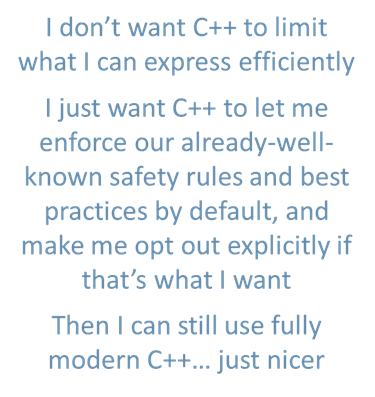
tl;dr: I don’t want C++ to limit what I can express efficiently. I just want C++ to let me enforce our already-well-known safety rules and best practices by default, and make me opt out explicitly if that’s what I want. Then I can still use fully modern C++… just nicer.

Let’s dig in.

The immediate problem “is” that it’s Too Easy By Default™ to write security and safety vulnerabilities in C++ that would have been caught by stricter enforcement of known rules for type, bounds, initialization, and lifetime language safety

In C++, we need to start with improving these four categories. These are the main four sources of improvement provided by all the MSLs that NIST/NSA/CISA/etc. recommend using instead of C++ (example), so by definition addressing these four would address the immediate NIST/NSA/CISA/etc. issues with C++. (More on this under “The problem ‘isn’t’… (1)” below.)

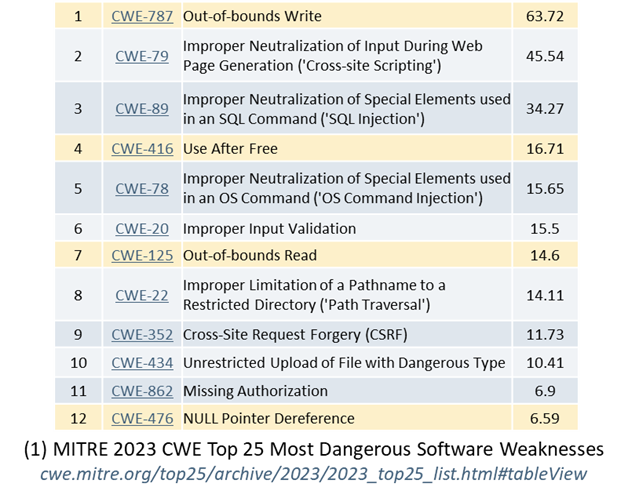
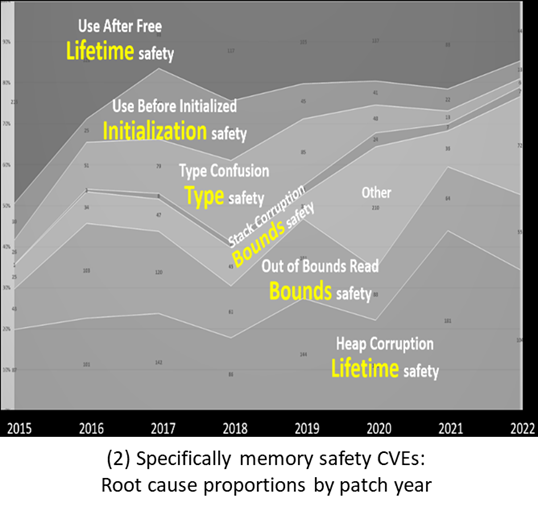
And in all recent years including 2023 (see figures 1’s four highlighted rows, and figure 2), these four constitute the bulk of those oft-quoted 70% of CVEs (Common [Security] Vulnerabilities and Exposures) related to language memory unsafety. (However, that “70% of language memory unsafety CVEs” is misleading; for example, in figure 1, most of MITRE’s 2023 “most dangerous weaknesses” did not involve language safety and so are outside that denominator. More on this under “The problem ‘isn’t’… (3)” below.)

The C++ guidance literature already broadly agrees on safety rules in those categories. It’s true that there is some conflicting guidance literature, particularly in environments that ban exceptions or run-time type support and so use some alternative rules. But there is consensus on core safety rules, such as banning unsafe casts, uninitialized variables, and out-of-bounds accesses (see Appendix).

C++ should provide a way to enforce them by default, and require explicit opt-out where needed. We can and do write “good” code and secure applications in C++. But it’s easy even for experienced C++ developers to accidentally write “bad” code and security vulnerabilities that C++ silently accepts, and that would be rejected as safety violations in other languages. We need the standard language to help more by enforcing the known best practices, rather than relying on additional nonstandard tools to recommend them.

These are not the only four aspects of language safety we should address. They are just the immediate ones, a set of clear low-hanging fruit where there is both a clear need and clear way to improve (see Appendix).

Note: And safety categories are of course interrelated. For example, full type safety (that an accessed object is a valid object of its type) requires eliminating out-of-bounds accesses to unallocated objects. But, conversely, full bounds safety (that accessed memory is inside allocated bounds) similarly requires eliminating type-unsafe downcasts to larger derived-type objects that would appear to extend beyond the actual allocation.

Software safety is also important. Cyberattacks are urgent, so it’s natural that recent discussions have focused more on security and CVEs first. But as we specify and evolve default language safety rules, we must also include our stakeholders who care deeply about functional safety issues that are not reflected in the major CVE buckets but are just as harmful to life and property when left in code. Programming language safety helps both software security and software safety, and we should start somewhere, so let’s start (but not end) with the known pain points of security CVEs.

In those four buckets, a 10-50x improvement (90-98% reduction) is sufficient

If there were 90-98% fewer C++ type/bounds/initialization/lifetime vulnerabilities we wouldn’t be having this discussion. All languages have CVEs, C++ just has more (and C still more). [Updated: Removed count of 2024 Rust vs C/C++ CVEs because MITRE.org search doesn’t have a great way of accurately counting the latter.] So zero isn’t the goal; something like a 90% reduction is necessary, and a 98% reduction is sufficient, to achieve security parity with the levels of language safety provided by MSLs… and has the strong benefit that I believe it can be achieved with perfect backward link compatibility (i.e., without changing C++’s object model, and its lifetime model which does not depend on universal tracing garbage collection and is not limited to tree-based data structures) which is essential to our being able to adopt the improvements in existing C++ projects as easily as we can adopt other new editions of C++. — After that, we can pursue additional improvements to other buckets, such as thread safety and overflow safety.

Aiming for 100%, or zero CVEs in those four buckets, would be a mistake:

  • 100% is not necessary because none of the MSLs we’re being told to use instead are there either. More on this in “The problem ‘isn’t’… (2)” below.
  • 100% is not sufficient because many cyberattacks exploit security weaknesses other than memory safety.

And getting that last 2% would be too costly, because it would require giving up on link compatibility and seamless interoperability (or “interop”) with today’s C++ code. For example, Rust’s object model and borrow checker deliver great guarantees, but require fundamental incompatibility with C++ and so make interop hard beyond the usual C interop level. One reason is that Rust’s safe language pointers are limited to expressing tree-shaped data structures that have no cycles; that unique ownership is essential to having great language-enforced aliasing guarantees, but it also requires programmers to use ‘something else’ for anything more complex than a tree (e.g., using Rc, or using integer indexes as ersatz pointers); it’s not just about linked lists but those are a simple well-known illustrative example.

If we can get a 98% improvement and still have fully compatible interop with existing C++, that would be a holy grail worth serious investment.

A 98% reduction across those four categories is achievable in new/updated C++ code, and partially in existing code

Since at least 2014, Bjarne Stroustrup has advocated addressing safety in C++ via a “subset of a superset”: That is, first “superset” to add essential items not available in C++14, then “subset” to exclude the unsafe constructs that now all have replacements.

As of C++20, I believe we have achieved the “superset,” notably by standardizing span, string_view, concepts, and bounds-aware ranges. We may still want a handful more features, such as a null-terminated zstring_view, but the major additions already exist.

Now we should “subset”: Enable C++ programmers to enforce best practices around type and memory safety, by default, in new code and code they can update to conform to the subset. Enabling safety rules by default would not limit the language’s power but would require explicit opt-outs for non-standard practices, thereby reducing inadvertent risks. And it could be evolved over time, which is important because C++ is a living language and adversaries will keep changing their attacks.

ISO C++ evolution is already pursuing Safety Profiles for C++. The suggestions in the Appendix are refinements to that, to demonstrate specific enforcements and to try to maximize their adoptability and useful impact. For example, everyone agrees that many safety bugs will require code changes to fix. However, how many safety bugs could be fixed without manual source code changes, so that just recompiling existing code with safety profiles enabled delivers some safety benefits? For example, we could by default inject a call-site bounds check 0 <= b < a.size() on every subscript expression a[b] when a.size() exists and a is a contiguous container, without requiring any source code changes and without upgrading to a new internally bounds-checked container library; that checking would Just Work out of the box with every contiguous C++ standard container, span, string_view, and third-party custom container with no library updates needed (including therefore also no concern about ABI breakage).

Rules like those summarized in the Appendix would have prevented (at compile time, test time or run time) most of the past CVEs I’ve reviewed in the type, bounds, and initialization categories, and would have prevented many of the lifetime CVEs. I estimate a roughly 98% reduction in those categories is achievable in a well-defined and standardized way for C++ to enable safety rules by default, while still retaining perfect backward link compatibility. See the Appendix for a more detailed description.

We can and should emphasize adoptability and benefit also for C++ code that cannot easily be changed. Any code change to conform to safety rules carries a cost; worse, not all code can be easily updated to conform to safety rules (e.g., it’s old and not understood, it belongs to a third party that won’t allow updates, it belongs to a shared project that won’t take upstream changes and can’t easily be forked). That’s why above (and in the Appendix) I stress that C++ should seriously try to deliver as many of the safety improvements as practical without requiring manual source code changes, notably by automatically making existing code do the right thing when that is clear (e.g., the bounds checks mentioned above, or emitting static_cast pointer downcasts as effectively dynamic_cast without requiring the code to be changed), and by offering automated fixits that the programmer can choose to apply (e.g., to change the source for static_cast pointer downcasts to actually say dynamic_cast). Even though in many cases a programmer will need to thoughtfully update code to replace inherently unsafe constructs that can’t be automatically fixed, I believe for some percentage of cases we can deliver safety improvements by just recompiling existing code in the safety-rules-by-default mode, and we should try because it’s essential to maximizing safety profiles’ adoptability and impact.

What the problem “isn’t”: Some common misconceptions

(1) The problem “isn’t” defining what we mean by “C++’s most urgent language safety problem.” We know the four kinds of safety that most urgently need to be improved: type, bounds, initialization, and lifetime safety.

We know these four are the low-hanging fruit (see “The problem ‘is’…” above). It’s true that these are just four of perhaps two dozen kinds of “safety” categories, including ones like safe integer arithmetic. But:

  • Most of the others are either much smaller sources of problems, or are primarily important because they contribute to those four main categories. For example, the integer overflows we care most about are indexes and sizes, which fall under bounds safety.
  • Most MSLs don’t address making these safe by default either, typically due to the checking cost. But all languages (including C++) usually have libraries and tools to address them. For example, Microsoft ships a SafeInt library for C++ to handle integer overflows, which is opt-in. C# has a checked arithmetic language feature to handle integer overflows, which is opt-in. Python’s built-in integers are overflow-safe by default because they automatically expand; however, the popular NumPy fixed-size integer types do not check for overflow by default and require using checked functions, which is opt-in.

Thread safety is obviously important too, and I’m not ignoring it. I’m just pointing out that it is not one of the top target buckets: Most of the MSLs that NIST/NSA/CISA/etc. recommend over C++ (except uniquely Rust, and to a lesser extent Python) address thread safety impact on user data corruption about as well as C++. The main improvement MSLs give is that a program data race will not corrupt the language’s own virtual machine (whereas in C++ a data race is currently all-bets-are-off undefined behavior). Some languages do give some additional protection, such as that Python guarantees two racing threads cannot see a torn write of an integer and reduces other possible interleavings because of the global interpreter lock (GIL).

(2) The problem “isn’t” that C++ code is not formally provably safe.

Yes, C++ code makes it too easy to write silently-unsafe code by default (see “The problem ‘is’…” above).

But I’ve seen some people claim we need to require languages to be formally provably safe, and that would be a bridge too far. Much to the chagrin of CS theorists, mainstream commercial programming languages aren’t formally provably safe. Consider some examples:

  • None of the widely-used languages we view as MSLs (except uniquely Rust) claim to be thread-safe and race-free by construction, as covered in the previous section. Yet we still call C#, Go, Java, Python, and similar languages “safe.” Therefore, formally guaranteeing thread safety properties can’t be a requirement to be considered a sufficiently safe language.
  • That’s because a language’s choice of safety guarantees is a tradeoff: For example, in Rust, safe code uses tree-based dynamic data structures only. This feature lets Rust deliver stronger thread safety guarantees than other safe languages, because it can more easily reason about and control aliasing. However, this same feature also requires Rust programs to use unsafe code more often to represent common data structures that do not require unsafe code to represent in other MSLs such as C# or Java, and so 30% to 50% of Rust crates use unsafe code, compared for example to 25% of Java libraries.
  • C#, Java, and other MSLs still have use-before-initialized and use-after-destroyed type safety problems too: They guarantee not accessing memory outside its allocated lifetime, but object lifetime is a subset of memory lifetime (objects are constructed after, and destroyed/disposed before, the raw memory is allocated and deallocated; before construction and after dispose, the memory is allocated but contains “raw bits” that likely don’t represent a valid object of its type). If you doubt, please run (don’t walk) and ask ChatGPT about Java and C# problems with: access-unconstructed-object bugs (e.g., in those languages, any virtual call in a constructor is “deep” and executes in a derived object before the derived object’s state is initialized); use-after-dispose bugs; “resurrection” bugs; and why those languages tell people never to use their finalizers. Yet these are great languages and we rightly consider them safe languages. Therefore, formally guaranteeing no-use-before-initialized and no-use-after-dispose can’t be a requirement to be considered a sufficiently safe language.
  • Rust, Go, and other languages support sanitizers too, including ThreadSanitizer and undefined behavior sanitizers, and related tools like fuzzers. Sanitizers are known to be still needed as a complement to language safety, and not only for when programmers use ‘unsafe’ code; furthermore, they go beyond finding memory safety issues. The uses of Rust at scale that I know of also enforce use of sanitizers. So using sanitizers can’t be an indicator that a language is unsafe — we should use the supported sanitizers for code written in any language.

Note: “Use your sanitizers” does not mean to use all of them all the time. Some sanitizers conflict with each other, so you can only use those one at a time. Some sanitizers are expensive, so they should only be run periodically. Some sanitizers should not be run in production, including because their presence can create new security vulnerabilities.

(3) The problem “isn’t” that moving the world’s C and C++ code to memory-safe languages (MSLs) would eliminate 70% of security vulnerabilities.

MSLs are wonderful! They just aren’t a silver bullet.

An oft-quoted number is that “70%” of programming language-caused CVEs (reported security vulnerabilities) in C and C++ code are due to language safety problems. That number is true and repeatable, but has been badly misinterpreted in the press: No security expert I know believes that if we could wave a magic wand and instantly transform all the world’s code to MSLs, that we’d have 70% fewer CVEs, data breaches, and ransomware attacks. (For example, see this February 2024 example analysis paper.)

Consider some reasons.

  • That 70% is of the subset of security CVEs that can be addressed by programming language safety. See figure 1 again: Most of 2023’s top 10 “most dangerous software weaknesses” were not related to memory safety. Many of 2023’s largest data breaches and other cyberattacks and cybercrime had nothing to do with programming languages at all. In 2023, attackers reduced their use of malware because software is getting hardened and endpoint protection is effective (CRN), and attackers go after the slowest animal in the herd. Most of the issues listed in NISTIR-8397 affect all languages equally, as they go beyond memory safety (e.g., Log4j) or even programming languages (e.g., automated testing, hardcoded secrets, enabling OS protections, string/SQL injections, software bills of materials). For more detail see the Microsoft response to NISTIR-8397, for which I was the editor. (More on this in the Call to Action.)
  • MSLs get CVEs too, though definitely fewer (again, e.g., Log4j). For example, see MITRE list of Rust CVEs, including six so far in 2024. And all programs use unsafe code; for example, see the Conclusions section of Firouzi et al.’s study of uses of C#’s unsafe on StackOverflow and prevalence of vulnerabilities, and that all programs eventually call trusted native libraries or operating system code.
  • Saying the quiet part out loud: CVEs are known to be an imprecise metric. We use it because it’s the metric we have, at least for security vulnerabilities, but we should use it with care. This may surprise you, as it did me, because we hear a lot about CVEs. But whenever I’ve suggested improvements for C++ and measuring “success” via a reduction in CVEs (including in this essay), security experts insist to me that CVEs aren’t a great metric to use… including the same experts who had previously quoted the 70% CVE number to me. — Reasons why CVEs aren’t a great metric include that CVEs are self-reported and often self-selected, and not all are equally exploitable; but there can be pressure to report a bug as a vulnerability even if there’s no reasonable exploit because of the benefits of getting one’s name on a CVE. In August 2023, the Python Software Foundation became a CVE Numbering Authority (CNA) for Python and pip distributions, and now has more control over Python and pip CVEs. The C++ community has not done so.
  • CVEs target only software security vulnerabilities (cyberattacks and intrusions), and we also need to consider software safety (life-critical systems and unintended harm to humans).

(4) The problem “isn’t” that C++ programmers aren’t trying hard enough / using the existing tools well enough. The challenge is making it easier to enable them.

Today, the mitigations and tools we do have for C++ code are an uneven mix, and all are off-by-default:

  • Kind. They are a mix of static tools, dynamic tools, compiler switches, libraries, and language features.
  • Acquisition. They are acquired in a mix of ways: in-the-box in the C++ compiler, optional downloads, third-party products, and some you need to google around to discover.
  • Accuracy. Existing rulesets mix rules with low and high false positives. The latter are effectively unadoptable by programmers, and their presence makes it difficult to “just adopt this whole set of rules.”
  • Determinism. Some rules, such as ones that rely on interprocedural analysis of full call trees, are inherently nondeterministic (because an implementation gives up when fully evaluating a case exceeds the space and time available; a.k.a. “best effort” analysis). This means that two implementations of the identical rule can give different answers for identical code (and therefore nondeterministic rules are also not portable, see below).
  • Efficiency. Existing rulesets mix rules with low and high (and sometimes impossible) cost to diagnose. The rules that are not efficient enough to implement in the compiler will always be relegated to optional standalone tools.
  • Portability. Not all rules are supported by all vendors. “Conforms to ISO/IEC 14882 (Standard C++)” is the only thing every C++ tool vendor supports portably.

To address all these points, I think we need the C++ standard to specify a mode of well-agreed and low-or-zero-false-positive deterministic rules that are sufficiently low-cost to implement in-the-box at build time.

Call(s) to action

As an industry generally, we must make a major improvement in programming language memory safety — and we will.

In C++ specifically, we should first target the four key safety categories that are our perennial empirical attack points (type, bounds, initialization, and lifetime safety), and drive vulnerabilities in these four areas down to the noise for new/updated C++ code — and we can.

But we must also recognize that programming language safety is not a silver bullet to achieve cybersecurity and software safety. It’s one battle (not even the biggest) in a long war: Whenever we harden one part of our systems and make that more expensive to attack, attackers always switch to the next slowest animal in the herd. Many of 2023’s worst data breaches did not involve malware, but were caused by inadequately stored credentials (e.g., Kubernetes Secrets on public GitHub repos), misconfigured servers (e.g., DarkBeam, Kid Security), lack of testing, supply chain vulnerabilities, social engineering, and other problems that are independent of programming languages. Apple’s white paper about 2023’s rise in cybercrime emphasizes improving the handling, not of program code, but of the data: “it’s imperative that organizations consider limiting the amount of personal data they store in readable format while making a greater effort to protect the sensitive consumer data that they do store [including by using] end-to-end [E2E] encryption.”

No matter what programming language we use, security hygiene is essential:

  • Do use your language’s static analyzers and sanitizers. Never pretend using static analyzers and sanitizers is unnecessary “because I’m using a safe language.” If you’re using C++, Go, or Rust, then use those languages’ supported analyzers and sanitizers. If you’re a manager, don’t allow your product to be shipped without using these tools. (Again: This doesn’t mean running all sanitizers all the time; some sanitizers conflict and so can’t be used at the same time, some are expensive and so should be used periodically, and some should be run only in testing and never in production including because their presence can create new security vulnerabilities.)
  • Do keep all your tools updated. Regular patching is not just for iOS and Windows, but also for your compilers, libraries, and IDEs.
  • Do secure your software supply chain. Do use package management for library dependencies. Do track a software bill of materials for your projects.
  • Don’t store secrets in code. (Or, for goodness’ sake, on GitHub!)
  • Do configure your servers correctly, especially public Internet-facing ones. (Turn authentication on! Change the default password!)
  • Do keep non-public data encrypted, both when at rest (on disk) and when in motion (ideally E2E… and oppose proposed legislation that tries to neuter E2E encryption with ‘backdoors only good guys will use’ because there’s no such thing).
  • Do keep investing long-term in keeping your threat modeling current, so that you can stay adaptive as your adversaries keep trying different attack methods.

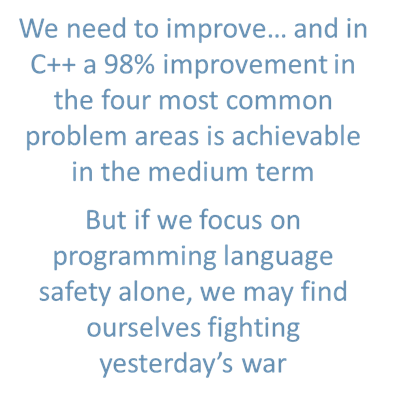
We need to improve software security and software safety across the industry, especially by improving programming language safety in C and C++, and in C++ a 98% improvement in the four most common problem areas is achievable in the medium term. But if we focus on programming language safety alone, we may find ourselves fighting yesterday’s war and missing larger past and future security dangers that affect software written in any language.

Sadly, there are too many bad actors. For the foreseeable future, our software and data will continue to be under attack, written in any language and stored anywhere. But we can defend our programs and systems, and we will.

Be well, and may we all keep working to have a safer and more secure 2024.

Appendix: Illustrating why a 98% reduction is feasible

This Appendix exists to support why I think a 98% reduction in type/bounds/initialization/lifetime CVEs in C++ code is believable. This is not a formal proposal, but an overview of concrete ways to achieve such an improvement it in new and updatable code, and ways to even get some fraction of that improvement in existing code we cannot update but can recompile. These notes are aligned with the proposals currently being pursued in the ISO C++ safety subgroup, and if they pan out as I expect in ongoing discussions and experiments, then I intend to write further details about them in a future paper.

There are runtime and code size overheads to some of the suggestions in all four buckets, notably checking bounds and casts. But there is no reason to think those overheads need to be inherently worse in C++ than other languages, and we can make them on by default and still provide a way to opt out to regain full performance where needed.

Note: For example, bounds checking can cause a major impact on some hot loops, when using a compiler whose optimizer does not hoist bounds checks; not only can the loops incur redundant checking, but they also may not get other optimizations such as not being vectorized. This is why making bounds-checking on by default is good, but all performance-oriented languages also need to provide a way to say “trust me” and explicitly opt out of bounds checking tactically where needed.

This appendix refers to the “profiles” in the C++ Core Guidelines safety profiles, a set of about two dozen enforceable rules for type and memory safety of which I am a coauthor. I refer to them only as examples, to show “what” already-known rules exist that we can enforce, to support that my claimed improvement is possible. They are broadly consistent with rules in other sources, such as: The C++ Programming Language’s advice on type safety; C++ Coding Standards’ section on type safety; the Joint Strike Fighter Coding Standards; High Integrity C++; the C++ Core Guidelines section on safety profiles (a small enforceable set of safety rules); and the recently-released MISRA C++:2023.

The best way for “how” to let the programmer control enabling those rules (e.g., via source code annotations, compiler switches, and/or something else) is an orthogonal UX issue that is now being actively discussed in the C++ standards committee and community.

Type safety

Enforce the Pro.Type safety profile by default. That includes either banning or checking all unsafe casts and conversions (e.g., static_cast pointer downcasts, reinterpret_cast), including implicit unsafe type punning via C union and vararg.

However, these rules haven’t yet been systematically enforced in the industry. For example, in recent years I’ve painfully observed a significant set of type safety-caused security vulnerabilities whose root cause was that code used static_cast instead of dynamic_cast for pointer downcasts, and “C++” gets blamed even when the actual problem was failure to follow the well-publicized guidance to use the language’s existing safe recommended feature. It’s time for a standardized C++ mode that enforces these rules by default.

Note: On some platforms and for some applications, dynamic_cast has problematic space and time overheads that hinder its use. Many implementations bundle dynamic_cast indivisibly with all C++ run-time typing (RTTI) features (e.g., typeid), and so require storing full potentially-heavyweight RTTI data even though dynamic_cast needs only a small subset. Some implementations also use needlessly inefficient algorithms for dynamic_cast itself. So the standard must encourage (and, if possible, enforce for conformance, such as by setting algorithmic complexity requirements) that dynamic_cast implementations be more efficient and decoupled from other RTTI overheads, so that programmers do not have a legitimate performance reason not to use the safe feature. That decoupling could require an ABI break; if that is unacceptable, the standard must provide an alternative lightweight facility such as a fast_dynamic_cast that is separate from (other) RTTI and performs the dynamic cast with minimum space and time cost.

Bounds safety

Enforce the Pro.Bounds safety profile by default, and guarantee bounds checking. We should additionally guarantee that:

  • Pointer arithmetic is banned (use std::span instead); this enforces that a pointer refers to a single object. Array-to-pointer decay, if allowed, will point to only the first object in the array.
  • Only bounds-checked iterator arithmetic is allowed (also, prefer ranges instead).
  • All subscript operations are bounds-checked at the call site, by having the compiler inject an automatic subscript bounds check on every expression of the form a[b], where a is a contiguous sequence with a size/ssize function and b is an integral index. When a violation happens, the action taken can be customized using a global bounds violation handler; some programs will want to terminate (the default), others will want to log-and-continue, throw an exception, integrate with a project-specific critical fault infrastructure.

Importantly, the latter explicitly avoids implementing bounds-checking intrusively for each individual container/range/view type. Implementing bounds-checking non-intrusively and automatically at the call site makes full bounds checking available for every existing standard and user-written container/range/view type out of the box: Every subscript into a vector, span, deque, or similar existing type in third-party and company-internal libraries would be usable in checked mode without any need for a library upgrade.

It’s important to add automatic call-site checking now before libraries continue adding more subscript bounds checking in each library, so that we avoid duplicating checks at the call site and in the callee. As a counterexample, C# took many years to get rid of duplicate caller-and-callee checking, but succeeded and .NET Core addresses this better now; we can avoid most of that duplicate-check-elimination optimization work by offering automatic call-site checking sooner.

Language constructs like the range-for loop are already safe by construction and need no checks.

In cases where bounds checking incurs a performance impact, code can still explicitly opt out of the bounds check in just those paths to retain full performance and still have full bounds checking in the rest of the application.

Initialization safety

Enforce initialization-before-use by default. That’s pretty easy to statically guarantee, except for some cases of the unused parts of lazily constructed array/vector storage. Two simple alternatives we could enforce are (either is sufficient):

  • Initialize-at-declaration as required by Pro.Type and ES.20; and possibly zero-initialize data by default as currently proposed in P2723. These two are good but with some drawbacks; both have some performance costs for cases that require ‘dummy’ writes that are never used but hard for optimizers to eliminate, and the latter has some correctness costs because it ‘fixing’ some uninitialized cases where zero is a valid value but masks others for which zero is not a valid initializer and so the behavior is still wrong, but because a zero has been jammed in it’s harder for sanitizers to detect.
  • Guaranteed initialization-before-use, similar to what Ada and C# successfully do. This is still simple to use, but can be more efficient because it avoids the need for artificial ‘dummy’ writes, and can be more flexible because it allows alternative constructors to be used for the same object on different paths. For details, see: example diagnostic; definite-first-use rules.

Lifetime safety

Enforce the Pro.Lifetime safety profile by default, ban manual allocation by default, and guarantee null checking. The Lifetime profile is a static analysis that diagnoses many common sources of dangling and use-after-free, including for iterators and views (not just raw pointers and references), in a way that is efficient enough to run during compilation. It can be used as a basis to iterate on and further improve. And we should additionally guarantee that:

  • All manual memory management is banned by default (new, delete, malloc, and free). Corollary: ‘Owning’ raw pointers are banned by default, since they require delete or free. Use RAII instead, such as by calling make_unique or make_shared.
  • All dereferences are null-checked. The compiler injects an automatic check on every expression of the form *p or p-> where p can be compared to nullptr to null-check all dereferences at the call site (similar to bounds checks above). When a violation happens, the action taken can be customized using a global null violation handler; some programs will want to terminate (the default), others will want to log-and-continue, throw an exception, integrate with a project-specific critical fault infrastructure.

Note: The compiler could choose to not emit this check (and not perform optimizations that benefit from the check) when targeting platforms that already trap null dereferences, such as platforms that mark low memory pages as unaddressable. Some C++ features, such as delete, have always done call-site null checking.

Reducing undefined behavior and semantic bugs

Tactically, reduce some undefined behavior (UB) and other semantic bugs (pitfalls), for cases where we can automatically diagnose or even fix well-known antipatterns. Not all UB is bad; any performance-oriented language needs some. But we know there is low-hanging fruit where the programmer’s intent is clear and any UB or pitfall is a definite bug, so we can do one of two things:

(A – Good) Make the pitfall a diagnosed error, with zero false positives — every violation is a real bug. Two examples mentioned above are to automatically check a[b] to be in bounds and *p and p-> to be non-null.

(B – Ideal) Make the code actually do what the programmer intended, with zero false positives — i.e., fix it by just recompiling. An example, discussed at the most recent ISO C++ November 2023 meeting, is to default to an implicit return *this; when the programmer writes an assignment operator for their type C that returns a C& (note: the same type), but forgets to write a return statement. Today, that is undefined behavior. Yet it’s clear that the programmer meant return *this; — nothing else can be valid. If we make return *this; be the default, all the existing code that accidentally omits the return is not just “no longer UB,” but is guaranteed to do the right and intended thing.

An example of both (A) and (B) is to support chained comparisons, that makes the mathematically valid chains work correctly and rejects the mathematically invalid ones at compile time. Real-world code does write such chains by accident (see: [a] [b] [c] [d] [e] [f] [g] [h] [i] [j] [k]).

  • For (A): We can reject all mathematically invalid chains like a != b > c at compile time. This automatically diagnoses bugs in existing code that tries to do such nonsense chains, with perfect accuracy.
  • For (B): We can fix all existing code that writes would-be-correct chains like 0 <= index < max. Today those silently compile but are completely wrong, and we can make them mean the right thing. This automatically fixes those bugs, just by recompiling the existing code.

These examples are not exhaustive. We should review the list of UB in the standard for a more thorough list of cases we can automatically fix (ideally) or diagnose.

Summarizing: Better defaults for C++

C++ could enable turning safety rules on by default that would make code:

  • fully type-safe,
  • fully bounds-safe,
  • fully initialization-safe,

and for lifetime safety, which is the hardest of the four, and where I would expect the remaining vulnerabilities in these categories would mostly lie:

  • fully null-safe,
  • fully free of owning raw pointers,
  • with lifetime-safety static analysis that diagnoses most common pointer/iterator/view lifetime errors;

and, finally:

  • with less undefined behavior including by automatically fixing existing bugs just by recompiling code with safety enabled by default.

All of this is efficiently implementable and has been implemented. Most of the Lifetime rules have been implemented in Visual Studio and CLion, and I’m prototyping a proof-of-concept mode of C++ that includes all of the other above language safeties on-by-default in my cppfront compiler, as well as other safety improvements including an implementation of the current proposal for ISO C++ contracts. I haven’t yet used the prototype at scale. However, I can report that the first major change request I received from early users was to change the bounds checking and null checking from opt-in (off by default) to opt-out (on by default).

Note: Please don’t be distracted by that cppfront uses an experimental alternate syntax for C++. That’s because I’m additionally trying to see if we can reach a second orthogonal goal: to make the C++ language itself simpler, and eliminate the need to teach ~90% of the C++ guidance literature related to language complexity and quirks. This essay’s language safety improvements are orthogonal to that, however, and can be applied equally to today’s C++ syntax.

Solutions need to distinguish between (A) “solution for new-or-updatable code” and (B) “solution for existing code.”

(A) A “solution for new-or-updatable code” means that to help existing code we have to change/rewrite our code. This includes not only “(re)write in C#/Rust/Go/Python/…,” but also “annotate your code with SAL” or “change your code to use std::span.”

One of the costs of (A) is that anytime we write/change code to fix bugs, we also introduce new bugs; change is never free. We need to recognize that changing our code to use std::span often means non-trivially rewriting parts of it which can also create other bugs. Even annotating our code means writing annotations that can have bugs (this is a common experience in the annotation languages I’ve seen used at scale, such as SAL). All these are significant adoption barriers.

Actually switching to another language means losing a mature ecosystem. C++ is the well-trod path: It’s taught, people know it, the tools exist, interop works, and current regulations have an industry around C++ (such as for functional safety). It takes another decade at least for another language to become the well-trod path, whereas a better C++, and its benefits to the industry broadly, can be here much sooner.

(B) A “solution for existing code” emphasizes the adoptability benefits of not having to make manual code changes. It includes anything that makes existing code more secure with “just a recompile” (i.e., no binary/ABI/link issues; e.g., ASAN, compiler switches to enable stack checks, static analysis that produces only true positives, or a reliable automated code modernizer).

We will still need (B) no matter how successful new languages or new C++ types/annotations are. And (B) has the strong benefit that it is easier to adopt. Getting to a 98% reduction in CVEs will require both (A) and (B), but if we can deliver even a 30% reduction using just (B) that will be a major benefit for adoption and effective impact in large existing code bases that are hard to change.

Consider how the ideas earlier in this appendix map onto (A) and (B):

In C++, by default enforce …(A) Solution for new/updated code (can require code changes — no link/binary changes)(B) Solution for existing code (requires recompile only — no manual code changes, no link/binary changes)
Type safetyBan all inherently unsafe casts and conversionsMake unsafe casts and conversions with a safe alternative do the safe thing
Bounds safetyBan pointer arithmetic Ban unchecked iterator arithmeticCheck in-bounds for all allowed iterator arithmetic Check in-bounds for all subscript operations
Initialization safetyRequire all variables to be initialized (either at declaration, or before first use)
Lifetime safetyStatically diagnose many common pointer/iterator lifetime error casesCheck not-null for all pointer dereferences
Less undefined behaviorStatically diagnose known UB/bug cases, to error on actual bugs in existing code with just a recompile and zero false positives:
Ban mathematically invalid comparison chains
(add additional cases from UB Annex review)
Automatically fix known UB/bug cases, to make current bugs in existing code be actually correct with just a recompile and zero false positives:
Define mathematically valid comparison chains
Default return *this; for C assignment operators that return C&
(add additional cases from UB Annex review)

By prioritizing adoptability, we can get at least some of the safety benefits just by recompiling existing code, and make the total improvement easier to deploy even when code updates are required. I think that makes it a valuable strategy to pursue.

Finally, please see again the main post’s conclusion: Call(s) to action.

Effective Concurrency: Live online course in April

I generally give one or two courses a year on C++ and related technologies. This year, on April 22-25, I’ll be giving a live online public course for four half-days, on the topic of high-performance low-latency coding in C++ — and the early registration discount is available for a few more days until this Thursday:

Effective Concurrency with Herb Sutter

High performance and low latency code, via concurrency and parallelism

22-25th April 2024, from 14:00 – 18:00 CEST daily

Participants in this intensive course will acquire the knowledge and skills required to write high-performance and low-latency code on today’s modern systems using modern C++. Presented by Alfasoft.

See the course link for details and a syllabus of topics that will be covered.

The times are intended to be friendly to the home time zones of attendees anywhere in EMEA and also to early risers in the Americas. If you live in a part of the world where these times can’t work for you, and you’d like another offering of the course that is friendlier to your home time zone, please email Alfasoft to let them know!

Because “high-performance low-latency” is kind of C++’s bailiwick, and because it’s my course, you’ll be unsurprised to learn that the topics and code focus on C++ and include coverage of modern C++17/20/23 features. But we are polyglots, after all… so don’t be overly shocked that I may sometimes show a few code examples in other popular languages, if only for comparison and to show how the other half lives.

Trip report: Autumn ISO C++ standards meeting (Kona, HI, USA)

Today, the ISO C++ committee completed its second meeting of C++26, held in Kona, HI, USA.

Our hosts, Standard C++ Foundation and WorldQuant, arranged for high-quality facilities for our six-day meeting from Monday through Saturday. We had over 170 attendees, about two-thirds in-person and the others remote via Zoom, formally representing 21 nations. Also, at each meeting we regularly have new attendees who have never attended before, and this time there were over a dozen new first-time attendees, mostly in-person; to all of them, once again welcome!

The committee currently has 23 active subgroups, most of which met in parallel tracks throughout the week. Some groups ran all week, and others ran for a few days or a part of a day and/or evening, depending on their workloads. You can find a brief summary of ISO procedures here.

This week’s meeting: Meeting #2 of C++26

At the previous meeting in June, the committee adopted the first 40 proposed changes for C++26, including many that had been ready for a couple of meetings and were just waiting for the C++26 train to open to be adopted. For those highlights, see the previous trip report.

This time, the committee adopted the next set of features for C++26. It also made significant progress on other features that are now expected to be complete in time for C++26 — including contracts and reflection.

Here are some of the highlights…

Adopted for C++26: Core language changes/features

The core language adopted four papers, including P2662R3 “Pack indexing” by Corentin Jabot and Pablo Halpern officially adds support for using [idx] subscripting into variadic parameter packs. Here is an example from the paper that will now be legal:

template <typename... T>
constexpr auto first_plus_last(T... values) -> T...[0] {
    return T...[0](values...[0] + values...[sizeof...(values)-1]);
}

int main() {
    static_assert( first_plus_last(1, 2, 10) == 11 );
}

For those interested in writing standards proposals, I would suggest looking at this and its two predecessors P1858 and P2632 as well written papers: The earlier papers delve into the motivating use cases, and this paper has a detailed treatment of other design alternatives considered and why this is the one chosen. Seeing only the end result of T...[0] would be easy to call “obvious” in hindsight, but it’s far from the only option and this paper’s analysis shows a thorough consideration of alternatives, including their effects on existing and future code and future language evolution.

Adopted for C++26: Standard library changes/features

The standard library adopted 19 papers, including the following…

The biggest, and probably this meeting’s award for “proposal being worked on the longest,” is P1673R13, “A free function linear algebra interface based on the BLAS” by Mark Hoemmen, Daisy Hollman, Christian Trott, Daniel Sunderland, Nevin Liber, Alicia Klinvex, Li-Ta Lo, Damien Lebrun-Grandie, Graham Lopez, Peter Caday, Sarah Knepper, Piotr Luszczek, and Timothy Costa, with the help of Bob Steagall, Guy Davidson, Andrew Lumsdaine, and Davis Herring. If you want to do efficient linear algebra, you don’t want to write your own code by hand; that would be slow. Instead, you want a library that is tuned for your target hardware architecture and ready for par_unseq vectorized algorithms, for blazing speed. This is that library. For detailed rationale, see in particular sections 5 “Why include dense linear algebra in the C++ Standard Library?” and 6 “Why base a C++ linear algebra library on the BLAS?”

P2905R2 “Runtime format strings”  and P2918R2 “Runtime format strings II” by Victor Zverovich builds on the C++20 format library, which already supported compile-time format strings. Now with this pair of papers, we will have direct support for format strings not known at compile time and be able to opt out of compile-time format string checks.

P2546R5 “Debugging support” by René Ferdinand Rivera Morell, building on prior work by Isabella Muerte in P1279, adds std::breakpoint(), std::breakpoint_if_debugging(), and std::is_debugger_present(). This standardizes prior art already available in environments from Amazon Web Services to Unreal Engine and more, under a common standard API that gives the programmer full runtime control over breakpoints, including (quoting from the paper):

  • “allowing printing out extra output to help diagnose problems,
  • executing extra test code,
  • displaying an extra user interface to help in debugging, …
  • … breaking when an infrequent non-critical condition is detected,
  • allowing programmatic control with complex runtime sensitive conditions,
  • breaking on user input to inspect context in interactive programs without needing to switch to the debugger application,
  • and more.”

I can immediately think of times I would have used this in the past month, and probably you can too.

Those are some of the “bigger” papers as highlights… there were 16 papers other adopted too, including more extensions and fixes for the C++26 language and standard library.

On track for targeting C++26: Contracts

The contracts subgroup, SG21, decided several long-open questions that needed to be answered to land contracts in C++26. Perhaps not the most important one, but the one that’s the most visible, is the contracts syntax: This week, SG21 approved pursuing P2961R2 “A natural syntax for contracts” by Jens Maurer and Timur Doumler as the syntax for C++26 contracts. The major visible change is that instead of writing contracts like this:

// previous draft syntax
int f(int i)
    [[pre: i >= 0]]
    [[post r: r > 0]]
{
    [[assert: i >= 0]]
    return i+1;
}

we’ll write them like this, changing “assert” to “contract_assert”… pretty much everyone would prefer “assert,” if only it were backward-compatible, but in this new syntax it would hit an incompatibility with the C assert macro:

// newly adopted syntax
int f(int i)
    pre (i >= 0)
    post (r: r > 0)
{
    contract_assert (i >= 0);
    return i+1;
}

I already had a contracts implementation in my cppfront compiler, which used the previous [[ ]] syntax (because, when I have nothing clearly better, I try to follow syntax in existing/proposed C++). So, once P2961 was approved in the subgroup on Tuesday morning, I decided to take Tuesday afternoon to implement the change to this syntax, except that I kept the nice word “assert” because I can do that without a breaking change in my experimental alternate syntax. The work ended up taking not quite an hour, including to update the repo’s own code where I’m using contracts myself in the compiler and its unit tests. You can check out the diff in these | commits. My initial personal reaction, as an early contracts user, is that I like the result.

There are a handful of design questions still to decide, notably the semantics of implicit lambda capture, consteval, and multiple declarations. Six contracts telecons have been scheduled between now and the next meeting in March in Tokyo. The group is aiming to have a feature-complete proposal for Tokyo to forward to other groups for review.

Today when this progress was reported to the full committee, there was applause. As there should be, because this week’s progress increases the confidence that the feature is on track for C++26!

Note that “for C++26” doesn’t mean “that’s still three years away, maybe my kids can use it someday.” It means the feature has to be finished in just the next 18 months or so, and once it’s finished that unleashes implementations to be able to confidently go implement it. It’s quite possible we may see implementations available sooner, as we do with other popular in-demand draft standard features.

Speaking of major features that made great progress this meeting to be confidently on track for C++26…

On track for targeting C++26: Reflection

The reflection subgroup, SG7, saw two experience reports from people actively using the prototype implementation of P2996 by Lock3 Software: P3010R0 “Using reflection to replace a metalanguage for generating JS bindings” by Dan Katz, and P2911R1 “Python bindings with value-based reflection” by Adam Lach and Jagrut Dave. As you can see from the titles, these were serious attempts to try out reflection for major use cases. Both experience reports supported P2996R1, so…

The group then voted unanimously to adopt P2996R1 “Reflection for C++26” by Wyatt Childers, Peter Dimov, Barry Revzin, Andrew Sutton, Faisal Vali, and Daveed Vandevoorde and forward it on to the main Evolution and Library Evolution subgroups targeting C++26. This is a “core” of static reflection that is useful enough to solve many important problems, while letting us also plan to continue building on it further post-C++26.

This is particularly exciting for me personally, because we desperately need reflection in C++, and based on this week’s progress now is the first time I’ve felt confident enough to mention a target ship vehicle for this super important feature.

Perhaps the most common example of reflection is “enum to string”, so here’s that example:

template <typename E>
    requires std::is_enum_v<E>
constexpr std::string enum_to_string(E value) {
    template for (constexpr auto e : std::meta::members_of(^E)) {
        if (value == [:e:]) {
            return std::string(std::meta::name_of(e));
        }
    }
    return "<unnamed>";
}

Note that the above uses some of the new reflection syntax, but this is just the implementation… the new syntax stays encapsulated there. The code that uses enum_to_string gets to not know anything about reflection, and just use the function:

enum Color { red, green, blue };
static_assert(enum_to_string(Color::red) == "red");
static_assert(enum_to_string(Color(42)) == "<unnamed>");

See the paper for much more detail, including more about enum-to-string in section 2.6.

Adding to the excitement, Edison Design Group noted that they expect to have an experimental implementation available on Godbolt Compiler Explorer by Christmas.

P2996 builds on the core of the original Reflection TS, and mainly changes the “top” and “bottom” layers that we knew we would likely change from the TS:

  • At the “top” or programming model layer, P2996 avoids having to do temp<late,meta<pro,gram>>::ming to use the API and lets us write something more like ordinary C++ code instead.
  • And at the “bottom” implementation layer, it uses a value-based implementation which is more efficient to implement.

This doesn’t mean the Reflection TS wasn’t useful; it was instrumental. Progress to this point would have been slower if we hadn’t been able to do the TS first, and we deeply appreciate all the work that went into that, as well as the new progress to move forward with P2996 as the reflection feature targeting C++26.

After the unanimous approval vote to forward this paper for C++26, there was a round of applause in the subgroup.

Then today, when this progress toward targeting C++26 was reported to the whole committee in the closing plenary session, the whole room was filled with sustained applause.

Other progress

Many other subgroups continued to make progress during the week. Here are a few highlights…

SG1 (Concurrency) will be working on out-of-thin-air issues for relaxed atomics at a face-to-face meeting or telecon between meetings. They are still on track to move forward with std::execution and SIMD parallelism for C++26, and SIMD was reviewed in the Library Evolution (LEWG) main subgroup; these features, in the words of the subgroup chair, will make C++26 a huge release for the concurrency and parallelism group.

SG4 (Networking) continued working on updating the networking proposal for std::execution senders and receivers. There is a lot of work still to be done and it is not clear on whether networking will be on track for C++26.

SG9 (Ranges) set a list of features and priorities for ranges for C++26. There are papers that need authors, including ones that would be good “first papers” for new authors, so please reach out to the Ranges chair, Daisy Hollman, if you are interested in contributing toward a Ranges paper.

SG15 (Tooling) considered papers on improving modules to enable better tooling, and work toward the first C++ Ecosystem standard.

SG23 (safety) subgroup made further progress towards safety profiles for C++ as proposed by Bjarne Stroustrup, and adopted it as the near-term direction for safety in C++. The updated paper will be available in the next mailing in mid-December.

Library Evolution (LEWG) started setting a framework for policies for new C++ libraries. The group also made progress on a number of proposals targeting C++26, including std::hive, SIMD (vector unit parallelism), ranges extensions, and std::execution, and possibly some support for physical units, all of which made good progress.

Language Evolution (EWG) worked on improving/forwarding/rejecting many proposals, including a set of discussions about improving undefined behavior in conjunction with the C committee, including eight papers about undefined behavior in the preprocessor. The group also decided to pursue doing a full audit of “ill-formed, no diagnostic required” undefined behavior that compilers currently are not required to detect and diagnose. The plan for our next meeting in Tokyo is to spend a lot of time on reflection, and prepare for focusing on contracts.

Thank you to all the experts who worked all week in all the subgroups to achieve so much this week!

What’s next

Our next meeting will be in Tokyo, Japan in March hosted by Woven by Toyota.

Wrapping up

Thank you again to the over 170 experts who attended on-site and on-line at this week’s meeting, and the many more who participate in standardization through their national bodies!

But we’re not slowing down… we’ll continue to have subgroup Zoom meetings, and then in just four months from now we’ll be meeting again in person + Zoom to continue adding features to C++26. Thank you again to everyone reading this for your interest and support for C++ and its standardization.

My new CppCon talk is on YouTube: “Cooperative C++ Evolution – Toward a TypeScript for C++”

My Thursday CppCon talk is now online.

Note: There’s already a Reddit thread for it, so if you want to comment on the video I suggest you use that thread instead of creating a new one.

At CppCon 2022, I argued for why we should try to make C++ 10x simpler and 50x safer, and this update is an evolution of the update talk I gave at C++ Now in May, with additional news and demos.

The “Dart plan” and the “TypeScript plan”

The back half of this talk clearly distinguishes between what I call the “Dart plan” and the “TypeScript plan” for aiming at a 10x improvement for an incumbent popular language. Both plans have value, but they have different priorities and therefore choose different constraints… most of all, they either embrace up-front the design constraint of perfect C++ interop and ecosystem compatibility, or they forgo it (forever; as I argue in the talk, it can never be achieved retroactively, except by starting over, because it’s a fundamental up-front constraint). No one else has tried the TypeScript plan for C++ yet, and I see value in trying it, and so that’s the plan I’m following for cppfront.

When people ask me “how is cppfront different from all the other projects trying to improve/replace C++?” my answer is “cppfront is on the TypeScript plan.” All the other past and present projects have been on the Dart plan, which again is a fine plan too, it just has different priorities and tradeoffs particularly around

  • full seamless interop compatibility with ISO Standard C++ code and libraries without any wrapping/thunking/marshaling,
  • full ecosystem compatibility with all of today’s C++ compilers, IDEs, build systems, and tooling, and
  • full standards evolution support with ISO C++, including not creating incompatible features (e.g., a different concepts feature than C++20’s, a different modules system than C++20’s) and bringing all major new pieces to today’s ISO C++ evolution as also incremental proposals for today’s C++.

See just the final 10 minutes of the talk to see what I mean — I demo’d syntax 2 “just working” with four different IDEs’ debuggers and visualizers, but I could also have demo’d that profilers just work, build systems just work, and so on.

I call my experimental syntax 2 (aka Cpp2) “still 100% pure C++” not only because cppfront translates it to 100% today’s C++ syntax (aka Cpp1), but because:

  • every syntax-2 type is an ordinary C++ type that ordinary existing C++ code can use, recognized by tools that know C++ types including IDE visualizers;
  • every syntax-2 function is an ordinary C++ function that ordinary existing C++ code can use, recognized by tools that know C++ functions including debuggers to step into them;
  • every syntax-2 object is an ordinary C++ object that ordinary existing C++ code can use;
  • every syntax-2 feature can be (and has been) brought as a normal ISO C++ standards proposal to evolve today’s syntax, because Cpp2 embraces and follows today’s C++ standard and guidance and evolution instead of competing with them;

and that’s because I want a way to keep writing 100% pure C++, just nicer.

“Nicer” means: 10x simpler by having more generality and consistency, better defaults, and less ceremony; and 50x safer by having 98% fewer vulnerabilities in the four areas of initialization safety (guaranteed in Cpp2), type safety (guaranteed in Cpp2), bounds safety (on by default in Cpp2), and lifetime safety (still to be implemented in cppfront is the C++ Core Guidelines Lifetime static analysis which I designed for Cpp2).

Cpp2 and cppfront don’t replace your C++ compilers. Cpp2 and cppfront work with all your existing C++ compilers (and build systems, profilers, debuggers, visualizers, custom in-house tools, test harnesses, and everything else in the established C++ ecosystem, from the big commercial public C++ products to your team’s internal bespoke C++ tools). If you’re already using GCC, Clang, and/or MSVC, keep using them, they all work fine. If you’re already using CMake or build2, or lldb or the Qt Creator debugger, or your favorite profiler or test framework, keep using them, it’s all still C++ that all C++ tools can understand. There’s no new ecosystem.

There are only two plans for 10x major improvement. (1-min clip) This is the fundamental difference with all the other attempts at a major improvement of today’s C++ I know of, which are all on the Dart plan — and those are great projects by really smart people and I hope we all learn from each other. But for my work I want to pursue the TypeScript plan, which I think is the only major evolution plan that can legitimately call itself “still 100% C++.” That’s important to me, because like I said at the very beginning of my talk last year (1-min clip), I want to encourage us to pursue major evolution that brings C++ itself forward and to double down on C++, not switch to something else — to aim for major C++ evolution directed to things that will make us better C++ programmers, not programmers of something else.

I’m spending time on this experiment first of all for myself, because C++ is the language that best lets me express the programs I need to write, so I want to keep writing real C++ types and real C++ functions and real C++ everything else… just nicer.

Thanks again to the over 120 people who have contributed issues and PRs to cppfront, and the many more who have provided thoughtful comments and feedback! I appreciate your help.