Deprecating export considered for ISO C++0x

How interesting.

I’m at the ISO C++ meeting in Santa Cruz, CA, USA this week. Ten minutes ago we had a committee straw poll about whether we should remove, deprecate, or leave as-is the export template feature for C++0x. The general sentiment was to remove or deprecate it, with deprecation getting the strongest support because it’s safer per ISO procedure. Deprecation would not remove it from C++0x, but would put the world on notice that the committee is considering removing it from a future standard.

Note: Nothing is happening to export at this meeting. The effect of this straw poll of the committee was to give guidance to the core language working group (CWG) on the committee’s general sentiment on this issue. The CWG is taking this as guidance to produce a detailed proposal to take some action on export at our next meeting in Pittsburgh in March.

I’ll write a longer trip report in the next week, but this was worth noting in real time because it’s the first time export template has been discussed in committee since the highly controversial discussion of my and Tom Plum’s proposal to remove export at the Oxford meeting in 2003.

Mailbag: Shutting up compiler warnings

I recently received the following reader question (slightly edited):

About the (Stroustrup) approach of implementing IsDerivedFrom at page 27 in your book More Exceptional C++: […] why the second pointer assignment in:

static void Constraints(D* p)
{
B* pb=p; // okay, D better inherit from B…
pb=p; // huh? why this again?
}

Isn’t the initialization ” B* pb=p ” enough? What does the second assignment bring to the picture?

Excellent question. Interestingly, here’s the exact text from the book, which contains an additional comment that was intended to answer this specific question (emphasis added):

static void Constraints(D* p)
{
B* pb = p;
pb = p; // suppress warnings about unused variables
}

The reason for the redundant assignment is to try to shut up some compilers that issue warnings about unused variables. In a normal function, this is a helpful warning because, dollars to donuts, it’s a mistake and the programmer meant to use the variable but forgot or accidentally used some other variable instead. In this case, without the second line, pb is declared but never mentioned again, and by adding the extra line that mentions it one more time after its declaration, some compilers stop complaining.

Sometimes, however, we’re intentionally not using the variable, such as in this case where the only purpose of the function is to ensure that code that tries to convert a D* to a B* is compilable. (Note: There are other/better ways to achieve this. See the rest of Item 27 for superior approaches.)

However, in practice even the line “pb = p;” doesn’t shut compilers up very much, because many will still notice that now the second assigned value isn’t used, and will helpfully remind you that you probably didn’t mean to write an apparently useless “dead write” that is never read again. Most compilers offer a compiler-specific #pragma or other nonportable extension to silence this warning, but wouldn’t it be nice to have a portable way to suppress the warning that will work on all compilers?

Here’s a simple one-liner that works on all compilers I tried, and should not incur any overhead: Define an empty function template that takes any object by reference, but doesn’t actually do anything with it and so the empty function body should compile down to nothing. Let’s call it “ignore” – you can put it into your project namespace to avoid collisions on that common name.

  template<class T> void ignore( const T& ) { }

Note that ignore<T>’s parameter does not need a name; in fact, it had better not have a name or else you’ll get the same compiler warning as before about an unused variables, only in a new place.

Using ignore is easy. When you want to suppress the compiler warning, just write:

  static void Constraints(D* p)
  {
    B* pb = p;
    ignore(pb); // portably suppresses the warning
  }

Now all compilers I tried agree that the variable is “used” and stop complaining about pb.

[Oct 20: Updated  to add “const” on ignore<T>’s parameter to also handle rvalues.]

Effective Concurrency: Avoid Exposing Concurrency – Hide It Inside Synchronous Methods

This month’s Effective Concurrency column, Avoid Exposing Concurrency – Hide It Inside Synchronous Methods, is now live on DDJ’s website.

From the article:

You have a mass of existing code and want to add concurrency. Where do you start?

Let’s say you need to migrate existing code to take advantage of concurrent execution or scale on parallel hardware. In that case, you’ll probably find yourself in one of these two common situations, which are actually more similar than different:

  • Migrating an application: You’re an application developer, and you want to migrate your existing synchronous application to be able to benefit from concurrency.
  • Migrating a library or framework: You’re a developer on a team that produces a library or framework used by other teams or external customers, and you want to let the library take advantage of concurrency on behalf of the application without requiring application code rewrites.

You have a mountain of opportunities and obstacles before you. Where do you start?

I hope you enjoy it. Finally, here are links to previous Effective Concurrency columns:

The Pillars of Concurrency (Aug 2007)

How Much Scalability Do You Have or Need? (Sep 2007)

Use Critical Sections (Preferably Locks) to Eliminate Races (Oct 2007)

Apply Critical Sections Consistently (Nov 2007)

Avoid Calling Unknown Code While Inside a Critical Section (Dec 2007)

Use Lock Hierarchies to Avoid Deadlock (Jan 2008)

Break Amdahl’s Law! (Feb 2008)

Going Superlinear (Mar 2008)

Super Linearity and the Bigger Machine (Apr 2008)

Interrupt Politely (May 2008)

Maximize Locality, Minimize Contention (Jun 2008)

Choose Concurrency-Friendly Data Structures (Jul 2008)

The Many Faces of Deadlock (Aug 2008)

Lock-Free Code: A False Sense of Security (Sep 2008)

Writing Lock-Free Code: A Corrected Queue (Oct 2008)

Writing a Generalized Concurrent Queue (Nov 2008)

Understanding Parallel Performance (Dec 2008)

Measuring Parallel Performance: Optimizing a Concurrent Queue (Jan 2009)

volatile vs. volatile (Feb 2009)

Sharing Is the Root of All Contention (Mar 2009)

Use Threads Correctly = Isolation + Asynchronous Messages (Apr 2009)

Use Thread Pools Correctly: Keep Tasks Short and Nonblocking (Apr 2009)

Eliminate False Sharing (May 2009)

Break Up and Interleave Work to Keep Threads Responsive (Jun 2009)

The Power of “In Progress” (Jul 2009)

Design for Manycore Systems (Aug 2009)

Avoid Exposing Concurrency – Hide It Inside Synchronous Methods (Oct 2009)

When is a zero-length array okay?

I just received a reader email that asked about GotW #42:

You write "Non-Problem: Zero-Length Arrays Are Okay", but both 14882:2003 and N2914 "[dcl.array]" say "If the constant-expression (5.19) is present, it shall be an integral constant expression and its value shall be greater than zero.". Shall we assume that you overrule the standard? :-) Or am I missing something, like the meaning of "derived-declarator-type-list" (I can’t find it anywhere in 14882:2003)?

I thought the answer might be of interest to other people, so I’m posting it here.

First, this reader gets kudos for consulting not only the ISO C++ standard, but also the current C++0x working draft from June (paper N2914), to do research before asking the question. Good stuff.

He also gets a small penalty point, though, for reading only the subhead text that he quoted from GotW #42, and not the actual short passage the heading introduces. The article already contains the answer to his qustion, and that answer is still the same in the current C++0x draft all these years later:

From 5.3.4 [expr.new], paragraph 7:

When the value of the expression in a direct-new-declarator is zero, the allocation function is called to allocate an array with no elements. The pointer returned by the new-expression is non-null. [Note: If the library allocation function is called, the pointer returned is distinct from the pointer to any other object.]

So the reader is quoting from 8.3.4 [dcl.array], which governs non-heap allocated arrays (e.g., T array[N];). In that case, a zero length is not allowed by the standard. You can’t rely on it in portable code because although it is allowed as an extension in some popular compilers (e.g., Gnu gcc) it is treated as an error in others (e.g., Visual C++).

But the case being discussed in GotW #42 is dynamically allocating an array using the array form of new (e.g., new T[n] where n is zero), which is governed by 5.3.4 [expr.new]. Here, zero length is okay for the reasons given in GotW #42:

The result of "new T[0]" is just a pointer to an array with zero elements, and that pointer behaves just like any other result of "new T[n]" including the fact that you may not attempt to access more than n elements of the array… in this case, you may not attempt to access any elements at all, because there aren’t any.

"Well, if you can’t do anything with zero-length arrays (other than remember their address)," you may wonder, "why should they be allowed?" One important reason is that it makes it easier to write code that does dynamic array allocation. For example, the function f above would be needlessly more complex if it was forced to check the value of its n parameter before performing the "new T[n]" call.

To make GotW #42 completely unambiguous, it could more specifically say that zero-length heap-allocated arrays are okay, which was the case being discussed in the article. But it always helps to read more than the subhead text.

Suggestions on improving C++ skills

Someone just asked me about getting more proficient in C++, and with their permission I thought I’d share the question and my answer in case it’s of broader interest to folks wanting to improve their C++ skills.

Here’s the question:

I need to take my C++ knowledge up a notch – or two. On a scale of 1-10 I’d consider my C++ knowledge a 5 and would like to get to 7-8 in the next 4, or so, months. As C++ is a large language my quandary is what subject areas, using what study materials, should I focus on to get myself to this next level.

Questions (assuming that I’m going to study approx 2 hrs/day for 4 months):

1. How would you suggest I structure such a course of study (subject areas, 5 of time for each) ?
1.1 If you were in my shoes, how would you proceed?
2. If I was going to study and hopefully know cold one of your books, which do you think I should select?

Here’s my response, which I didn’t limit to my own books. These are the first two “next books” books I would recommend to anyone who already knew the basics of the language and wanted to improve their proficiency with using C++ in production code:

If you’re not already familiar with Scott Meyers’ Effective C++, the current third edition is the plate to start (it’s substantially reworked since the first and second editions).

After that, I’d say the most important is C++ Coding Standards which I wrote with Andrei Alexandrescu. Not only does it cover the top 100 things we felt were important to say about using C++ in production code, and had its guidance peer-reviewed in advance by a who’s-who of the C++ community more than any other C++ book I’ve ever heard of, but it also includes references in each Item for where to find more in-depth treatment. Most Items are just one or two pages, so if you know that Item already you can use it as a refresher; and if you discover ones that you’re less familiar with or rusty on the details, it tells you where to go to find out more.

I’d say those are the two most important that I can suggest. Best wishes with your studies!

Trip Report: Exit Concepts, Final ISO C++ Draft in ~18 Months

A week ago, I attended the summer ISO C++ meeting in Frankfurt, Germany. The C++ committee made a lot of progress on addressing national body comments on the full committee draft published last year, and is well on the way to publishing a second and final CD this winter with a final draft international standard a year after that. To meet that schedule, the committee decided to defer a major feature, “concepts”, and not include it in this standard.

I’m surprised at some of the commentary I’ve been reading on the web about the deferral of concepts, including not just technical inaccuracies but also that their absence in C++0x is somehow a big deal for C++ as a language or is a major geopolitical firestorm. It may feel like a big deal because of the work that’s gone into concepts and the large number of pages of standardese that were needed to specify the feature, and there was a lot of discussion about important design details including heavy traffic on the committee reflectors this spring and early summer that probably made them look more controversial than they are.

But my opinion is that concepts’ presence or absence in C++0x just won’t make much difference to most users. Let me give some reasons why I feel that’s so, and maybe debunk some common misconceptions along the way, in the form of an unofficial FAQ. Note that I was never involved in the design of concepts and don’t speak for the designers, whose views might differ here and there; the following are observations from my point of view as a participant in the standards body (including in Frankfurt last week), and chair of the ISO C++ committee during the entire time concepts were being developed up to the meeting they were voted into the ISO C++0x working draft last fall.

Q: Bjarne Stroustrup is the creator of C++ and a primary designer of concepts. What’s his take?

A: Great question. See Bjarne’s coverage here, published earlier today in Dr. Dobb’s.

Q: Were concepts removed because of political reason X, Y, or Z?

A: No. Concepts were removed because of normal project management considerations. The basic constraint has been phrased in many ways, all of them hitting at the same underlying tension among time, scope, cost, and quality. Here are two examples: “You can pick what goes on the train, or you can pick when the train leaves the station, but you can’t pick both.” “You can have good, fast, and cheap – pick any two.”

Fundamentally, the committee members felt that concepts are desirable but many (though not all) believed that they were still in design mode and needed more “bake time” – a formal poll of committee members in Frankfurt put the expected time at between three and four years – to get up to the quality of a feature that belongs in an international standard. Therefore, the two major options, and the ones that people generally argued for, were to either:

  • Prioritize (bigger) scope. Wait for concepts, and accept a delay to the rest of the standard including features that are already finalized and ready to ship.
  • Prioritize (faster) schedule. Finish and ship the standard to get already-done features into users’ hands, and decouple concepts to continue work on them for a future standard.

The committee decided to prioritize schedule and ship C++0x sooner while still leaving the door wide open to also adopt concepts later.

Q: Isn’t removing concepts a lot of work? Concepts are used pervasively in the C++0x CD published last fall.

A: Yes, but it’s less work than you’d think. We won’t have a de-conceptized working draft for the post-meeting mailing, two weeks after the meeting, but should have one soon after that. (I would be remiss not to add: Thanks to our always-hardworking project editor, Pete Becker!)

Recall that, until last September, we had a complete draft of C++0x features specified entirely without the use of concepts. And many of the uses of concepts in the draft standard library were just replacements of preexisting non-concepts wording or implicit requirements (e.g., DefaultConstructible, MemberContainer), and will just revert to their previous wording or disappear back into implicitness.

The main C++0x feature that was always specified in terms of concepts was the new range-based for loop (e.g., for( x : collection ) ). I’ve seen some wonder what we’ll do about that, but it’s already done; the non-concepts text for that feature was already voted in at the same Frankfurt meeting.

Q: Wasn’t this C++0x’s one big feature?

A: No. Concepts would be great, but for most users, the presence or absence of concepts will make no difference to their experience with C++0x except for quality of error messages (see below).

C++0x is still a major revision with many new major features, including improvements to templates (e.g., variadic templates, template aliases). C++’s other major new features include lambda functions (which unfortunately for Java were rejected for Java 7), move semantics (aka rvalue references), a concurrency memory model, threading and atomics libraries, initializer lists, and more. Other handy new features include delegating constructors, inherited constructors, defaulted and deleted functions, explicit virtual overriding control, alignment support, static assertions, and more. Not to mention convenience features like range-based for loops and “auto” type inference that are small but will certainly get a lot of use (as they do in C# and Java).

A number of those features are available now or soon in real compilers, including Gnu gcc, Visual C++ 2010, and Intel C++.

Q: Aren’t concepts about adding major new expressive power to the language, and so enable major new kinds of programs or programming styles?

A: Not really. Concepts are almost entirely about getting better error messages.

Yes, concepts would add one truly new expressive capability to the language, namely the ability to overload on concepts. That’s inconvenient to simulate without language support. Concept-based overloading would have been used in a handful of places in the standard library. But that’s it.

By far the most visible benefit of concepts lies in clearer template error messages, including the ability to do separate checking – confirming that a template’s implementation type-checks correctly with all possible valid types without having to instantiate it, and confirming that a given type can be used to instantiate a template without knowing the template’s implementation.

Q: Weren’t concepts all about bringing templates into the 21st century? Where does this leave templates?

A: Templates are still king of the genericity hill, for all their faults in the area of opaque compiler messages.

It’s important to remember that, in 1994, C++ was the only major language whose type genericity capabilities were strong enough to create the Standard Template Library (STL). Today, 15 years later, that is still true; you can’t express the STL’s containers-algorithms design separation well, or at all, using generics facilities in Ada, Java, .NET, or any other significant commercial or research language that I know of; as we learned when doing STL.NET, you can do the containers well with other generics, but not the orthogonalization with algorithms that is the heart of STL design style. Concepts or not, that hasn’t changed.

So my personal view is that templates have been in the 21st century since about 1994. No other language has yet caught up to their expressive power. And C++0x is adding some further power to templates, in particular by adding variadic templates and template aliases, both of which will help to simplify template code.

Answering email about error handling in concurrent code

Someone emailed me today asking:

I’m writing because I’m somewhat conscious of what I would consider a rather large hole in the parallel programming literature.

… What if one or more of your tasks throws an exception? Should the thread that runs the task swallow it? Should the caught exceptions get stashed somewhere so that the "parent" thread can deal with them once the tasks are complete? (This is somewhat tricky currently in a language such as C++(98) where one cannot store an exception caught with the "catch(…)" construct). Perhaps all tasks should have a no-throw guarantee? Perhaps some kind of asynchronous error handlers might be installed, somewhat like POSIX signals? The options are many, but choosing a strategy is hard for those of us with little parallel programming experience.

I thought I’d share my response here:

That’s an excellent question. Someone asked that very question in Stockholm last month at my Effective Concurrency course, and my answer started out somewhat dismissive: "Well, it’s about the same as you do in sequential code, and all the same guarantees apply; nothrow/nofail is only for a few key functions used for commit/rollback operations, and you’d usually target the basic guarantee unless adding the strong guarantee comes along naturally for near-free. So it’s pretty much the same as always. Although, well, of course futures may transport exceptions across threads, but that’s still the same because they manifest on .get(). And of course for parallel loops you may get multiple concurrent exceptions from multiple concurrent loop bodies that get aggregated into a single exception; and then there’s the question of whether you start new loop bodies that haven’t started yet (usually no) but do you interrupt loop bodies that are in progress (probably not), and… oh, hmm, yeah, I guess it would be good to write an article about that."

So the above is now adding to my notes of things to write about. :-) Maybe some of that stream-of-consciousness may be helpful until I can get to writing it up in more detail.

I pointed him to Doug Lea’s Concurrent Programming in Java pages 161-176, "Dealing with Failure", adding that I haven’t read it in detail but the subtopics look right. Also Joe Duffy’s Concurrent Programming on Windows, pages 721-733.

If you know of a good standalone treatise focused on error handling in concurrent code, please mention it in the comments.

Truth In Spam

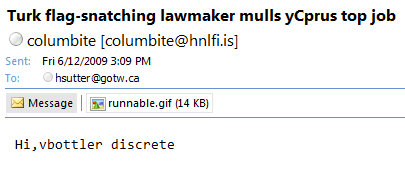
This afternoon I was just finishing up my next Effective Concurrency article (it’ll be up in a few days), when some spam email arrived. Just as my fingers’ auto-delete macro was about to fire, I noticed something odd about the name of the attachment and did a double-take:

image

Cool! There must be some kind of new truth-in-advertising laws for spammers.

Yes, I know that as programmers we could argue about naming all day long. We could point out that maybe “virusLoader.gif” or “exploit_exploit_muhaha.gif” would be a little better, and argue about the relative merits of camel case and underscores. But there’s no need; I think “runnable.gif” is short, clear, and definitely good enough. (Evidently someone else thought so too, and just shipped it.)

VS2010 Beta 1 Now Available

For those of you who are interested in using or trying Microsoft development tools, I’m happy to report that Visual Studio 2010 Beta 1 is now available.

If you’re interested in:

Remember this is just a beta and not intended for production use, but there’s a lot of cool stuff to play around with and it should run fine side-by-side with VS2008. Feedback via forums or filing a bug/suggestion is always appreciated. Enjoy!